
Why has the internet become obsessed with a 500-page book about salt?
Originally published in 2002, Mark Kurlansky’s tome about the everyday ingredient is enjoying an unexpected revival thanks to social media
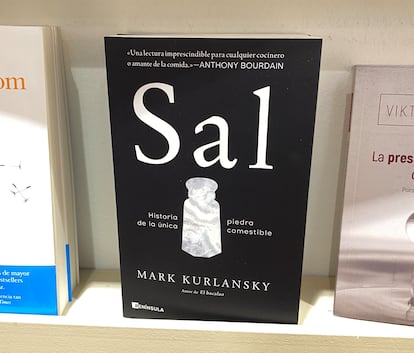

“I read a 500-page book about salt and it has altogether ruined my ability to have a normal conversation.” That’s how content creator Wyatt Derman began his now-viral video, explaining that he could no longer stop talking about this everyday seasoning.
“At first the facts were fun and casual: did you know Romans were paid in salt?” the young creator explains, admitting that from that point on he couldn’t stop pointing out words that came from the word “salt.” “‘Soldier’ comes from salt, ‘salad’ comes from salt, ‘salami,’ ‘salacopis’...”
Fascinated by the fact that empires, wars and even famous protests such as Gandhi’s Salt March were all connected to the substance, he says he has become: “a man who can’t pass a salt shaker without feeling the weight of human civilization.”
The book he references is Salt: A World History, written by U.S. journalist Mark Kurlansky, who specializes in food history. The substantial volume was first published in 2002 and now, more than two decades later, has experienced an unexpected resurgence thanks to the internet, which has pushed it onto the New York Times weekly best-seller list (where it also appeared in 2002). “Appearing on the New York Times best-seller list again after last being on it nearly 25 years ago is comforting. This gives me the pleasant sense that books can endure,” Mark Kurlansky told EL PAÍS.
In an Instagram post announcing that the book had become a bestseller again, Penguin thanked Wyatt Derman for getting so many people interested in it, and Kurlansky himself also joked on social media about how surprising it was for Salt to go viral so many years after its publication.
But why has the book found renewed success? What is it about such a lengthy work on such a specific topic that has connected with readers in this way?
Anyone who spends any amount of time on social media is subjected to a constant barrage of fragmented information, much of which is difficult to retain because of the speed at which it arrives and because we jump from one topic to another without pause. Niche subjects, such as the history of salt, offer a kind of antidote to this accelerated pace, or at least a brief refuge from it: they allow us to dive deeply into a single topic and focus on it, and only it, for as long as the obsession lasts.
The fatigue that so many people have recently come to feel toward social media seems to be fueling a return to analogue experiences, seen by many as the only way to escape the distracting grip of the online world. And what could be more analogue than a book? If it is a long one that keeps us away from our phones for hours at a time, so much the better. This particular work also has the advantage of focusing on one of the most commonplace ingredients imaginable, found on tables and in kitchens all over the world, yet now stripped of the importance it once held for countless civilizations. That alone is enough to spark curiosity.
It is somewhat ironic that when the book was first published, people joked about how boring a book devoted to such a mundane product might be. In its 2002 review, The Guardian toyed with the idea that only someone who secretly did not want to write a book would choose such a subject, because no publisher would ever take a chance on it. The reviewer, Chris Lavers, concluded that this was not the case with Mark Kurlansky, because Salt: A World History is written with such enthusiasm that the author’s fascination with the subject becomes contagious. As Wyatt Derman’s viral video demonstrates, when someone conveys genuine passion for a topic, there is a good chance that passion will spread.
Kurlansky wonders with genuine curiosity who this new audience discovering Salt might be: “I feel very fortunate to have reached them; perhaps they are a new generation of readers. It is wonderful, and I am grateful to the young man who gave me that boost.”
In his viral video, Wyatt Derman argued that nothing is truly boring; some things simply have not yet received enough of our attention. Judging by what is happening with this book, he may well be right.
What is the book about?
The obvious answer is: salt. But in reality, it is something closer to a world history told through the lens of a single substance.
Salt: A World History is an expansive journey from ancient China to the 20th century, packed with surprising discoveries. Throughout the book, Kurlansky explains why salt has long been one of humanity’s most coveted commodities. He explores its many uses, from melting ice to cleaning chimneys, not to mention its crucial role in medicine and food preservation.
These practical applications made salt indispensable. It served as currency, became the object of monopolies and smuggling operations, sparked conflicts, and even helped shape landscapes, as wild animals dug into the earth in search of it.
The book also examines the countless beliefs associated with salt. It was famously thought to ward off evil spirits, and at one point was even believed to prevent impotence. Many iconic foods would not exist without it, including Roman garum, soy sauce, cured ham, salt cod, sauerkraut, and pickles.
Spanish readers may be surprised to learn from the very first page that Kurlansky’s fascination with salt began in Spain, specifically in the Catalan town of Cardona, where he purchased a chunk of rock salt. Back home, he began observing how the stone behaved under different conditions, and the idea for the book was born.
“Those who think a fascination with salt is a bizarre obsession have simply never owned a rock like this,” Kurlansky writes in the introduction.
Beyond salt
Although Kurlansky has enjoyed a long and prolific career, having written more than 40 books, he may still be unfamiliar to many readers. His first work, devoted to cod, employed a similar approach to Salt: using a single food to explain the broader history of humanity. Published in the late 1990s, it became a major success and established Kurlansky’s reputation, but many more books followed.
While he does not write exclusively about food history, most of his work revolves around it. He has written books about oysters, milk, onions, and salmon, and even published a biography of Clarence Birdseye, considered the inventor of frozen food.
His broader body of work ranges from Paper, a history of one of humanity’s most transformative inventions, to studies of 1968, nonviolence and the global influence of Spain’s Basque culture.
Indeed, readers in the Basque Country will soon have the opportunity to see him in person. This October, Kurlansky is scheduled to appear as a speaker at San Sebastián Gastronomika, where he will discuss his work and ideas firsthand.
Sign up for our weekly newsletter to get more English-language news coverage from EL PAÍS USA Edition









































