
Johnny Cross, ‘the vegan butcher’: ‘I’ve been in the world 34 years and I’ve never eaten meat or fish, and I’m alive, I’m healthy’
A Scotsman based in Seville, the chef has found success on social media with recipes that replicate meat, fish or egg using 100% plant-based ingredients
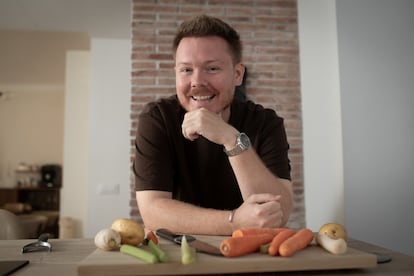

In another life, Johnny Cross (Clovenfords, Scotland, 34) might have become a sports journalist covering British football teams, but an Erasmus year in Seville during his final year of university changed everything. There he met Marta, his partner, with whom he now has two children, and he decided to stay in Spain. He also realized sports journalism wasn’t for him, so he began teaching English to make some money — “very typical of the guiris [a Spanish term for British people] here,” he says with a laugh.
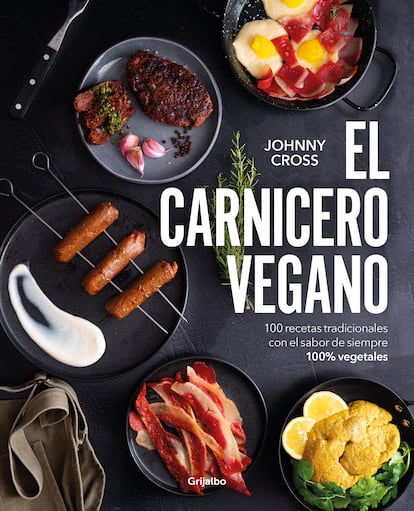
The couple eventually moved to Madrid, where their first child was born and Johnny became “a full-time dad.” When the little one started daycare, he had to decide whether to return to teaching English or try something else. He had always liked cooking and had been vegan for years, so back in Seville he tried his hand at making 100% plant-based recipe videos on social media. Today his Instagram and TikTok profiles have more than 420,000 followers and Johnny Cross is known as The Vegan Guiri — his alias — or “the vegan butcher,” the title of the cookbook (El carnicero vegano) he published in 2025 with 100 vegan recipes.
These recipes are notable for evoking meat without containing a single animal ingredient: chorizo, chicken, bacon, meatballs or even beef cheek in Pedro Ximénez sauce. There are also dishes that mimic fish or egg using surprising ingredients such as watermelon, melon, glutinous rice or corn starch. For him, recreating these textures is almost a personal challenge. “I don’t eat like this every day; I do it to show that it’s possible and that even the most meat-like thing can be replicated if we use a little imagination.”
Cross has been vegan for 11 years, but he was raised vegetarian because his parents followed the same diet. “I’ve been in the world 34 years and I’ve never eaten meat or fish, and I’m alive, I’m healthy. With my content I want to show that this is possible.”
He says that although he grew up in a small Scottish village where livestock farming was a mainstay, he was always respected by everyone. “I was ‘the vegetarian,’ just as a friend of mine was ‘the one who liked Manchester United’ and another was ‘the one who liked Dragon Ball.’ Everyone had their quirks.” As a vegan and an adult, he has faced some prejudices. “I’m a big soccer fan and, for example, when I ask someone if they watched last night’s match, many times people react like, ‘Does this vegan even like soccer?’ It seems trivial, but people have that idea that a vegan can’t enjoy something as popular as soccer.”
His love of cooking is closely linked to his shift toward veganism: “That’s when I really started to get interested in cooking. I’d been vegetarian my whole life and had it more or less down, but suddenly I had to remove some foods from my diet; I started researching and inventing so I wouldn’t lose the things I really liked and could keep enjoying them in another way.”
How does someone who has never tasted meat or fish recreate those flavors? “I always say you don’t eat meat raw. There’s a process behind it, a way of cooking it, seasoning it and turning it into something else. I spend a lot of time researching these flavors and textures, exploring and testing things,” he explains. “And I have people in my life who either have eaten meat at some point or still do, so I can give them samples while I’m developing recipes for them to tell me if I’ve nailed it, if a spice is missing, or if the texture needs work.”
The universe of meat-lookalike dishes is somewhat controversial within veganism itself, because while some people use them to evoke flavors they miss, others can be put off by how realistic some creations look. Cross is clear that he doesn’t want to cross “that line into morbid curiosity,” but he believes “there’s a visual element — food needs to look appealing. I make vegan cracklings with their fat and tapioca pearls on top to simulate the bubbles that form on pork skin. A lot of people have told me I went too far and that it made them queasy, and I understand that, but I just want to show that it’s possible.”
He also says the evolution of vegan options outside the home “has been a bit like a roller coaster.” “When I became vegan there were few options, but around 2019 there was a green boom, or maybe it was a trend, because in the last two or three years that bubble burst. Here in Seville, some fully vegan places are closing; the cost of living keeps rising and these are small businesses — it’s very hard to open the shutters every morning. That’s one reason I cook more creative things, so to speak, because if I can’t eat out as much I invest my time and resources in preparing tasty, interesting food at home.”
Although Cross favors meat-lookalike dishes for his social media content, he argues there’s no need to be so inventive, because many traditional recipes are already vegan or can be made so by omitting a few ingredients. “Here in Spain, although there’s a strong meat-and-dairy culture, we also have a cuisine rooted in making the most of ingredients, with stews of legumes and vegetables that have always been the cheapest food. It’s cool to do different things to show the world, but I think we already have a good 100% plant-based offer without overthinking it.”
For him, imitating meat-based dishes with plant ingredients is in some ways a form of cultural appreciation. “We live in a society where meat is highly valued; it’s part of our culture, for better or worse. I want to replicate these dishes and taste them, but without the suffering behind them,” he explains. He says he knows people who would like to be vegan or eat less meat but who love jamón or cheese, or who will miss bacon or fish. “I understand them perfectly; you can also reduce consumption, and if they finally want to make the change, I offer them alternatives to replace it.”
In his recipe videos he not only demonstrates how to make the dish but also takes the chance to introduce reflections or answer questions viewers raise about food or veganism itself. “I try not to judge others, because I don’t know their situation, and some people within the vegan movement have told me I should be firmer, but I’m more of the school that reducing consumption is more realistic than eliminating it. If instead of eating meat every day you eat it twice a week and swap your meat-based Bolognese for one made with textured soy, that works for me. You’re already doing a lot.”
The comments he receives on social media aren’t always positive; some people are extremely offended to see him attempting to replicate a sirloin steak. “I try, as we say in English, to ‘kill them with kindness.’ I calmly explain why I do what I do and, in general, people end up understanding.” Although his veganism is closely tied to his work and identity on social media, he insists he doesn’t want to be just “Johnny the vegan.” “It’s part of who I am, but it’s not all I am.”
Sign up for our weekly newsletter to get more English-language news coverage from EL PAÍS USA Edition









































