
The world against vegans: can the movement withstand the reactionary wave and its own crisis of faith?
After years of booming vegan and vegetarian diets, data reveals that the movement is somewhat in decline. This is bad news, but not entirely
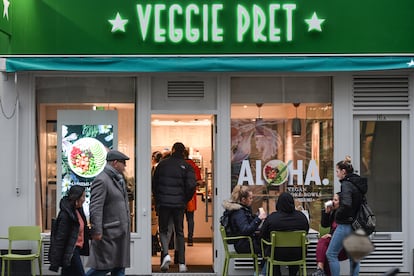

The flame of veganism is beginning to flicker. It’s still too early to assess the extent of the decline in the movement that rejects the consumption of animal products, and the conclusions of studies, depending on who commissions them, point in opposite directions. In any case, if there is a decrease in the “veggie” population (which includes vegans, vegetarians and flexitarians), it’s not particularly significant. The change is more qualitative than quantitative.
Last August, the Financial Times published an article discussing “why the vegans lost.” It mentioned the case of the New York restaurant Eleven Madison Park, which, after Covid-19, opted for a completely plant-based menu and has now reintroduced meat. In another article, The Guardian added more examples such as London’s Unity Diner, famous for its 3D-printed vegan steak, and other establishments that have disappeared both in the British capital and elsewhere in the country.
The alleged decline in sales at chains like Beyond Meat and Impossible Foods, which make vegan burgers, is another point covered in the Financial Times. According to The Guardian, vegan food sales have fallen by 13.6% year-on-year in the UK. Meatless Farm recently ceased operations before being rescued from administration when its competitor, VFC, acquired it, while vegan brand Oatly and food manufacturer Heck have reduced production of some products.
The Financial Times mentions some well-known vegans, such as crypto entrepreneur Sam Bankman-Fried, currently in prison, and former New York City Mayor Eric Adams, who was reportedly caught enjoying a plate of fish. To this list could be added the case of singer Miley Cyrus, who followed a vegan diet for nearly seven years and decided to quit in 2021 after feeling her brain wasn’t functioning properly. She reintroduced fish into her diet to regain essential nutrients, such as omega-3 fatty acids.
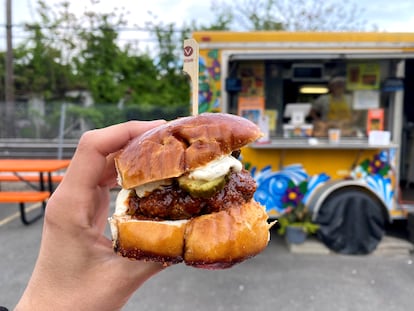
The Madrid Vegan Association partially agrees with this analysis: “In recent years we have observed a slight decline in the number of vegans, as well as an increase in 100% plant-based businesses that have had to close, some of them after many years in operation.” The data supports this view: after years of growth, between 2021 and 2023, the number of strict vegans fell from 0.8% to 0.7% of the population, according to the Spanish Vegetarian Union. The percentage of the “veggie” population (which includes vegetarians and flexitarians) dropped from 13% in 2021 to the current 11%.
At the same time, they state that there are increasingly more plant-based alternatives available in supermarkets, both in large cities and smaller towns. “It is also more common for non-vegan restaurants to include some plant-based options on their menus, although it is often presented as a ‘healthy alternative’ rather than as a complete and standardized offering,” they explain.
This paradox—a decline in the number of strict vegans coupled with an increase in plant-based options at restaurants—is partly explained by a shift in focus toward well-being. The complete renunciation of animal products has lost ground to a broader concern for health and longevity. For many, the goal is no longer to eliminate meat, but to reduce the consumption of ultra-processed foods. The concept of healthy eating has thus shifted from “less meat” to “fewer additives.” Added to this are the critical narratives surrounding plant-based diets—from their supposed impact on muscle or child development—and the practical difficulties of maintaining them in a predominantly meat-eating society.
The case of Mario Oliveros, 33, perfectly illustrates this concern for health. After four years as a vegan, he abandoned the diet. “A decade ago, social media really pushed veganism; the images of farms were shocking and led many to reflect,” he recalls. Although he remains convinced it’s the most ethical option, he maintains that it involves excessive sacrifice: “Following a 100% vegan diet isn’t optimal. The need to supplement with vitamin B12 makes you feel like you need medication to survive. During the four years I maintained that diet, my life revolved around it. It’s a huge sacrifice.”
Enric Urrutia, founder of the magazine Bueno y Vegano, acknowledges that the movement “has slowed down a bit and lost some followers.” In his opinion, part of the problem lies in the lack of nutritional education among many young people, which makes it difficult to maintain a balanced vegan diet. “They don’t eat organic food, they eat without animal products, but without dietary awareness. You can’t live on fried food: that’s junk food too,” he points out. Nevertheless, Urrutia believes that this setback does not represent a structural regression and that the expansion of veganism will continue in the long term.
The Madrid Vegan Association is also calling for more rigorous and verified information. “Veganism remains a little-known option for a significant portion of the population, and considerable misinformation persists regarding key issues, such as protein intake or vitamin B12,” they explain. This lack of knowledge, they add, also extends to the restaurant sector: although many establishments now offer detailed allergen information, “it is still common to find dishes labeled as plant-based that include ingredients like egg or tuna, which creates confusion and highlights the need for clearer and more consistent communication.”
There are different ways to cope with social adjustment to a vegan or vegetarian diet. Eduardo Bordón stopped eating meat seven years ago, after reflecting on animal consumption. The change was relatively easy for him because it coincided with his period as an Erasmus exchange student, a time when he started cooking for himself; his partner at the time, who was vegan, also played a role. He recalls that at first, his social circle—friends, family, and colleagues—was much more insistent, although they have gotten used to it over time. The most frequent question, he says, is still: “But so, what do you eat, lettuce?”
Bordón points out that it helps to surround yourself with vegetarians or vegans, both for emotional support and for practical reasons, such as finding options at restaurants. “Eventually you get tired of eggs and potatoes or grilled vegetables.” He doesn’t believe that society is fully accustomed to veganism, but neither does he think the movement is in decline: there are more alternatives and greater awareness, although fewer people are strictly vegan. In fact, several people in his close circle have ended up abandoning the strict diet.
Others, like Jaime Lorite, a contributor to EL PAÍS and a vegan for several years, remain steadfast in their commitment. He argues that veganism shouldn’t be treated as a mere fad: “Being vegan is very complicated. My life has been more difficult since I stopped eating meat. Besides transforming your consumption habits, it forces you to endure endless nagging. People who become vegan don’t do it because it’s trendy, but from a very solid political standpoint.” After having endured so many unsolicited opinions, it doesn’t seem like the time to give up.
Sign up for our weekly newsletter to get more English-language news coverage from EL PAÍS USA Edition









































