
Longevity: The great new status symbol
Once thought to be a balance between genetic lottery and lifestyle, it is now seen as a race for privileges that allow for earlier diagnoses, halting processes and reversing damage. And all of this comes at a premium price

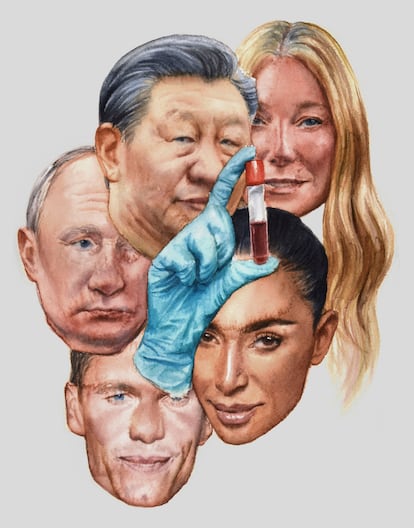
Let’s get this out of the way: being old is certainly not a status symbol. We live in a society where the value of everything plummets after the age of 50, but where, paradoxically, the struggle to extend the limits of life by trying to reverse biological aging has become the latest religion. It’s called longevity.
His followers have everything they need to nurture a new creed: a divine word, longevity —the English term is colonizing digital marketing everywhere—; an aspirational metric: 120-150, the number of years that, according to various studies, the latest one published in Nature, mark the limits of the human lifespan; a doctrine: the Don’t Die philosophy, founded by the biohacker Bryan Johnson with the ambition of being “the most influential ideology in the world by 2027”; a common enemy: death, “the only cause capable of uniting all of humanity” (also Johnson’s words). Their messiah, who could be Johnson himself, but also the Harvard University geneticist David Sinclair or even the technocapitalist Peter Thiel. Any one of them is followed by their apostles, an elite willing to sacrifice themselves and be guinea pigs for all the new procedures.
A bible or a theoretical framework is also required for this new religion: in 2024, nearly 6,000 longevity papers were published in PubMed, five times more than two decades ago. And finally, a god is also needed, in this case a technology that spits out metrics and analytics on almost everything without almost nobody questioning its veracity. Longevity devotees fearfully submit to a full-body MRI scan, just as early Christians knelt before the cross. The difference is that the new faith is considerably more expensive.
The desire for eternal life is as old as humanity, but longevity, once thought to be a balance between genetic lottery and lifestyle, is now seen as a race for privileges that allow for earlier diagnoses, halting processes and reversing damage. And all of this comes at a premium price.
A report by the consulting firms The Future Laboratory and Together Group analyzed how longevity and luxury have become a tandem. Experts believe the first step was creating the desire for longevity, and to achieve this, it had to become a popular concept. In this phase, according to experts, two Netflix documentaries were crucial: Don’t Die: The Man Who Wants to Live Forever, which made the biohacker Brian Johnson popular, and Live to 100: Secrets of the Blue Zones, which showcased the five areas of the world with the largest centenarian population. These products covered both approaches to the issue: the futuristic and dystopian one, and the one that suggests returning to a simple life with good nutrition, exercise, and quality social connections.
The controlling, competitive individual who measures every one of his vital signs and relies on technology above all else is more seduced by the idea of hacking nature’s destiny with vitamin injections and plasma transfusions. The Financial Times reports that in the financial centers of London and New York, people no longer boast about being very busy, or about the miles they’ve accumulated on various airlines, but about the eight hours of sleep they’ve recorded with their Oura ring, or the number of minutes they’ve endured during a cryotherapy session.
The Future Laboratory report asserts that an idea is consolidating that the best investment is in oneself and one’s quality of life. This turns longevity-related procedures into a status symbol, the document states. The consultancy firm detects “a new paradigm of transformational luxury” that would explain why many brands are changing the word “wellness” to “longevity,” even in their names. What was once a wellness clinic or retreat is now a longevity resort. “We are moving from wellness, a tactic for ephemeral enjoyment with practically no added value, to a long-term personalized health strategy,” explains Dr. Vicente Mera, head of the Healthy Aging Unit at SHA, a luxury clinic in Alicante, on the Spanish Mediterranean, that now advertises itself as Master of Longevity.
Paz Torralba runs The Beauty Concept, a beauty conglomerate that manages the spa at the Mandarin Oriental Ritz Hotel in Madrid and has hosted everyone from Anna Wintour to Joaquin Phoenix. Although she doesn’t plan to replace the word beauty with a more clinical term, she has had to change the logistics of her services to introduce complex analytics and personalized serum therapy master formulas. “People want to truly take care of themselves and demand more complex treatments, which is why we have opened a Regenerative Medicine and Longevity unit that covers all the parameters that can be measured in the human body, and includes, among other services, an anti-inflammatory pack that measures histamine, cortisol, and intestinal permeability. All the tests are analyzed in a laboratory in Seville, a public body that is the only one that can handle these types of analyses.” Paz is looking for larger premises in Madrid to open a longevity clinic. She has outgrown her current one.
The latest Future of Wellness report from the consulting firm McKinsey highlights that for 60% of people, aging well is “a top priority,” regardless of the treatments they can afford. In its survey, 70% of consumers in the United States and the United Kingdom, and 85% of those in China, indicated that in 2024 they purchased more products from the healthy aging category than in previous years. McKinsey also points out that customers in the global wellness market, valued at two trillion dollars and curiously dominated by more millennials and Gen Zs than boomers, are reluctant to take too many leaps of faith and are looking for therapies backed by scientific evidence whose results can be verified in the short term. “Not everyone is willing to wait half a century to see whether supplements deliver on their promises,” the authors note.
Critics say there’s too much anxiety about market leadership, and this means that the effectiveness of many therapies and machines is only supported by the studies conducted by their manufacturers. The statements by Joel Huizenga, CEO of Egaceutical, a startup that has created a water-based beverage that claims to reverse cellular aging, are paradigmatic in this regard. “We don’t work in mice, we work in billionaires,” he told the U.S. edition of Vanity Fair, boasting about his ultra-wealthy and dedicated clientele as if that justified the absence of well-designed studies on a representative number of individuals.
Timothy Caulfield, a professor at the Health Law Institute at the University of Alberta in Canada, has been investigating the evolution of health misinformation for several years. In his research, he has noticed “a cultural shift” in the approach to health, and particularly to longevity. “But I think it’s the same old noise packaged in a new concept.” Caulfield mentions a biohacking practice popular on TikTok, the cold plunge (immersing oneself for several minutes in a bathtub filled with ice cubes). “It’s an extreme practice that some preliminary studies suggest could impact the immune system, but there’s no evidence that it extends life. People do it, they feel refreshed, but the promise of biological change is unproven,” he explains.
Caulfield points out that the longevity boom is “very masculine,” and highlights the rise of the longevity influencer, a figure who thrives on TikTok but also writes books, in theory to help people live longer. “In reality, they sell something else; they promise personal and professional success, defined abs, and an active sex life. All of this falls under the concept of life optimization, an obsession for many people, but with no direct relationship to longevity, but rather to social pressure, which is just another marketing tool.”
Aspiring biohackers don’t have an easy life when it comes to dealing with one of the industry’s problems: the conflict between numerous contradictory theories. Research by Italian geriatrician Luigi Ferrucci suggests that the key to living longer lies in the mitochondria, the cell’s energy reserve; Canadian researcher Peter Attia argues that muscle is the organ of longevity; and Tibetan Buddhist master Tenzin Wangyal Rinpoche encourages people to forgo the gym and a healthy diet in order to focus on the one thing that matters: getting eight hours of sleep a day.
And although it’s not known which of these strategies is the key to extending life, scientists from Oxford and Harvard Universities have calculated exactly how much this scientific breakthrough would be worth. According to the study, published in 2021, a discovery that could extend life expectancy by a decade would be worth $367 trillion. And, as Professor Caulfield says, the day it happens, we’ll know about it.
Sign up for our weekly newsletter to get more English-language news coverage from EL PAÍS USA Edition









































