
‘She should have been better protected back then’: Nastassja Kinski, the teenager who grew up too fast in front of the whole world
The actress has turned 65 away from cinema, but is back in the headlines after one of her earliest films, in which she appeared naked at age 13, was withdrawn by director Wim Wenders


“From our balcony I used to watch a very beautiful girl who would go to the pool every afternoon to swim a little and sunbathe. I remember that golden skin because at the time she seemed the most beautiful creature I had ever seen.” This is how Demi Moore describes in her memoir Inside Out. My Story her first encounter with Nastassja Kinski (Berlin, 1961). The very young German actress had arrived in the United States under the wing of Roman Polanski, whom she had met at a party in Munich. Fascinated by her beauty, he found in her the ideal actress to play the lead in the film adaptation of Thomas Hardy’s novel Tess of the d’Urbervilles, a role that had been planned for his wife Sharon Tate, who was brutally murdered by members of Charles Manson’s sect in 1969.
Polanski had postponed production until he found the perfect actress — and Kinski was that actress. That meant an added responsibility for her. “It was a labor of love—this film, the entire crew, the feelings and big nature, everything about it. It helped me grow and be out in the world, it was my step into being an adult, and seeing the world,” she told the critic Roger Ebert. She was thrilled. She did everything the director asked: she immersed herself in the classic novel, worked to lose her German accent and adopt an acceptable Wessex inflection, and moved to the countryside, to a farm in the English interior where she learned rural customs. She won the Golden Globe for New Star of the Year. The film premiered at Cannes and received six Academy Award nominations, of which it won six.
Polanski’s gamble had paid off — including on a personal level. During filming there was speculation about a romance; the director confirmed it to Diane Sawyer in a 1994 interview. “She was young and we had an affair.” Very young. When they met in Munich, he was 42 and she was 15. The actress denied it: “It started out as a light romance,” she recalled years later in The Independent, “but he became demanding and possessive.” The speculation was understandable. Polanski was in Europe because he had fled the United States after being accused of raping Samantha Geimer, a 13-year-old aspiring actress. With today’s perspective it’s hard to understand how Nastassja’s mother allowed her daughter to work with a man whose moral standing was far from spotless, but a brief look back at Kinski’s biography explains it.
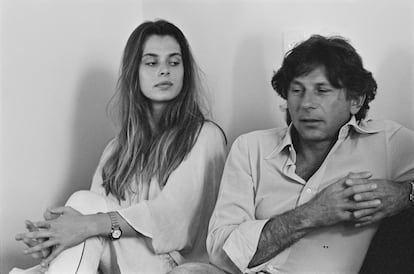
The young performer had been discovered in a nightclub at age 12 by actress Lisa Kreuzer, the wife of Wim Wenders. At the time she was living in Munich with her mother and they were struggling financially. That encounter led to her being cast in the film Wrong Move (1975), in which, despite her young age (she was 13 during filming), she bared her breasts and had a murky relationship with a man who was almost three times her age. For years that was one of many titles in a filmography marked by highly sexualized roles, but this year she returned to the headlines after telling the German newspaper Süddeutsche Zeitung that she had asked Wenders to remove those images from the film. “It was my first film, he was my first director and he did not protect me,” she said. The actress said she had been trying for years to achieve this. This time Wenders took up the challenge.
At last year’s Berlin festival he said he would withdraw his film from all platforms. “As the only person responsible at the time for Wrong Move who is still here, I recognize that Nastassja Kinski should have been better protected back then. For that, I apologize to you, Nastassja, unreservedly, no ifs and buts.” A couple of years ago the actress had already asked public television to pull an episode of a police series in which she appeared naked at just 15. Her lawyer says her mother was not present on the set and those scenes should not have been shot. They were not the only Kinski roles that would be unthinkable today: in her second film, To the Devil a Daughter (1976), she was a novice coveted by a Christopher Lee approaching his sixties. A year later she played a schoolgirl who had an affair with her teacher in Passion Flower Hotel (1976).
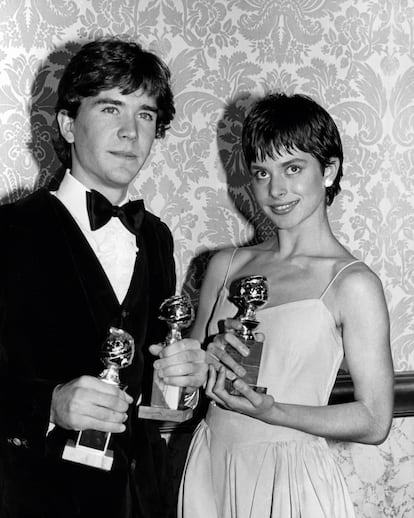
“I wish I had the money to buy it and burn it,” she said about it years later. That same year she was Marcello Mastroianni’s partner in Stay As You Are (1978). Kinski was 17 and Mastroianni was 54. No one found it strange then; in fact, everyone considered it normal that a very beautiful teenager would fall for men who could have been her grandfathers. “If she were my daughter, I wouldn’t allow it. I wouldn’t allow certain people to say certain things or try certain things,” she later acknowledged. That is why she felt fortunate when Polanski offered her a significant role beyond the sexual element, which she had. “He gave me so much dignity,” she told The Telegraph. “He was one of the people in my life who cared for me. Who took me seriously and gave me a lot of strength.”
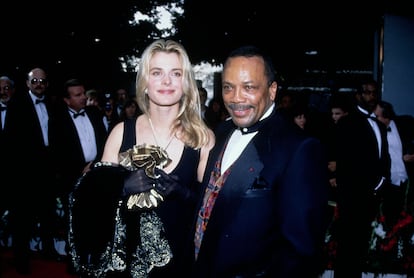
He is not the only man who has acted as a mentor in her life. In some way she has also sought that figure in her partners. Egyptian filmmaker Ibrahim Moussa, with whom she had two children and to whom she was married for eight years, admitted as much. “I was more a father to her than a husband,” he said. By his side she had the family life she had never experienced. Her other major relationship, with American producer Quincy Jones, followed a similar pattern. “For me, Quincy was someone who told me what to do and what was right. He was always there when I needed him; someone I could talk and argue with. In a Freudian sense he was the father I never had. For me, partners tended to be father figures.”
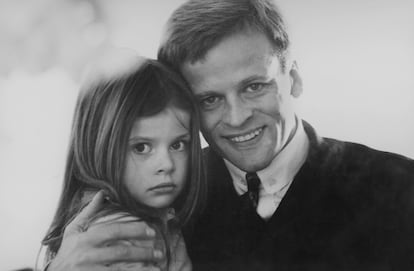
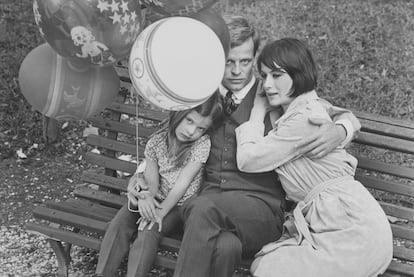
Kinski sought a father for much of her life, although she did have one — and he was probably the worst one of all: German actor Klaus Kinski. The Spanish film director Fernando Colomo, who endured him during the filming of The Knight of the Dragon, headlined his obituary in this newspaper Let’s Rest in Peace, giving an idea of how it was to be near him. Nastassja said something similar. “When he died, I had a moment of grief that lasted about five minutes. It was very intense, and then never again. Not because I forced myself not to feel it, but because I think it caused too much pain.” It was hard not to mention Klaus Kinski earlier in a piece devoted to the actress, but Kinski was far more than her father, and his importance cannot be hidden. The actor left her and her mother almost destitute when he abandoned them, but the worst abuse was for her half-sister Pola. In 2013 she revealed in her memoir Kindermund (or From a Child’s Mouth) the abuse she suffered from their father from age five to 19. Nastassja acknowledged that he had also tried it on her. “He was not a father. Ninety-nine percent of the time I was terrified of him. He was so unpredictable that the family lived in constant fear,” she said in an interview with Bild.
In the U.S., her father’s name was not as relevant. What made her known was the success of Tess and her extraordinary beauty. “Very mature and very childlike at the same time,” Rolling Stone described her in 1982. Almost as defining as her filmography is a photograph that defined her career. In the early 1980s she told then–Vogue editor Polly Mellen that she loved snakes and the magazine’s machinery started turning. They obtained a Burmese python and hired Richard Avedon. He suggested she pose nude — how imaginative — and she agreed. The photographer told a U.S. public television program that the actress had spent two hours naked on a concrete floor. “They tied the snake to her ankles and waited to see what would happen.” When the snake began to move across Kinski’s body, it came up to her face and stuck out its tongue as if to kiss her; Vogue had the cover of the year and the photograph became one of the most popular posters of all time. It spawned hundreds of imitations. The most notable was the one starring Sonja Kinski, her daughter, 20 years later.
In the United States she made a string of remarkable films. She had a role in One From The Heart (1981) after Francis Ford Coppola asked if she had any circus experience and, yes, she had worked with elephants and a friend of her mother trained tigers. Her image inside a giant Martini glass became one of the most recognizable shots of the film that sank the director’s production company. It was a failure, but she keeps an extraordinary memory of the shoot. Her feline face made her the perfect candidate to star in Cat People (1983), Paul Schrader’s remake of Jacques Tourneur’s classic, which she loved — working with big cats and meeting David Bowie, who wrote the main song. She had become a star and a familiar face by now. In The Hotel New Hampshire (1984), an adaptation of John Irving’s novel, she flirted with Rob Lowe and Jodie Foster and spent much of the film stuffed into a bear suit.
Hollywood saw in her “the mystery of Garbo, the wit of Lombard and the sensuality of Monroe.” And then came the best film of her filmography: Paris, Texas (1984), which reunited her with Wim Wenders, with whom she would later work again on Faraway, So Close! (1993), the sequel to Wings of Desire. She seemed destined for absolute stardom, but at the height of her fame she chose to focus on her family. She wanted to give her children the stability she had not had. No later title regained the relevance of those years, although films like One Night Stand (1997), in which she was Wesley Snipes’s lover, and Your Friends and Neighbors (1998), Neil LaBute’s dark comedy, deserved better luck. In David Lynch’s Inland Empire (2006), her role was reduced in the cutting room and she barely appears as a ghostly presence at the film’s end.
Away from the glare of the spotlight, she maintains a low profile that only drew press attention after her spat with Wenders. At 65 she leads a quiet life, as shown on her social media, where she shares everyday moments, such as a visit this week to Mallorca, an island she visits frequently. A normal life, the one she could not live when she was a child forced to grow up too fast.
Sign up for our weekly newsletter to get more English-language news coverage from EL PAÍS USA Edition









































