
Helen DeWitt: ‘Publishers treat authors like outcasts until it’s time to go out and sell books’
The acclaimed author of ‘The Last Samurai’ recently saw her 2018 short story collection, ‘Some Trick,’ as well as her 2022 novella, ‘The English Understand Wool,’ released in Spanish as part of a single collection
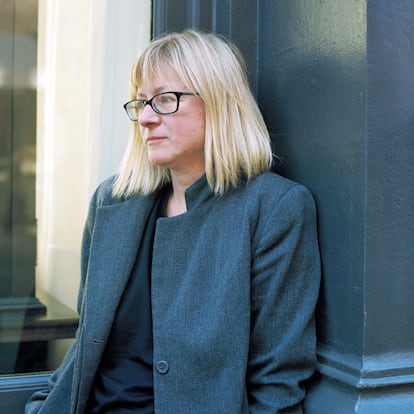

The warning arrives in the form of an email, just a couple of days before the interview. Helen DeWitt, author of The Last Samurai, one of the most acclaimed novels of the century, has requested, as a prelude to the conversation with EL PAÍS, that her latest blog post be read. According to the mediator from Random House (her Spanish-language publisher) in the post, she “talks a bit about how, sometimes, the promotion imposed on her by publishers or awards prevents her from doing what she’s dedicated to: writing books.”
The text in question is a rather lengthy manifesto against obligatory interviews. It discusses the ineptitude of various literary agents when it comes to understanding writers, while also listing the reasons for her recent rejection of one of the 2026 Windham-Campbell prizes, worth $175,000. She declined because she was unable to fulfill the award’s promotional obligations.
DeWitt cordially and charmingly answers the video call from her home in Berlin. Her speech pattern is sharp. And it’s marked — as in her novels — by a relentless sense of humor. She speaks in English, but could just as easily do so in French or German. She can also read Greek and Latin. In fact, she understands nearly a dozen languages, with varying degrees of fluency. Spanish, however, eludes her, despite having lived in Colombia and Mexico at different points during her childhood.
“It’s embarrassing. I can only remember the lyrics to [the song from a Colombian talcum powder commercial],” she laughs. She stops herself just before beginning to sing it: “No, it’s not good for conversation… maybe I’ll sing it at the end.”
“You don’t really like giving interviews.”
“And yet, here I am, doing this one with you.”
“Why?”
“Look, I know Penguin Random House has millions [of dollars] and all that… but they’ve taken a risk. And I want to help the publisher.”
Last month, the Spanish publishing house released a translation of the author’s book of short stories, Some Trick (2018), and her novella, The English Understand Wool (2022), as part of a single collection.
“Don’t ask me how the stories were selected,” she shrugs. “I don’t know. I wasn’t part of that decision. When I sent them to the American publisher to see if they would buy them, they made a list that perhaps didn’t make much sense… but I didn’t have the strength to nitpick and argue.”
DeWitt, now 69, began her literary career in 2000, at the age of 44, with the publication of The Last Samurai (unrelated to the film starring Tom Cruise). The novel almost immediately established her as one of the most unique and disruptive voices in American literature. It was an unexpected success, selling over 100,000 copies in English alone and becoming a classic. It was crowned “the best book of the century” by New York magazine and appeared on The New York Times’ list of the 100 best books of the 21st century.
The novel is about a single mother in London raising a brilliant boy named Ludo, who quickly masters ancient Greek, Arabic and Japanese. He then sets out to discover his father’s identity, in a story that’s filled with both humor and structural complexities. There are linguistic fragmentations, the use of multiple typefaces, foreign languages (ancient Greek, Japanese, hieratic script), as well as discontinuous blocks of text, which the author designed to reflect her characters’ chaotic minds.
Upon publication, she entered into her first clashes with an industry that still frustrates the Maryland-born author to this day. She spent months at odds with her copy editor, who — according to DeWitt — imposed her own changes aimed at standardizing the text. It was, she recalls, as if the publishing house wanted to “kill the mind that wrote the book.” This led to a nervous breakdown: she attempted suicide before disappearing. When the police found her in upstate New York, she was admitted to a psychiatric unit. When remembering this period in her life, Dewitt notes that she felt “alienated by intellectual mediocrity.”
Shortly after the release of The Last Samurai, the publishing house that introduced it to the world — Talk Miramax Books — disappeared. The book subsequently went out of print, before being reissued in 2016.
“When I was younger, I imagined that one of the things that people in the publishing world would enjoy most was interacting with brilliant writers. I didn’t realize that people went to great lengths to avoid discussing texts with an author,” she sighs. This is something that still happens to her: “You know, it’s as if these people get contaminated if they interact with the author, as if we’re outcasts. And then, ‘okay, now we’re going to publish the book… and yes, it’s great that you have all these opinions, [so now you can] go out and share them with the public.’”
She had already attempted suicide before, when she was a student suffering from depression. She survived and decided to go to Oxford University, to study Classics and Philosophy. “If I could go to Oxford, where intellectual life is taken seriously, life would be worthwhile,” is how she describes her thought process at the time. However, she left academia after nine years, frustrated with an education system that she continues to criticize today, especially for its failure to teach languages. “It’s like that [Colombian] commercial — I’m not going to sing it to you — which I heard when I was 13. I still know it by heart. There are people whose job it is to drill something into your head; there are people who are good at that. But those aren’t the people we have teaching classes,” she argues.
DeWitt’s books have been published inconsistently. It took her 11 years to sell her second novel (which she wrote before her debut), titled Lightning Rods (2011), a satire about a company that tries to prevent sexual harassment by allowing employees to have sex through a hole in the bathroom wall. And, last year, she published Your Name Here (2025), co-written with journalist Ilya Gridneff. DeWitt thought that they “could [put out the novel] in a few weeks, sell it and make some money,” so that she could then focus on her writing. But it ultimately took 20 years for her and her co-author to get it published.
“Something always interferes with the writing,” she laments. Her mind seems as complex as those of the characters she depicts: she doesn’t keep track of the number of books she’s writing simultaneously, nor of the drafts that she’s abandoned. “What happens,” she explains, as she lays out her creative method, “is that not only do voices come to you, but it’s almost like looking at a wall and seeing a movie playing on it; you know, you see everything at once… and the voices pop into your head.”
It would be better, she admits, “if I worked on one thing at a time.” She finds this to be very difficult, “because there’ll always be so many different voices and so many different storylines.”
“I might not know if the different voices belong to the same book, or if maybe they belong to another. Maybe a story doesn’t need a whole book: maybe it would have more power if you simply put these voices side by side. And that’s one of those decisions that requires a lot of thought,” she continues.
DeWitt is constantly striving to write “a masterpiece.” In a 2011 interview with The Los Angeles Review of Books, she recalled an interaction: “[A psychologist] asked me why dealing with my publishers had led to a suicide attempt. And I said, ‘well, if a book is technically challenging, it’s hard to get it through the machine, but if you want to write a work of genius it is necessary to take risks.’ He said: ‘Your sanity is more important than writing a work of genius.’ I thought: ‘Nobody who thinks that will ever write a work of genius.’ I thought: ‘We all die sooner or later.’”
Does she still prioritize literary success over her mental health? “It’s not exactly like I say, ‘I’m going to write a masterpiece and I don’t care if I lose my mind.’ But for certain kinds of books, you need to work with committed people. So, if [they’re] not interested in solving the technical challenges, it’s not possible. A masterpiece requires technical support that I can’t get,” she replies.
Her writing often contains strong autobiographical elements. “I think there [definitely] are. It’s scary,” she laughs. For instance, The English Understand Wool is a kind of satire of the publishing industry, in which a brilliant young woman has to defend herself against editors, agents and lawyers, who are just interested in making a sale. And, in the recent Spanish translation, the novella is followed by a series of short stories — two of them previously unpublished in any language — featuring writers, artists, musicians, agents, as well as businessmen who are disguised as patrons of the arts. My Heart Belongs to Bertie, for example, is about a children’s author whose book of “robot stories” has been an unexpected success, bringing him big royalties. However, irritated by the limitations imposed by his publisher, Peter looks for a new company and a new editor for his next book.
The stories possess the same sharp satire, as well as the sometimes absurd humor, as her first novel. And the classics that she studied at Oxford have also had a clear influence on her. “If something is truly awful, sometimes humor is the way to fight back. The more awful it is, the more you want to laugh,” the author explains. Much of the focus of her writing is on the publishing industry, but she also satirizes things like the art world, snobbery, cultural prestige and the commodification of talent.
Back in April, just a few days after declining the prize, DeWitt received a $175,000 grant (the same amount she gave up) from the Mercatus Center, a think tank affiliated with George Mason University, in Virginia, with no strings attached. “Today, there’s enormous pressure on writers to be publicly available all the time. That’s difficult for writers, artists, [or] anyone who creates works in various fields. I think we all need to accept that, sometimes, we just need to step away, be quiet and not be asked to do anything,” she affirms, noting that the donation will help her as she tries to do this. Perhaps it will even allow her to self-publish her next masterpiece.
“I should write the book myself and not try to convince a publisher to do what I want. [This may] seem like a defeatist attitude… I have the feeling that it is. But yes, that possibility exists.”
Sign up for our weekly newsletter to get more English-language news coverage from EL PAÍS USA Edition









































