
Trump’s wall threatens sacred lands of San Diego’s Tecate Peak
Construction of a section of the president’s border barrier in a remote mountain area east of the Californian city alarms environmentalists and tribal leaders
This story was co-published with Puente News Collaborative in partnership with palabra, by the National Association of Hispanic Journalists. Puente News Collaborative is a bilingual nonprofit newsroom, convener and funder dedicated to high-quality, fact-based news and information from the U.S.-Mexico border
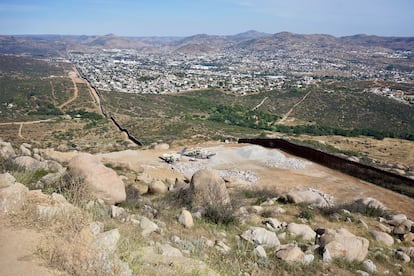
On a warm summer day, dynamite explosions boomed through the silence on Tecate Peak, which towers over a stretch of high desert east of San Diego.
The contrast was sharp. Prior to the blasts, the only sounds along the mountain pass leading to the peak were occasional calls from birds of prey overhead, the rattling of dry brush under a hiker’s boots, and a brisk wind sweeping across a dusty ridge trail. Then the bulldozers and dynamite took over, echoing across the mountain as crews blasted away at chaparral and granite that had stood for eons.
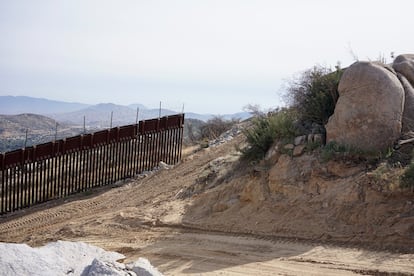
The work is ongoing; the latest expansion of President Donald Trump’s wall that’s gradually punctuating the U.S.-Mexico border in order to keep out undocumented migrants and drug runners crossing from Latin America.
But as ambitious and intrusive as it is, the tall, iron fence — like others in remote areas of the 3,000-mile U.S.-Mexico border — may end up interrupting mostly sacred native rituals and the lives and migrations of wild animals, some of them endangered and found only in this remote swath of rugged desert.
Crossings of undocumented migrants in dangerous mountain and desert regions of the Southwest borderlands have fallen drastically. Migrants know that U.S. policy is now all about hard-nosed deportation and making life uncomfortable for the foreign-born and asylum seekers.
Despite the ongoing public drumbeat of concern about border security, the U.S. Border Patrol’s San Diego Sector reported a significant reduction in undocumented crossings. Between October and November of 2025, the sector recorded 1,793 apprehensions — a 93% decrease from the 24,734 apprehended during the same months in 2026. Attempted clandestine crossings around Tecate Peak have not been this low since the early 1960s. The same trend is being reported in other remote reaches of the border — in Texas’ iconic Big Bend National Park, across religious landmarks in New Mexico, and on native land in Arizona prized for ancient reminders of the region’s first people.
The Puente News Collaborative has documented how sacred sites and privately owned land along the border have been confiscated and degraded by the federal government. Earlier this year, DHS contractors in Arizona damaged a massive 1,000-year-old fish-shaped geoglyph called Las Playas Intaglio, located in Cabeza Prieta
National Wildlife Refuge. Work crews ignored the Tohono O’odham Nation markings at the site, which were intended to warn contractors of the site’s cultural and ancestral value.
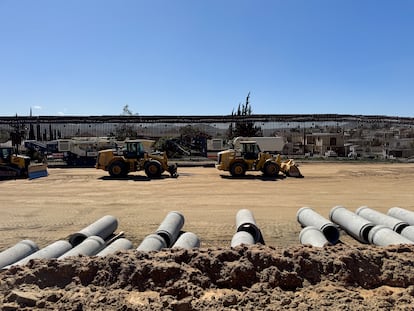
In Big Bend National Park, heavy machinery is clearing the path for a future patrol road, part of the Trump administration’s $46.5 billion price tag for security infrastructure, and critics say, a continuation of the massive wall along the Mexican border. The effort has led to massive bipartisan mobilization among residents and politicians from throughout Texas to defend the iconic park.
In a statement Wednesday, U.S. Senator John Cornyn of Texas, the highest-ranking Republican, expressed concern, writing that, “Many residents that live and work around the parks are also concerned that a physical wall, which would be accompanied by lighting systems, access roads, and maintenance corridors, would (1) ruin the beauty, landscape, and wildlife of the park, (2) threaten culturally significant Native American sites, (3) disrupt wildlife migration, (4) limit access to the Rio Grande River, and (5) significantly harm the local economy as tourism is a major economic driver for the region.”
In Southern California, on the 3,885-foot-tall Tecate Peak, known as Kuuchamaa Mountain by the indigenous Kumeyaay people, the emerging iron wall has become a reminder of a deepening divide between twin towns on either side of the border. The communities share the name Tecate, a common landscape, and residents with lives and families in both.
The stark physical barrier is also a turnabout for environmentalists and tribal leaders who thought they had defeated the construction of the local wall during the first Trump administration.
“The difference between then and now is that now [the U.S. government] is coming to a … site that we all know for a fact is holy to our people,” said Blue Eagle Vigil, a member of the Viejas Band of Kumeyaay Indians.
Sacred geography
In 2020, the Kumeyaay led a series of protests against the construction of nearly 14 miles of wall planned on ancestral and ceremonial lands. The Kumeyaay argued that construction and dynamite blasting destroyed artifacts and disturbed sacred burial sites.
Indigenous leaders say the federal government is once again desecrating a sacred place in its zeal to rapidly expand the president’s signature wall.
According to Kumeyaay folklore, Kuuchamaa Mountain is a hub for healing, peace, and spiritual power. Young men would spend extended periods at its base in coming-of-age ceremonies, and its peak served as a refuge and ceremonial site for tribal shamans.
Blue Eagle Vigil explained the mountain’s significance: “A long time ago, different medicine people would go travel to the top of that peak, not just from around this area, but from other nations, and have these ceremonies. This was a spiritual place of reverence, and always respected and revered as such.”
Although the mountain is not on tribal land, it was added to the U.S. National Register of Historic Places in 1992. Yet under the banner of national security, the Trump administration waived rules that typically require National Environmental Policy Act reviews before construction projects.
Similar to wall work on the nearby Laguna Mountains in 2020, blasting and land leveling near Tecate Peak have scarred a once-pristine landscape and sparked protests from Indigenous groups on both sides of the border. This time, Vigil added, the construction feels far more personal.
“It’s like blowing through or building a wall straight through a church,” he said.
Evidence of permanent damage?
John B. Mennell, the Public Affairs Specialist for the Arizona & Smart Wall Construction Office of Public Affairs for CBP, issued this statement: “CBP is committed to ongoing coordination with stakeholders, including tribal nations, throughout planning and construction activities. During border wall construction, U.S. Customs and Border Protection (CBP) maintains a tribal monitor on-site to minimize cultural and environmental impacts and to address concerns to the greatest extent possible, while ensuring operational requirements are met.
“CBP has conducted environmental and cultural resource reviews, solicited public feedback, and continues to work closely with tribal representatives and relevant agencies to identify and protect cultural resources and to minimize impacts,” Mennell said, adding that claims of harm to cultural artifacts around Tecate Peak have not been substantiated.
Among anthropologists and environmentalists, however, the wall’s adverse effects are clear: damage that will last long after Trump has left office.
“It’s irreparable damage that they’re doing to the environment there,” said anthropologist Michael Wilken-Robertson, author of the book “Kumeyaay Ethnobotany: Shared Heritage of the Californias.”
Tecate Peak is home to endangered animals and plants, such as the Tecate Cypress with habitat limited to four mountain groves in Southern California and northern Baja California state in Mexico, Wilken-Robertson said. Construction will also harm watersheds, he added, noting that the work will alter natural water drainage off the mountain.
“They’re just blasting and bulldozing their way through without any concern for those long-fought-for regulations,” said Wilken-Robertson, who studies native environments in Baja California.
“It’s being done to placate the perceptions of people who think that somehow there are thousands of migrants just waiting to get through in this place,” Wilken-Robertson said.
A militarized border
For Jaqueline Arellano, Wilken-Robertson’s concern is not ideological rumination. Arellano is the community coordinator for Al Otro Lado, a nonprofit organization that provides legal and humanitarian services to migrants. For years, she’s hiked to remote water stations to leave food, first-aid kits, and fresh clothes for migrants.
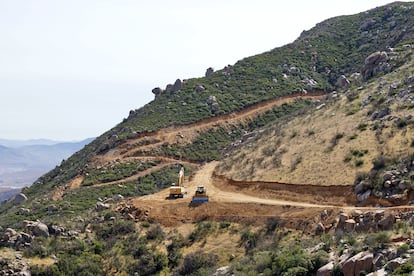
Since March, Arellano has also documented construction on the mountain. She said much of it is almost unrecognizable, after demolition explosions and haulers moving earth closer to the border, so roads could be built to bring in more equipment.
“Excavators, bulldozers, backhoes, scraper tractors, haul trucks, all of it,” Arellano said. “They’ve defaced and cut into the mountain so significantly that parts of it are wide enough for three vehicles across. They’ve also filled in low areas to connect ridges where there used to be natural drainage.”
The Trump administration’s designation of a strip of federal land along the border a “National Defense Area” has effectively created a 170-square-mile U.S. military zone, complete with signs to warn people away, Arellano said. It’s now a federal crime to be within 60 feet of the border without government permission.
The border wall won’t stop migration, she said. It will just make it more dangerous.
“As surveillance increases and construction moves into new areas, people adapt and start utilizing different routes,” she said. “Those routes are usually farther from roads, more isolated, and result in many more deaths.”
Normalizing the militarization of the border has ramifications that will ripple beyond the borderlands, she added. “There is the less discussed consequence of what it means for us as a society to behave so brutally…the impact on the collective when we accept mass surveillance as a rule, and death as an acceptable consequence for simple legal infractions.”
Roberto Camacho is an independent journalist and frequent Puente News Collaborative contributor.
Sign up for our weekly newsletter to get more English-language news coverage from EL PAÍS USA Edition









































