
Power outages, the economic crisis, and the blockade against María Corina Machado reignite social protests in Venezuela
The public is gradually speaking out against Chavismo amid the U.S.-led transition
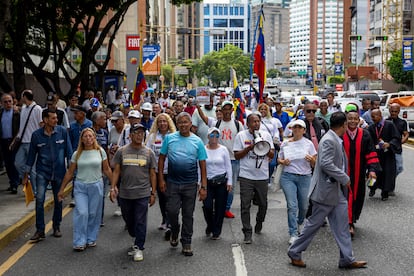

A military contingent blocked the bridge over Lake Maracaibo on Monday in the Venezuelan oil capital to prevent a workers’ protest from closing the road. In Guayana, in front of the state-run basic industries, workers erected a barricade to demand better wages. In Caracas, a group protested for the release of political prisoners after news emerged of a death in the women’s prison run by the National Institute for Women’s Guidance (INOF). Over the weekend people took to the streets to demand a date for elections and the return of opposition leader María Corina Machado. Almost every night during a sweltering September, in inland cities such as Maracay, Guanare, Barinas, Valencia, and Maracaibo, people have expressed on the streets their frustration over blackouts that are increasingly prolonged, lasting up to 10 or 12 hours a day.
The multiplication of protests has become part of the landscape in Venezuela again. The country is moving through a transition overseen by the United States that has prioritized stability and economic recovery through oil investments that still have not been felt in people’s pockets. Venezuelans are not “dancing in the streets,” as President Donald Trump said a few months ago. Large numbers are protesting daily over the precariousness of life, human rights, and for elections to bring a change of government — one of the country’s main demands after the electoral fraud of 2024.
The months since January 3, when the United States captured Nicolás Maduro, and the promised political transition are stretching ever longer. But the political opening that created this watershed in the Venezuelan crisis has made it possible for Venezuelans to return to the streets after the silence produced by the post-election repression.
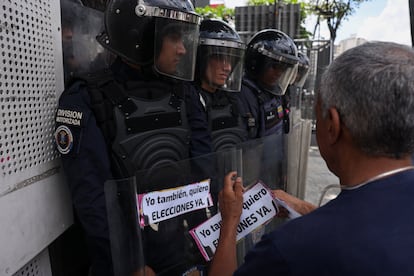
The Observatory of Social Conflict underlines this in numbers. In 2025 only 160 demonstrations were recorded in the country. So far in 2026 there have been nearly 4,200; more than 650 in August alone — an average of 22 a day, almost one third driven by blackouts — and protests in September could exceed those of the previous month, according to Marco Ponce, who directs the observatory. “We are seeing a significant reactivation of demonstrations,” the researcher says. “People are reclaiming the streets to peacefully demand rights, despite the fact that the repression system remains in place. In Zulia, the military prevented the mobilization on Monday, but in Plaza Caracas, a week ago, workers bypassed police roadblocks.”
Political prisoners
Just a few meters from the Miraflores Palace — a site zealously guarded by Chavismo for years — protests have erupted by workers and relatives of political prisoners. More than a decade ago, downtown Caracas was declared “fascism-free” territory by then-mayor Jorge Rodríguez, who is now the head of the National Assembly and the right-hand man of the interim president, his sister Delcy Rodríguez. By decree, opposition organizations, labor unions, and activists were banned from demonstrating in areas where the main branches of government are concentrated.
Last week on Caracas’s main highway, students and political activists stood in the rain to demand María Corina Machado’s return. It was a response to Machado’s complaints that she had been prevented from boarding commercial and private flights to return to her home country. Days later, her supporters and collaborators organized demonstrations across the country to demand that her entry be allowed.
“The culture of protest is deeply rooted in Venezuela. People express themselves through it and make the crisis visible,” Ponce explains. The capacity developed to demonstrate in the streets during two decades of Chavismo has left lessons in Venezuelan society, he says. “Before, people closed streets or marched and that became a justification for the state to repress them. Now people identify centers of power and go directly to protest there. This shows that people have organized and that there is greater coordination to protect themselves from repression. We are also seeing combined protests, where different motives come together, because society is moving in solidarity.”
On Monday in Caracas the National Trade Union Coalition joined relatives of political prisoners. Dozens marched along Avenida Libertador in the capital. The call was repeated in seven other states across the country. The demands were multiple: higher wages, an electoral timetable, the release of those detained for political reasons, and the return of the opposition leader and Nobel Peace Prize laureate. A group of jurists unhappy with the agreements reached last week by the dialogue table to appoint the Supreme Court of Justice through a credentials-verifying commission also joined.
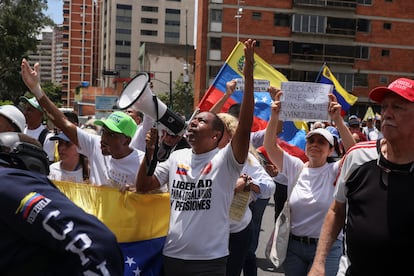
Union leader Carlos Salazar said the demands keeping them in the streets include decent wages and pensions, which have been frozen for years and largely replaced by bonuses; the restoration of basic services; and an end to what they consider a ban on Machado’s return. “We want presidential elections this December and we want all political prisoners released,” Salazar said, announcing a new gathering next week aimed at reaching Miraflores Palace.
This group has kept organizing protests for almost the entire year. They have gone to the U.S. Embassy, one of the decision-making centers for Venezuela in 2026, where they have not been received. When they tried to protest in front of the Marriott Hotel, where the U.S. representation in Venezuela currently operates, they were quickly cleared out by local police. While protest hotspots are activating across the country, this sector of the capital now seems to be the most closely guarded by authorities.
Sign up for our weekly newsletter to get more English-language news coverage from EL PAÍS USA Edition









































