
Jorge Rodríguez: ‘The most important thing in Venezuela right now is the economy’
The president of Venezuela’s National Assembly says the regime has learned from the ‘mistakes’ of the past
Since January 3, when the United States military bombed Caracas, forcibly removed Nicolás Maduro and his wife, Cilia Flores — who are now imprisoned in New York — and killed more than 120 people, Venezuela has been facing a situation that would have been hard to imagine just a few months ago. Laws, such as those governing hydrocarbons or mining, are being rapidly reformed to facilitate the inflow of foreign capital; anti-imperialist Chavismo maintains constant contact with Washington; an amnesty law has been passed, freeing thousands of prisoners — though some remain incarcerated or lack full political freedom — and Maduro’s name is beginning to fade amid more immediate crises. Jorge Rodríguez (Barquisimeto, age 60), president of Venezuela’s National Assembly and the country’s second-highest-ranking official after his sister, President Delcy Rodríguez, prefers the term she coined — “a new political moment” — to describe current events rather than speaking of a transition.
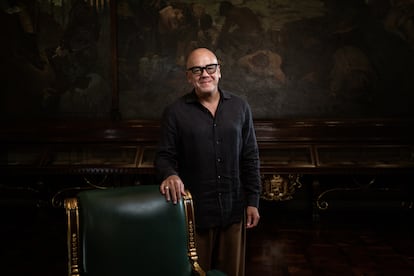
Rodríguez appears at 5:00 p.m. on Friday in one of the Parliament’s grand halls, dressed casually in linen. After the interview, he will head a few blocks away to the Miraflores Palace, where he will meet with his sister, the president, to address the list of pressing issues the country is currently facing: the lifting of sanctions, the fragility of the economy, the influx of investment, boosting oil production, and the search for a political base capable of countering the opposition led by María Corina Machado.
Rodríguez is an experienced negotiator who deflects the most uncomfortable questions: he avoids setting specific dates for potential elections, denies direct U.S. interference in the country’s decisions, and prefers to leave Machado’s fate up in the air, accusing her of having instigated Washington’s attacks. Rodríguez claims to be convinced that the majority of Venezuelans support the current course, something that is difficult to gauge. His main concern, in any case, is the same as that of an exhausted country: how to revive the economy.
A psychiatrist by training, Rodríguez carefully times his moves and chooses his words. He also assesses the political climate: his sister, with the explicit backing of Donald Trump, seems poised to consolidate her power beyond a brief transition. New elections with guarantees — following those held in July 2024, in which Maduro proclaimed himself the winner amid accusations of fraud and a lack of international recognition, and those of 2025, in which the National Assembly he presides over was elected with scant participation from the opposition — are not on the horizon.
Question. There has been a lot of speculation about the circumstances surrounding President Maduro’s capture. Do you believe there was a betrayal within the Chavista movement that led to his arrest and transfer to the United States?
Answer. I am certain that this is not the case when it comes to the political and military leadership. In fact, then-Vice President Rodríguez was working with President Maduro until 8:00 p.m. on the 2nd. That same day at 10 p.m., I spoke with him on the phone. I understand that Diosdado was also in constant contact with him during those hours, and if an event of the nature you are suggesting had occurred, we would surely know about it by now.
Q. Since January 3, you have had more power and more responsibility than ever before.
A. No, no, I have the responsibility that the Constitution assigns to me.
Q. What are you doing now that you couldn’t do before?
A. What all of us — and I mean Chavismo — are doing is agreeing on the need to safeguard and defend peace, along with Venezuela’s sovereignty and independence. Right now, we maintain relations with President Trump’s administration based on respect, cooperation, and the need to advance the economy, increase oil production, and also adapt our legal framework so that these processes — which undoubtedly include foreign investment — can move forward.
Q. It’s striking that such an ambitious agenda was implemented in just 90 days, rather than over the many years prior. Was there some kind of obstacle before?
A. I believe that we learn a great deal from traumas. A sociologist might talk about the benefits of crises, but since I’m a psychiatrist, I prefer to discuss the concept of trauma. We’ve learned many things from an event as traumatic as the one we’ve experienced. First and foremost, I believe it is the need not to view the other as an enemy. When in politics you begin to see your adversary as an enemy, the divide becomes much wider and leads to a lack of recognition. One of the small or great tragedies of Venezuelan politics is that we Chavistas are bad losers, but the opposition are terrible winners.
Q. How much of what has been implemented in these first 90 days was planned before the attacks on January 3?
A. First, the economy. Venezuela is emerging from an extremely dire situation caused by past sanctions that led to a complete dismantling of the country’s economic fabric. There was also a situation I wouldn’t wish on anyone: hyperinflation. Of course, there were also unscrupulous actions by some who resorted to the most appalling forms of corruption. We have to acknowledge our mistakes, because if we don’t recognize where we went wrong, then we run the risk of repeating that problem.
Q. The president has also spoken about correcting mistakes and about the arrogance of the past. What do you think have been her main mistakes?
A. One is the lack of recognition among Venezuela’s political sectors. Second, the absence of real guarantees: every time we’ve sat down to negotiate, we always overlook the clause that any agreement with these political sectors must include — specifying the guarantees we’ll have following a specific event, whether social, political, economic, or electoral. And third, the fight against corruption must be draconian. How is it possible that at a time like 2020, when we were facing so many economic difficulties, some PDVSA executives or ministers were stealing what little money there was? I believe this amnesty process also depends on us moving toward respecting differences. I also believe that extremism sometimes creates a sense of arrogance that we must overcome in all sectors. What works is talking, talking, talking, and above all, listening.
Q. Is Venezuela under U.S. tutelage?
A. No, it is not. What does exist is a cooperative relationship, a process that we would like to see move faster — such as the gradual lifting of sanctions on the oil industry and the Venezuelan financial system. That will undoubtedly lead to an increase in foreign investment in oil, mining, gas, and services. All of that is part of this entire process of talks.
Q. What is the United States demanding in exchange for lifting the sanctions?
A. I can tell you this with absolute certainty, because I am the one in charge of political dialogue on the Chavista side: nothing. So far, not once have they told us: On such-and-such day you must do this, on another day you must do that. Not once has a single U.S. official told us: Look, pass the law by such-and-such a date. Besides, that would violate the Constitution.
Q. So, in drafting legislations such as the hydrocarbons law or the mining law, is there no exchange or any suggestions from the U.S. on how to proceed?
A. Of course there can be suggestions, and there have been. We don’t have any hang-ups about that, but not just from the United States. Repsol also sent its suggestions for the hydrocarbons law, and they were right about some of them. No one is going to come and invest their money if they don’t have sufficient guarantees and a legal basis. We realized that we were lagging behind all other oil and gas producers in the world when it came to attracting foreign investment. And who was going to come to Venezuela to invest based solely on good intentions? Venezuela is becoming quite sexy from the perspective of foreign investment opportunities.
Q. Since January 3, there has also been a battle over the narrative, over the words being used. One of them is “transition,” a term coined by Secretary of State Marco Rubio. Do you believe there is a transition taking place in Venezuela?
A. I prefer the term used by President Rodríguez, which is a “new political era.” Obviously, this involves healing the wounds of the economic war; we must rapidly increase oil production to generate more revenue, so we can restore the welfare state that Venezuelans grew accustomed to during the Chávez administration and the early stages of President Maduro’s government.
Q. You wouldn’t say that what’s being experienced is a transition.
A. No, what I do believe is that this new political era — have no doubt — will lead us to a roadmap for political action that involves reaching agreements, working to strengthen state institutions, and establishing an institutional reality in the country that will then allow us to organize the elections that need to be held.
Q. If you could express it as a percentage, how much leeway does Venezuela have with respect to the United States?
A. I couldn’t put a number on it because we’re doing what we believe needs to be done. If we didn’t think we were doing what we believe needs to be done, we’d leave, and let someone else take over.
Q. Hugo Chávez went so far as to say at the UN that the U.S. president is the devil. How would you describe Trump?
A. In all honesty and sincerity, after an event as traumatic as that of January 3, the relationship with President Trump’s administration has been one of respect and cooperation; we have to tell it like it is. The calls have been based on respect and the need to move forward with shared plans.
Q. When is it feasible for Venezuela to hold presidential elections?
A. The most important thing right now is the economy; the Venezuelan economy needs to gain enough momentum so that the population feels this entire process was worth it. Furthermore, we are engaged in a process of in-depth dialogue with all opposition groups that operate within the framework of the Constitution, including sectors based abroad. I cannot tell you exactly when — or even what the first election will be — because there is still much work to be done. Another thing that needs to be done is for all of us to be able to trust the electoral authority organizing those elections; that comes long before the actual organization of the election itself.
Q. There has been talk of three quarters, of three semesters. Can you give a minimum or maximum timeframe?
A. I cannot, but I can tell you in all honesty that we are rapidly pushing for changes so that people feel the country’s democratic institutions are functioning properly in preparation for any electoral eventuality.
Q. The perception is that there is a sector of society that wants a transition followed by an election, and another that believes an election is necessary for a true transition to occur.
A. That sector pushing for everything to happen immediately isn’t just playing games — they’re playing with a stacked deck, trying to drag things back to a situation prior to the one we’re currently trying to build. A situation where confrontation is at its peak, where we’re back in a state of extreme polarization. I think what all the people of Venezuela feel is: Well, let’s stop fighting and see if we can move forward and organize elections in peace, so that the results don’t cause trauma for anyone.
Q. María Corina Machado is visiting Spain this week.
A. Good for them.
Q. Will Machado be allow to return to Venezuela?
A. If you review the Amnesty Law, 34 situations were listed that generated violence and disrupted the peace. Only one was left out as not subject to the Amnesty Law, which was the call for and invasion of the country and the call for coups d’état. It’s turning out — and I don’t mean to be insulting — that Ms. Machado is acting quite like a Bourbon, because it seems she hasn’t learned anything and she persists in her stance that violence should prevail, that the scorched-earth policy should be applied, something no one in Venezuela is talking about right now.
Q. So, based on this, if she decides to return to Venezuela, will she be arrested?
A. I am a member of the National Assembly; it is not up to me to answer that question.
Q. Machado has met with President Trump and recently met with the Secretary of State.
A. Good for them.
Q. Have you discussed her as part of the talks you’ve had with the United States?
A. No. We’ve discussed oil, gas, mining, investments, Venezuela’s ability to quickly purchase medical equipment from the United States for the country’s hospitals, and its ability to purchase equipment to improve and modernize the oil industry. That’s what we’ve talked about. We don’t have much time to discuss other matters.
Q. Machado enjoys a great deal of popular support. Do you think that segment of Venezuelan society — which is by no means insignificant, even abroad — would accept her exclusion from the electoral process, from any potential elections?
A. I believe we all have to be part of this plan. But they have to want it. He who wants to kiss seeks the mouth. If you insist and persist in saying no, that everything must be destroyed, that they should bomb us again, then there is a process of self-exclusion. There are people here — you will learn this in the coming days — who were in a similar situation and are willing to come to Venezuela to participate in the dialogue processes and seek an agreement that leads us to an electoral timeline.
Q. During one of the Assembly sessions, you acknowledged that there were prisoners who should not have been there. Why were they imprisoned, then?
A. Because mistakes were made that should not have been made, without a doubt. And we are all subject to that error. And we have no scruples whatsoever, not only in acknowledging it, but President Rodríguez and I were among the first to ask for forgiveness.
Q. How has Chavismo been doing since January 3? There have been hints that you’re also facing internal resistance. What is that “internal resistance,” and who is behind it?
A. I think Venezuela was the first exporter of soap operas, but you Spaniards really got hooked on them. That’s completely false. Chavismo is more united than ever. Before, they said it was Maduro and Diosdado; now it’s the Rodríguez family. Our hope is that this cohesion will extend further to other sectors of Venezuelan society.
Q. To avoid soap operas… There have been a series of arrests of people close to Maduro who have been members of the government, such as Alex Saab, Raúl Gorrín… Are those people in custody? Where are they right now?
A. I think you’ll have to ask the Attorney General that question.
Q. Well, but you know everything.
A. Rest assured that if a person is arrested, it is not due to purges or for political reasons, but because at some point they violated one of the provisions set forth in Venezuela’s Penal Code.
Q. But those arrests, combined, for example, with very significant changes in the Executive Branch and the Armed Forces, inevitably lead one to think that a new chapter is beginning. The same goes for changes in the judiciary… It’s no secret that there are certain figures in the Venezuelan government who answer to — or used to answer to — the presidential couple.
A. Without wishing to dwell on the drama, when there is a sitting president in any country in the world, it is logical that they implement the changes that need to be made, even more so when President Rodríguez, on her first day, in her first address on the afternoon of January 3, said: “We are in a new era.” That is not rhetoric. And if you look at the profiles of the people appointed, you can see that she has sought to focus on capabilities and credentials, and that she has also opened the door to people from the opposition… We are in pursuit of excellence. Changes are normal.
Q. Spain, like much of the international community, did not recognize the results of the July 28, 2024, elections. What is the current state of relations with the Spanish government?
A. I think they’re going well. I’ve been particularly pleased with the statements made by Foreign Minister [José Manuel] Albares. Spain has an extraordinary and plenipotentiary ambassador for friendship with Venezuela, who is President José Luis Rodríguez Zapatero. One day, everyone will learn of all that Zapatero has done for peace in Venezuela, all that he has done especially for the opposition sector, the very same people who publicly shame him in restaurants, who insult him, and who take advantage, as Chapulín Colorado would say, of his nobility. I also believe that Europe is very slow. We are moving quickly and working at a rapid pace so that everyone feels they belong in this country. I see a very promising opportunity for Venezuela and Europe to grow even closer.
Q. Slow in what sense? In terms of lifting sanctions?
A. In terms of adapting to these new times we’re living in. We have the four largest oil companies in Europe here; they stuck it out through the toughest times, and right now they’re working at full speed. I feel that private companies are adapting to these changes more quickly than governments.
Q. Many Venezuelan journalists have been persecuted, many are abroad, and international channels can’t be viewed here… Will press freedom be possible in Venezuela in the short term?
A. I believe that freedom of expression — which is also a constitutional principle — must be respected without restriction, even though I feel that the media has increasingly abandoned its commitment to impartiality. What they do now is more a battle between opposing positions than a search for the truth. But even under these circumstances, freedom of expression must be respected without restriction.









































