
A Chinese court sets limits on the dismissal of a worker replaced by AI
A Hangzhou judges declares illegal the termination of the contract of an employee whose job was replaced with large language models
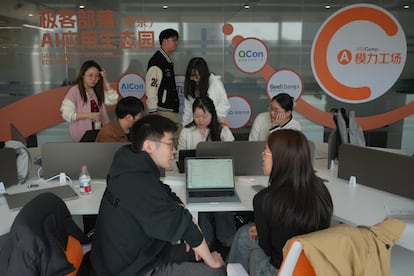

Hangzhou, the city that gave birth to tech giant Alibaba and the DeepSeek model, and a showcase of China’s ambition in artificial intelligence (AI), has issued a legal warning regarding the labor limits of that very same technology. The Intermediate People’s Court of this eastern Chinese city has ruled illegal the dismissal of an employee whom his company attempted to replace with AI after demoting him and cutting his salary by 40%. Released on the eve of International Labor Day as part of a series of landmark cases concerning the protection of labor rights in the industry, the ruling draws a red line in a country determined to lead this new technological revolution, but increasingly vigilant to ensure that its costs do not erode social stability.
The central figure in the case is a 35-year-old employee, identified by Chinese media as Zhou, who joined a financial technology company (more popularly known as a fintech) in 2022 as a quality assurance supervisor for AI models. This senior technician’s role involved reviewing discrepancies produced by large language models, similar to ChatGPT or Gemini, to ensure accurate results. Among other duties, he matched user queries with AI systems and filtered illegal content or content that could violate privacy, according to the case file cited by the Xinhua news agency.
Over time, these tasks were taken over by AI. In January 2025, the company proposed moving Zhou to a lower-level position, which would have meant a pay cut from 25,000 yuan per month to 15,000 yuan, or from about €3,200 to €1,900. When Zhou refused, the company terminated his contract, citing internal reorganization and staff reductions. Zhou filed an arbitration claim demanding higher compensation and won.
The company took the case to a district court in August and, after losing, appealed to the intermediate court. The firm argued that the advancement of AI had transformed the project Zhou was working on and that his functions could be performed by the technology itself. Legally, it attempted to invoke a clause in China’s labor contract law that allows for the termination of a contract when there is a “substantial change in objective circumstances” that makes continued performance impossible.
The intermediate court rejected that argument, noting that the concept typically applies to events such as relocations, mergers, or structural changes within a company, not to a voluntary decision to reduce costs. Speaking to state broadcaster CCTV, Judge Shi Guoqiang of the court said that companies cannot terminate a contract on the argument that technology has replaced the human’s job. Ultimately, the court concluded that the company had failed to demonstrate that Zhou’s contract had become impossible to fulfill and deemed the alternative offered to the employee unreasonable. Consequently, it upheld the ruling that the termination was unlawful and that the company must pay him compensation of 260,000 yuan, approximately €33,000.
The situation is somewhat paradoxical. Hangzhou, the capital of the eastern province of Zhejiang and home to nearly 12 million people, has emerged in recent years as one of China’s new tech hubs. More welcoming and far less saturated than Beijing or Shanghai, it has become home to some of the sector’s most cutting-edge companies. In addition to DeepSeek, the generative AI model that shook up the industry early last year by achieving groundbreaking results at low cost, there are others such as Unitree Robotics, Deep Robotics, BrainCo, Manycore Tech, and Game Science, which the Chinese media has grouped under the label of the “six little dragons” of Hangzhou. These firms embody the new ambition of the communist authorities under the umbrella of self-sufficiency: to advance in large-scale language models, robotics, brain-machine interfaces, and industrial software.
The decision comes at a sensitive time for China. The country has made AI a cornerstone of its rivalry with the United States, but at the same time faces persistent pressure on youth employment and office workers, precisely those most vulnerable to the automation of administrative, creative, and analytical tasks. According to the National Bureau of Statistics, the unemployment rate among 16- to 24-year-olds, excluding students, stood at 16.9% in March, eight-tenths of a percentage point higher than in February. The overall urban unemployment rate was 5.4%.
The Hangzhou case is not an isolated incident. In 2024, the Guangzhou Intermediate Court examined a similar case in which a graphic designer’s position had been filled by AI. It also concluded that the technological upgrade cited by the company could not, in itself, be considered an “objective circumstance” justifying the unilateral termination of the contract. In Beijing, the Municipal Bureau of Human Resources and Social Security publicized an arbitration case in 2025 concerning a data mapper replaced by AI and whose dismissal was also deemed illegal.
The most prudent interpretation of the Hangzhou ruling is not that China has banned AI-related layoffs, but rather that it will attempt to prevent automation from being used to circumvent labor obligations and reduce the cost of restructuring. In a column published in the online newspaper Fengmian, the journalist Jiang Jingjing cautioned against an overly broad interpretation of the ruling: “It’s an old problem, and AI is just a new pretext.” His conclusion points to the limitations of the legal system, since courts cannot guarantee that AI will not replace jobs. “They can only ensure that, when it does happen, the worker receives fair compensation in accordance with the law,” he writes. The challenge, he adds, now lies in translating official guidelines on “job-friendly development” into concrete measures to manage the inevitable impact of AI on employment.
Sign up for our weekly newsletter to get more English-language news coverage from EL PAÍS USA Edition









































