
Rzeszów Airport in Poland, Ukraine's wartime air terminal
The airfield, 55 miles from the border, has become the main point of arrival for military and humanitarian aid


The Polish airport of Rzeszów is modestly sized, a regional airfield. The Patriot air defense batteries deployed alongside the runway, however, indicate that it handles more than just charter flights. Following the start of Russia’s full-scale invasion of Ukraine in February 2022, Rzeszów became the air terminal for delivering military and humanitarian aid to Kyiv. Those imposing missile defense systems visible from the aircraft windows protect key supplies sent by allies.
The immediate closure of Ukrainian airspace on February 24, 2022, positioned Rzeszów Airport, 55 miles from the border, as a gateway from Poland. In one of the two VIP lounges where heads of state and government from around the world have sat, including former U.S. president Joe Biden, airport administration sources recall those early days of rapid transformation.
They went from handling about 10 or 12 commercial flights a day to receiving between 20 and 40 large cargo planes daily from all over the world, such as Hercules, Boeing 747s, or Antonov An-124s. “We weren’t prepared for this; we were a small regional airport,” these sources recalled to a group of Spanish newspapers invited by the Polish government, including EL PAÍS. They lacked staff and fuel.
The airfield administration expanded its staff from 300 to 550. Fuel consumption increased from 100,000 liters per week to between 500,000 and 600,000 liters per day. The lines of trucks were endless. The infrastructure was quickly adapted to receive tons of weaponry and humanitarian aid, military personnel, politicians, NGO workers, and refugees.
“When the Patriots were installed, it was strange,” they acknowledge. The airfield has never ceased to be civilian, although it has become the target of espionage and sabotage attributed to operations linked to Russia. “We don’t know what arrives in the crates; we can only imagine. We don’t store it here. Military personnel inspect it, organize the logistics, and remove it,” the same sources explain.
The city of Rzeszów, with nearly 200,000 inhabitants, has been one of the fastest-growing in southern Poland in recent decades, driven by the aerospace and pharmaceutical industries. With the war on its doorstep, the city witnessed the arrival of thousands of foreign civilians and military personnel who settled there temporarily.
Medical transit center
A whole ecosystem of temporary infrastructure also emerged, and is now entering its fifth year. Along one side of the fence surrounding the airport perimeter, a large tent is guarded by more Patriots. Opposite, just outside the terminal and across the street, an industrial building houses a medical transit center. With removable panels and curtains instead of doors, wounded soldiers transferred from the front lines pass through these facilities before being flown to hospitals across Europe.
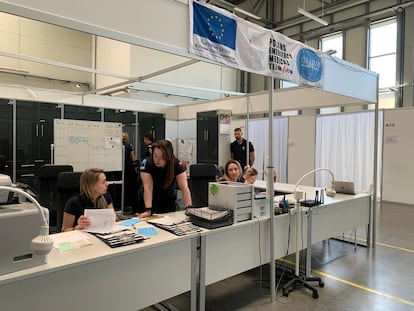
Adam Szyszka, a 45-year-old paramedic with extensive experience in combat theaters such as the war in Afghanistan, and his team of doctors, psychologists, nurses, and interpreters, were working last Tuesday to prepare for the arrival of a group of 14 patients. Their files were ready, and a sign with each patient’s country of origin and identification number was placed on the door of their cubicle.
“This is a unique center. Never before in medical history has it been necessary to create a facility like this,” says Szyszka. Since its opening in September 2022, more than 2,300 patients and 830 companions have passed through its doors. The medicalized facility, approximately 1,000 square meters in size, has space for 50 patients. They typically spend 24 hours there, during transfers that last from two days to two weeks.
The European Commission is co-financing 95% of the project, which connects the needs of wounded military personnel and civilians in Ukraine with medical centers in 22 countries. Sixty percent are trauma patients, 30% are cancer patients, and 10% are children, burn victims, or people with amputations who need prostheses. Those affected by Vladimir Putin’s war are transferred from frontline hospitals to Lviv, near the Polish border. When there are at least eight or 10 patients, the trip to the center in Rzeszów is organized in buses converted into ambulances.
There, they update their medical records, encourage them to borrow a book from the small library to disconnect from the flight alert apps, and prepare their airport documentation. For some, it’s their first time flying.
The war has significantly impacted all activity at this infrastructure site, located some 185 miles south of Warsaw. The number of cargo planes landing there also indicates the extent of Western involvement.
At a photovoltaic panel company in a nearby technology park, a worker named Piotr Golas recounted on Thursday that they had a U.S. facility across the street. “When they delivered defense equipment, our cell phones would stop working,” he said. Last year, they dismantled the temporary infrastructure and left. With Donald Trump in the White House, the United States drastically cut off humanitarian and military aid to Kyiv in 2025. Now, the other allies are buying weapons from the U.S. to send to Ukraine.
The ceaseless movement of planes at this war-torn terminal dropped significantly last year. The runway was closed between June and the end of October for repairs, and traffic was diverted to Lublin. When it reopened in December, it handled between 10 and 15 daily flights, occasionally as many as 20, all related to Ukraine. But the war continues, and Poland feels it is its duty to remind everyone of this. In a few days, they plan to bring a group of Spanish parliamentarians to Rzeszów.
Sign up for our weekly newsletter to get more English-language news coverage from EL PAÍS USA Edition









































