
Surviving for months in a trench: Lack of reinforcements pushes Ukrainian infantry to the limit
Drones that restrict movement and a shortage of troops are forcing some soldiers to spend more than a year on the front lines
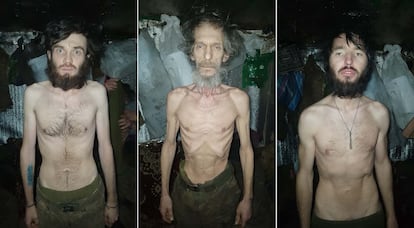

Photographs of four emaciated soldiers have shocked Ukraine. Ukrainian soldiers returning home in prisoner exchanges, after years in Russian jails, also show deplorable physical condition. The treatment they receive violates the minimum standards of respect stipulated by the Geneva Convention for prisoners of war. But these four men had not been mistreated by the enemy: their commanders had abandoned them, without the most basic resources, on the front lines.
The four men have been in a trench on the Kupiansk front in eastern Ukraine for nine months. They have been surviving since July 2025 in a dugout shelter on the other side of the Oskil River. Their families made their plight public on social media on April 22: they hadn’t eaten in 17 days. The outcry triggered the dismissal of the commander of their regiment — the 14th Mechanized Brigade — and of the commander of Ukraine’s 10th Army Corps.
On April 24, the new brigade commander, Colonel Taras Maksymkov, shared a video call with the four soldiers, who showed the food packages that aerial drones had dropped on their position days earlier. The good news was that they finally had supplies; the bad news was that, nine months on, they were still stuck on the front lines of the war.
If there’s one thing a man in Ukraine wants to avoid, it’s being drafted into the infantry. In this war, where drones monitor every square meter of the front lines, relieving the soldiers who have to hold their positions on the front line is a near-impossible mission.
Troop rotation is kept to a minimum on both sides due to the drone threat. For Ukraine, the problem is compounded by a shortage of soldiers. In the sector defended by the four men of the 14th Brigade, the terrain is also challenging: they hold the forward tip of Ukraine’s defenses on the left bank of the Oskil River. Russian forces keep the river‑crossing pontoons under permanent fire. As a result, crossings are reduced to the bare minimum, and priority goes to delivering supplies via ground robots.
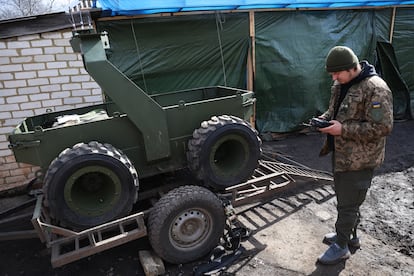
The commander of a battalion defending the left bank of the Oskil River admitted to this newspaper in January, on condition of anonymity, that it was common for his men to spend half a year in forward positions — and in at least one case, a full year.
Botanist is the code name of a 37-year-old captain in the 128th Mountain Assault Brigade. His regiment released a statement on April 16 explaining that Botanist had spent 343 days on the front line in Zaporizhzhia, in southeastern Ukraine. The fact that he was an officer, a company commander, and not a private, was highlighted by the brigade as an example of everyone’s sacrifice: “What makes this case unique is not that he spent almost a year in that position, but that he is a captain.”
“I’ve been in this position for so long because we don’t have enough people. Half of my men are over 50 and constantly sick,” said Botanic. Ukraine has the oldest infantry in the world, with an average age of 42. Botanic was able to be relieved this April so he could return home for his daughter’s 10th birthday.
The known record for the longest stay in one position belongs to physician Serhii Tishchenko: he lived for 471 days in an underground shelter on Line Zero, between August 2024 and October 2025. Ukrainian President Volodymyr Zelenskiy awarded him the Hero of Ukraine medal. Tishchenko explained in an interview last November on the television news program TSN that the hardest part was recovering physically after nearly 16 months hunched over in a space only 1.5 meters high.
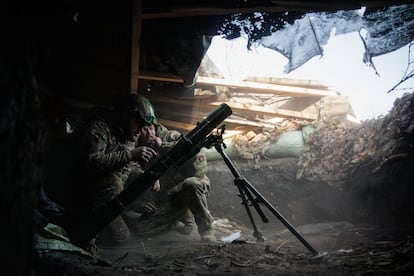
“The psychological toll is immense, but the physical toll is too. We’re talking about spending weeks confined in a space two meters long and 1.5 meters high.” These are the words of December, the code name for the 29-year-old commander of a mortar unit in the 150th Separate Reconnaissance Battalion of the Ukrainian army. His stints in position last between three and six weeks. His situation is better than that of the troops on the very front line: operating mortars and minelaying systems keeps him about two miles from the fighting. The soldiers ahead of him can spend twice as long without being relieved.
Forty days is the limit
December believes that your mind starts to fail after a month without rest: “You lose your civility, you don’t talk, you disregard social norms. That’s why it’s important that you spend the first few days of rest with other soldiers.”
His experience aligns with a study by the Ministry of Defense. On 27 April, Ukraine’s military ombudsperson, Olga Reshetilova, told Ukrainska Pravda that the research concludes that after 40 days on the front lines, “soldiers lose heart to the point where they become indifferent to whether they survive or not.” The Ombudsperson role was created in 2025 to safeguard the rights of Ukraine’s more than 800,000 service members.
The maximum time a Ukrainian soldier may remain in a frontline position without rest was extended on Thursday to two months — up from the previous limit of two weeks.
According to Viktor Tregubov, an officer in the Ukrainian Armed Forces, the two-week limit was “in practice, impossible.” “Firstly, because of the shortage of personnel; secondly, because each rotation is very difficult,” he explains.
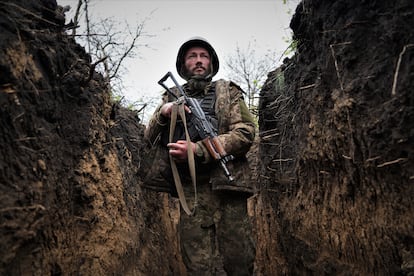
Not all units of the army face the same rotation problems. The farther a position is from the enemy, the easier it is to rotate troops. The situation has worsened for all types of units, but a team operating a howitzer or drones nine miles from the fighting could meet the two-week rotation rule. One example is Volodimir, a sergeant on a tank on the Zaporizhzhia front. These armored vehicles are now kept more than three miles from the front line and are used sparingly, either to contain enemy offensives or as artillery pieces. The usual stretch without rest is up to four weeks, though his personal record is eight months.
One-way ticket
The infantryman heading to his position “often does so with the feeling that he’s only going with a one-way ticket.” These are the words of Historian, the code name for a ground robot operator in the 150th Battalion. His robots deliver supplies to troops who typically spend three months on the line. “The worst part is the feeling that they’ve forgotten about you, especially when you’re running out of food, water, and ammunition.”
Historian lost a leg in November 2024 during the Russian siege of Pokrovsk. He was wounded after three weeks of constant bombardment and daily assaults. It took 20 hours to evacuate him — a delay that resulted in the amputation of his leg.
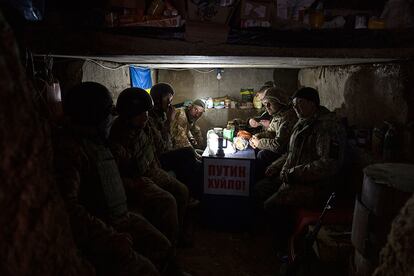
December recalls an occasion when he went directly from spending weeks in the position to resting in the city of Dnipro: “I felt enormous anger towards all those men I passed who went about their lives, unaware of what I had experienced.”
“It’s difficult to understand,” adds Historian. “You spend weeks or months in a tiny space with almost no access to the outside, you always have to be crouched or lying down, relieve yourself there, physically you lose abilities and your body doesn’t respond, your hygiene suffers too. You form a deep bond with your partner in the position, but at the same time you can’t stand him — even his breathing irritates you."
In the interview with Ukrainska Pravda, Reshetilova argued that the time has come to allow many of these troops to return to civilian life and to set a clear time limit on military service. Until now, the General Staff has rejected demobilization because the army’s greatest need is infantry. But Reshetilova insists it is a matter of fairness — and that Ukraine has the means to do it: according to government figures, two million men are currently avoiding conscription.
Sign up for our weekly newsletter to get more English-language news coverage from EL PAÍS USA Edition









































