
NATO’s eastern flank fears greater exposure to Russia as US pulls away
Poland’s foreign minister warned: ‘Putin is desperate, so he might do something desperate’
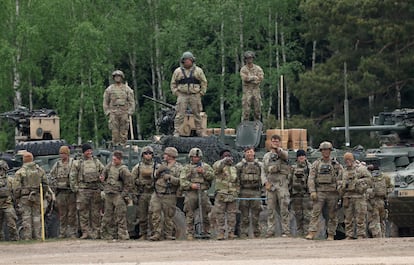

NATO countries most exposed to the Russian threat are watching with concern as the guarantor of Europe’s security pulls away. U.S. President Donald Trump’s disdain for America’s allies — most recently seen by his withdrawal of 5,000 troops from Germany — is setting off alarm bells in the countries along the Alliance’s eastern flank. They fear that the crisis in transatlantic ties could undermine the core principle of mutual defense and send a message of weakness that Moscow will be quick to exploit.
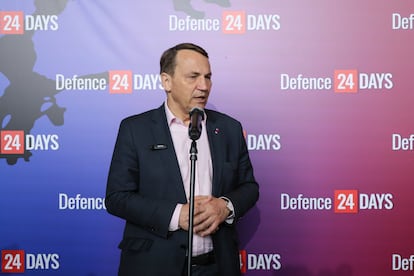
Intelligence agencies and governments across several European countries warn that the Kremlin could attack an EU neighbor in the short or medium term. As Polish foreign minister Radosław Sikorski said at last week’s Defence24 Days conference in Warsaw, “the likelihood of a conventional incursion across NATO’s borders is low. We would detect it — you can’t hide tank brigades.” Yet he added: “The concern is that [Russian President Vladimir] Putin is desperate, so he might do something desperate.”
Poland, the Baltic states, and the Nordic countries are home to some of NATO’s most vulnerable points — places where Putin could test the Alliance’s unity and response. Beyond strategic positions in the Arctic, such as Norway’s Svalbard archipelago, two locations stand out on the EU’s far eastern edge. The first is Narva, Estonia’s third‑largest city, where the European Union meets Russia. With 97% of its population Russian‑speaking, it is exposed to potential destabilization attempts by the Kremlin. The other major headache is Suwałki, on the border between Poland and Lithuania. This 40-mile corridor between Russia’s Kaliningrad exclave and Belarus is the Baltic states’ only land link to the EU.
“For Putin, this Trump presidency is a window of opportunity, and the Baltic states are very worried,” a senior official explained to several Spanish newspapers last Monday during a study visit organized by the Polish government. “Russia believes that the EU and NATO are weak and sees that under Trump, the EU-U.S. relationship has weakened. This perception is reinforced by every comment Trump makes, such as the announcement of the troop withdrawal from Germany,” he added. Moscow also knows that the European rearmament effort is a process that will take years.
“NATO’s eastern flank is under intense pressure from Russia. Strategic depth lies in Germany,” the senior official said regarding Trump’s announced troop pullout. Poland’s ultraconservative, anti‑German, Trump‑aligned Law and Justice party — represented by its president, Karol Nawrocki — has turned the issue into a domestic political weapon and is maneuvering to have the United States relocate those troops to Poland. On Friday, Trump opened the door to that possibility: “I like him [Nawrocki] a lot, so that’s possible,” he said.
Poland wants more US soldiers
The liberal government of Donald Tusk is trying to balance two priorities: avoiding any move that might unsettle cohesion among European allies, while also pushing to increase the U.S. military presence in Poland, which it considers strategic for its defense. “Poland is ready to accept more American soldiers in order to strengthen NATO’s eastern flank and provide even better protection for Europe,” said Defense Minister Wladyslaw Kosiniak-Kamysz, following Trump’s remarks. More than 8,000 U.S. troops are already stationed in the country, but Warsaw has long been working to expand that contingent.
The minister warned on Wednesday at Defence24 Days that “there will be no security in Europe without the presence of U.S. troops.” “Europe must assume more responsibility, but the U.S. has an irreplaceable strategic nuclear deterrent capability,” he added.
Over the two‑day event — the most important security and defense forum in NATO’s northeastern region — politicians, academics, and military officials debated how to strengthen Europe’s deterrence against Russia and bolster military defense. Priorities included expanding air capabilities, developing long‑range precision‑strike systems, reinforcing land forces and drones, improving military mobility, and enhancing cyberdefense.
No alternative to the US
Experts argued that rearmament — strengthening national armies and developing the European pillar — is urgent, but there was also a note of unease about the evident distancing of the United States. “There is a lot of rhetorical noise out there, and naturally that noise is being fueled by statements from U.S. President Donald Trump,” acknowledged Karolis Aleksa, Lithuania’s deputy defense minister. “Our shared conclusion, and also our strategic one, is that there is no alternative to the transatlantic relationship or to collective defense. Because without the United States and without the presence of U.S. forces, we are not able to defend ourselves against our adversaries — against Russia — as we would like.”
Hanno Pevkur, Estonia’s defense minister, still hopes the relationship with the White House can be steered back on track: “Article 5 is not only about defending territory. It is also about values such as freedom — of movement, of expression, economic freedom — which are important for democracy. This helps us understand each other, because they also defend democracy.”
Nikolina Volf, head of Croatia’s Directorate of Defense Policy, echoed this sentiment: “We cannot conceive of European security without the United States. But they haven’t said they’re going to abandon Europe either. They’re still here, they’re still with us.”
However, Kévin Thieron, responsible for transatlantic and NATO relations at the French Ministry of Defense, warned that Europe needs to come to terms with the new reality: “The shift is already happening, and my message is that we must accept it.”
Robert Pszczel, a former Polish diplomat with more than two decades of experience in the Atlantic Alliance, told EL PAÍS that the concern palpable across the region is “fully justified,” describing the moment as “NATO’s most serious crisis in a long time.” To the long‑standing burden‑sharing dispute — a complaint Washington has voiced for decades — one must add the war in Ukraine, the largest conflict on European soil since World War II, and Trump’s approach to NATO.
“There are many things — the verbal attacks on allies, the threats regarding Greenland and Canada — that are already almost incomprehensible. But, in terms of concrete policy, I think the most difficult thing to understand is the United States’ policy toward Russia. It’s almost incomprehensible to us; that’s the only way to describe it,” said Pszczel, who is now an analyst at the Center for Oriental Studies. For him, “it’s a form of unjustifiable leniency.”
On NATO’s eastern flank, officials are keen to maintain a working relationship with Trump despite his unpredictability. European leaders note that the United States also benefits from its military presence in Europe, which projects geopolitical power, while trying to keep Trump appeased. That is why many see statements such as those by German Chancellor Friedrich Merz — who criticized Washington’s lack of strategy in the war against Tehran and said Iran was humiliating the U.S. — as unwise. The same goes for the stance of Spain’s prime minister, Pedro Sánchez, who has positioned himself as the standard-bearer of the opposition to Trump.
There is also concern about Washington’s waning leadership among its allies. “Who, if not the U.S., can exert pressure on Europe as a whole to increase defense spending?” asked Tomasz Szatkowski, former Polish permanent representative to NATO and secretary‑general of the ultraconservative European Conservatives and Reformists group in the European Parliament. Under Trump’s leadership, the Alliance agreed last year to raise military spending to 5% of GDP over the next decade.
On the Alliance’s eastern flank, there is a palpable irritation that the Russian threat is not perceived with the same urgency in western and southern Europe. Poland and the Baltic states, which are already close to the 5% target, struggle to understand the reluctance of countries like Spain to increase defense investment and appeal to the principle of solidarity among allies. “NATO is like a symphony orchestra; we all have to play our part for it to work. France, Italy, Spain… we all need to spend more on defense,” urged Estonia’s defense minister, Hanno Pevkur.
Sign up for our weekly newsletter to get more English-language news coverage from EL PAÍS USA Edition









































