
Spirits are flagging in Kyiv as another year of war looms
Since 2022, life in the Ukrainian capital has been changing at the pace set by Russian troops and missiles
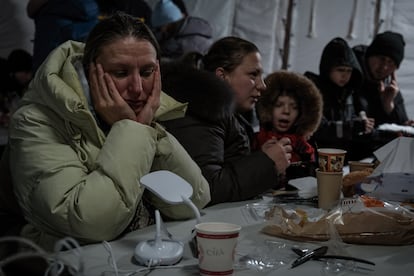

The toll of enduring a war that has now lasted almost four years is evident in almost everything in Ukraine: from the lanes of a swimming pool to the clientele of a hair salon, from the location of a cemetery to the casualty list, from the curfew to the power outages. Above all, it is evident in the increasingly weary mood of the population. What follows is an attempt to describe the corrosive effects of war on an entire country.
In 2022, the first year of the invasion, finding a free lane in the swimming pool at Kyiv’s Olympic Stadium wasn’t a problem. But the pleasure of swimming alone gradually faded, in step with the advance of Russian troops and missiles.
The first change came in September of 2022, when children returned to enjoy extracurricular activities in the water. They had disappeared from the city in February of that year, when Russia launched its invasion of Ukraine and its assault on Kyiv. The attempt to capture the capital failed that April, and the local population gradually returned. Families fleeing the eastern provinces where fighting was taking place also arrived.
In the autumn of 2023, the second major change took place at the Kyiv Olympic Stadium swimming pool: one of the lanes was now reserved almost entirely for wounded soldiers. Men with severe injuries and scars covering half their bodies performed rehabilitation exercises in the water.
The arrival of these veterans came shortly after the failed counteroffensive that summer on the Zaporizhzhia front, which proved a debacle and marked the last time Ukrainian troops held the initiative in the war. A year later, at the end of 2024, two swimming pool lanes were reserved for military rehabilitation.
The Ukrainian Army General Staff does not provide figures on its casualties, but independent organizations that count obituaries and confirmed missing persons put the number of military deaths at over 160,000. The number of wounded is at least three times that, meaning over half a million. The Ukrainian Armed Forces number approximately one million soldiers.
Russian bombing has destroyed Ukraine’s power generation system, and the major cities are suffering the most. In Kyiv, for example, the average daily power outage this January is 18 hours. The population has adapted after four winters of blackouts. In major Ukrainian cities, most people already have generators at home and are accustomed to the schedule of power cuts. But this winter’s extreme conditions, with temperatures near -20°C, are taking a toll on morale more than ever.
“I think for the first time I’m noticing a widespread weariness, as if everything weighs more heavily,” commented Taras Yatsenko, director of the digital media outlet Tvoe Misto. “There’s less and less desire to talk, to do things,” explained another friend, the interpreter Emil Prikhodko, on December 24 in Zaporizhzhia. The following day, soldiers from the 128th Mountain Assault Brigade, stationed on the front lines in Zaporizhzhia province, discussed the growing distance between the army and civil society during their Christmas lunch. “The country is less united; the change is significant as the years go by. It’s weariness, but that first year, in 2022, the popular mobilization was enormous,” said Lieutenant Maria Ana with a touch of sadness, longing for that time.
Maria Ana and her comrades gave examples of what they observe in their daily lives that represent the mental divide between soldiers and civilians. “We live in increasingly separate worlds,” said Mejan, the codename for a sergeant in the 128th Brigade, at the Christmas gathering
Opposition to the cemetery
An example of this is the construction of the National War Memorial Cemetery, which will be the main burial ground for soldiers who died defending Ukraine. This “Ukrainian Arlington” is being built in the forests of Markhalivka, south of Kyiv, after years of relocation due to opposition from local residents and environmental groups.
The forests of Markhalivka are renowned among mushroom enthusiasts. Boletus, the “white mushroom” in Ukrainian, the most prized variety, abounds. But the planned cemetery, with a capacity for 100,000 graves and 50,000 niches, has led many to abandon the forest, as representatives of neighborhood associations opposed to the project explained during an excursion to the area this autumn. Authorities have already begun burying those killed in combat despite local protests, which even appealed to European institutions. In 2025, the Council of Europe requested that the government halt construction due to the high ecological value of the area, particularly because it contains the headwaters of three rivers.
Locals fear the water will be contaminated by the decomposing bodies, and few want the mushrooms from Markhalivka. For the residents of the region, this is a clear case of a violation of the rule of law. The Ukrainian government has dismissed their protests, including demonstrations, as selfishness at a time when tens of thousands of soldiers are sacrificing their lives for them.
An empty hair salon
Zirulnik is a well-known barbershop chain in Kyiv. This journalist has been a regular at one of its locations since 2022. Over the three and a half years of monthly visits, the clientele has steadily declined. In recent months, the shop has typically been empty. Bogdan Kushnarov, one of its employees, lists the many reasons for this: the first is that, since the summer of 2024, when a stricter conscription system came into effect, men avoid traveling far from home to avoid being stopped by recruitment patrols. In the spring of that year, the minimum mandatory military service age was lowered from 27 to 25.
The fear of being stopped by a recruitment patrol can even be detected on dating apps like Tinder or Bumble. “There are men, when you connect with them, who ask if you can meet in their neighborhood because they prefer not to go to a restaurant downtown, where there are more suitable restaurants or cafés for a romantic date,” explains Adriana Kucher. This 33-year-old journalist agrees with other women’s accounts gathered in recent years: it’s difficult to find a partner on these apps because there are fewer and fewer men.
There are also the customers the barbershop has lost because they’ve left the country, legally or illegally. Martial law in Ukraine prohibits men aged over 18 and under 60 from crossing the border unless they are exempt from military service. The final blow to the barbershop came in August, when a decree by President Volodymyr Zelenskiy took effect, allowing men aged between 18 and 22 to travel abroad. The decision was designed to encourage these young men to pursue their studies overseas, but the result has been a mass exodus to avoid military service.
Ukraine has lost nearly 10 million inhabitants since the start of the invasion, according to estimates from the Mykhailo Ptukha Institute for Demography and Social Studies, Ukraine’s leading institution on this matter. The Ukrainian population now stands at around 32 million: in four years of war, it has lost approximately 25% of its inhabitants. The birth rate has plummeted to the lowest level in the world.
Economic hardship is another reason for losing clients, according to Kushnarov. Inflation in Ukraine reached 12.6% in 2025, according to the International Monetary Fund, during a period of rampant economic crisis due to the war. According to an analysis by the media outlet Hromadske, only two sectors are growing: construction and armaments. More critical for the hairdressing business are the clients who have been drafted.
Kushnarov is 25 years old but exempt from military service: he is studying for a degree through distance learning. People pursuing their first higher education qualification do not have to go into the army. As a result, there are now 230,000 people over the age of 25 in Ukraine studying for a degree, nine times more than before the war, according to government data published in December by the newspaper ZN.
“I’m fed up with having to be strong”
Kyiv has a large swing dancing community. Before the war, events were held almost daily. In 2023, the parties resumed, albeit once a week and with the curfew as a limit. The curfew hasn’t changed; it remains in effect in the capital from midnight to 5:00 a.m., during which time no one is allowed on the streets, public transport is suspended, and taxis are unavailable. But other things have changed since that festive restart in 2023. Back then, there was a balance between men and women; now, 80% of the participants are women.
At the first party this newspaper witnessed in 2023, out of a group of six men, only one remains active as a dancer. Three of them are in the army, one prefers not to leave his neighborhood, and another lives in Poland. This man managed to leave Ukraine to avoid being drafted using a common trick: registering with the authorities as the guardian of a dependent relative (in this case, his father) exempts him from conscription. Father and son crossed the border, but only the father returned. He lives with his wife, who cares for him.
Parties are no longer held in bars with space for a live band. They’re almost entirely organized in private venues without a band due to problems with the electricity supply. At a Christmas party in December, Olga and Irina, two friends with over 20 years of dancing experience, explained that these gatherings are essential for their morale. “I’m fed up with having to be strong,” says Olga, a 43-year-old graphic designer.
Irina, also a graphic designer, shares this opinion. Her main concern for 2026 is that Zelenskiy will lower the military mobilization age, as demanded by politicians and the army, from 25 to 23. Irina has a 23-year-old son.
Both confirm that there is a growing sense of exhaustion, but they don’t attribute it to disunity within Ukraine. For them, there is only one party responsible for their plight: Russia. Both are admirers of Pyirg i Batig, a musical group that sings Ukrainian poems. Their singer, Marian Pirozhok, currently in the army, put it this way in an interview on December 31: “The easiest thing is to judge someone without knowing their circumstances or, God forbid, to accuse someone. If we can accuse anyone, it is only our enemy.”
Sign up for our weekly newsletter to get more English-language news coverage from EL PAÍS USA Edition









































