
Ground robots push Ukraine toward a robotized infantry
President Zelenskiy recently announced the first recapture of an enemy position carried out entirely with uncrewed systems, as Ukraine increasingly relies on machines for both logistical and combat missions
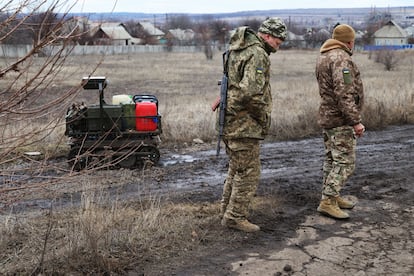

They evacuate the wounded and dead, distribute food and medicine, plant mines, transport munitions, launch drones, fire projectiles, erect barricades, recover damaged vehicles, and conduct intelligence operations. Ground robots are playing an increasingly prominent role in the Ukrainian army, which has already made significant progress with its unmanned air and naval forces. Ukrainian President Volodymyr Zelenskiy announced on Monday that, for the first time, Ukraine had recaptured a position held by the Russians using only ground and air drones, forcing the enemy to surrender.
On the ground, more and more tasks are falling to this new robot infantry, which — sometimes while being controlled from hundreds of miles away — saves lives and adapts to the new electronic warfare. Some of them have even held a position on the front lines for several weeks. Replacing soldiers on the battlefield, however, is still a long way off, experts say.
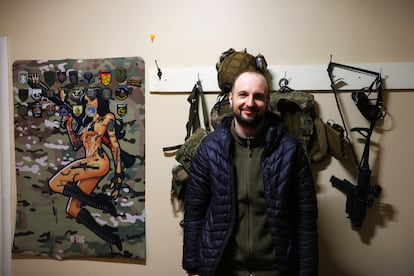
It is a “cheap, fast, and effective” weapon with “enormous potential,” says Oleksandr (who doesn’t give his last name), the head of the Alter Ego Battalion of the 93rd Brigade, in his office in Kramatorsk, in eastern Ukraine. His battalion is dedicated exclusively to the development of ground robots. For Oleksandr, a member of the Armed Forces even before Russia’s full‑scale invasion in 2022, this shift is no surprise, because “there has been a natural evolution.”
“Until now, ground robots haven’t been very necessary because their functions were carried out by soldiers,” he explains. “Now, with the so-called ‘kill zone’ becoming increasingly wider, they are more necessary than ever. We’re looking for technologies that reduce the risk to the military.”
His battalion is located in a facility that used to be a ballet studio. Large mirrors now sit partially hidden behind screens used to control the devices deployed in the field. “Look at this one, it’s stuck in the ground, and we have to send another robot to retrieve it,” says Oleksandr. The bulk of the activity takes place at night, and he estimates that around 10% of the devices are lost.
Outside Kramatorsk, on a promontory where the sounds of the conflict’s explosions are ever-present, several soldiers are conducting training exercises with one of these devices. Loaded with fuel, water, and a generator, among other things, the robot advances with minimal resistance across terrain dominated by thick mud and patches of ice. Its battery allows it to operate for two to three hours.
At the controls are Dmytro, 54, and Mikhailo, 61, two of the service members who have had to adapt to the new demands of warfare. The aircraft is equipped with an autonomous Wi-Fi system from Starlink (owned by U.S. magnate Elon Musk), allowing it to be controlled from hundreds of miles away.
The commander of the Ukrainian army’s Third Corps, Andrii Biletski, estimates that, in the coming months, if current technological advancements continue, ground robots will allow for the withdrawal of up to a third of the infantry. These troops would then form part of an elite unit that will perform tasks that the robots cannot handle, he told TSN, Ukraine’s daily news program, on March 20.
Replacing infantry is still a distant prospect, says David Kirichenko, an associate fellow at the Henry Jackson Society, though he acknowledges Ukraine’s advances in the field. “Ground robots will likely be vital for Ukraine in 2026, but they are not miracle weapons nor can they serve as a panacea for Kyiv’s personnel problems,” he notes, pointing to the hundreds of thousands of citizens evading their obligation to serve in the army.
But meeting the ambitions laid out by Biletski will not be easy, despite the progress already made. Ukraine’s biggest obstacle is its limited capacity to mass‑produce large numbers of robots, largely due to a shortage of many of the necessary components, Oleksandr explains. “In our workshops, we think and act very quickly. However, it’s no secret that we have problems mass-producing our weapons. We have experience in developing inexpensive solutions, something irreplaceable,” he says.
That, in his view, is the reality Ukraine faces in the fifth year of Russia’s full‑scale invasion: “First, the war keeps us all highly motivated. In the U.S., what these men are doing would earn them a good salary; here, it means saving our lives. Second, we see the war up close and know what the immediate needs are. People practice, research, and learn on the ground. The major powers have money, engineers, components… but they don’t have the war on their doorstep. What we’re doing is meeting immediate needs.”
In another operation described as extraordinary, EL PAÍS interviewed a soldier who stepped on a mine and survived nearly five weeks behind enemy lines before being rescued by a ground robot on the sixth attempt.
Despite the progress made over the past four years, “Ukraine’s expanding robot army remains incapable of carrying out many military functions that require infantry,” analyst Kirichenko observes. “When small groups of Russian troops infiltrate Ukrainian positions and push into urban areas, for example, soldiers are needed to clear and hold terrain. Advocates of drone warfare need to recognize these limitations.”
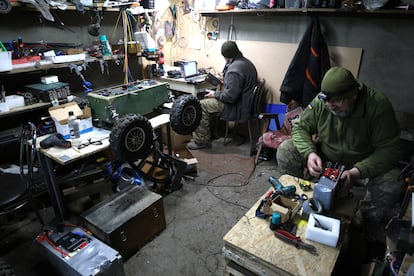
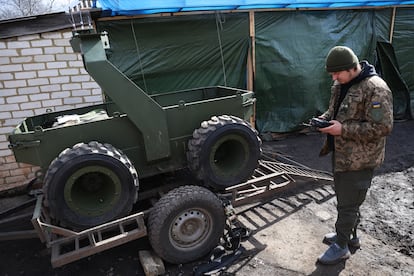
On the ground, however, troops continue working toward those ambitious goals. In one of the four workshops run by the Alter Ego battalion in Donetsk province, several men are busy upgrading equipment. Experience has pushed them to adopt tracks rather than wheels, and batteries rather than combustion engines. “We’re two years ahead of the Russians in ground robots, although they learn very quickly and have a greater capacity than we do for rapid manufacturing,” says Oleksandr, surrounded by various devices of different functions and sizes.
Andrii, 28, was training to be an engineer — while also working as a magician — when he enlisted in 2024. He is convinced these systems will grow exponentially, though, he jokes, no amount of technological progress will make his magic tricks useful. Oleksandr, his boss, sticks to what matters most: “They’re going to save a lot of lives.”
Sign up for our weekly newsletter to get more English-language news coverage from EL PAÍS USA Edition









































