
Ann Dooms, mathematician: ‘In the real world, human intuition remains irreplaceable’
She is one of the world’s experts in what she and others in her field call ‘digital mathematics’: a term of their own to distinguish it from classical signal processing or more conventional data analysis
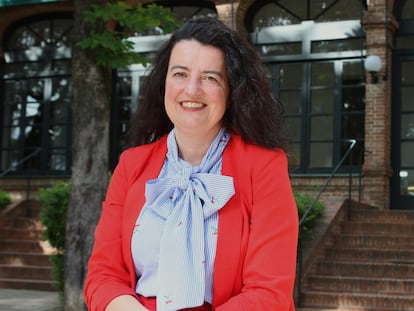
After two days in Madrid, Ann Dooms, 47, still hadn’t managed much sightseeing: only a quick visit to the Santiago Bernabéu stadium with her daughter. She was staying at the Residencia de Estudiantes, where she gave a talk at the invitation of the Institute of Mathematical Sciences and the Spanish National Research Council (CSIC). Public outreach is only one of the many tasks that occupy Dooms. She also leads the Mathematics and Data Science research group at the Free University of Brussels (VUB, by its Dutch initials), where she is a full professor, and chairs both the Belgian Defence Scientific Council and the Education Committee of the European Mathematical Society.
Across all these roles, one conviction appears again and again — something she repeats several times during the conversation: understanding, and making understandable, the ways in which mathematical patterns help us read the world. The teaching of mathematics is another of Dooms’s concerns, as she also chairs the Education Committee of the European Mathematical Society.
Her vocation began in high school when she saw a BBC program featuring Michael Barnsley, a pioneer of fractal geometry who became a multimillionaire after developing a revolutionary image‑compression technique based on fractals that Microsoft incorporated into its Encarta encyclopedia. After completing a PhD in noncommutative algebra, Dooms shifted her career back toward her childhood idol: she moved to an engineering faculty to develop algebraic watermarking techniques to authenticate digital images.
That move toward the applied end of the spectrum would make her one of the world’s leading experts in what she and her group call “digital mathematics”: a term coined at the Free University of Brussels — the alma mater of Ingrid Daubechies, a pioneer in the field and recipient of the Princess of Asturias Award and the BBVA Foundation Award — to distinguish this approach from classical signal processing or more conventional data analysis. It involves developing mathematical tools, largely from functional analysis, capable of extracting structure and meaning from different types of digital information.
Question. Your contributions in this field — in which you began working alongside Daubechies — include collaborations with major museums to analyze high‑resolution digital scans of masterpieces in order to characterize a painter’s style or detect hidden restorations. Can these be considered one of the early major successes of machine learning?
Answer. Yes. On a computer, an image is a numerical structure made up of pixels: we examine it through that structure, manipulate the numbers mathematically and translate the result into information a human can interpret. We were doing this in the 2000s, although we didn’t call it machine learning then, because it was still frowned upon to say we were making a machine learn.
Q. What information can these tools extract that could not be perceived otherwise?
A. We develop transforms that decompose images into different kinds of building blocks depending on the goal: simplify information to compress files; characterize with great detail the brushstrokes of a painting to mathematically distinguish one painter’s style from another’s; identify cracks in a work so they can be digitally removed... Recently, together with the Reproductive Medicine Center at UZ Brussel University Hospital, we are applying these ideas to select oocytes to be frozen for women undergoing cancer treatments who want to preserve their fertility.
Q. You also say this approach can improve artificial intelligence models.
A. I think right now we are exploiting the power of neural networks in a very naive way. If we can add mathematical structure to data processing, the results will be much better. The key is to look for the best representation for the problem you want to solve, transform the data into constructive building blocks, and only then apply machine learning. It is proven that neural networks can learn to do what wavelets [the mathematical transforms with which Daubechies revolutionized image processing from the 1980s] do; there is a theorem that guarantees any continuous task can be approximated by a neural network with a single hidden layer. But that means spending enormous computational resources to rediscover something we already know. Why not start from it directly?
Q. What else would we gain from that mathematical approach?
A. Reliability and transparency. The next generation of artificial intelligence models should not consist only of larger models, but of models that are better understood mathematically and more tightly linked to the structure of the problem they aim to solve.
Q. Have you been able to test it?
A. I’ve run some tests, but even with a high-performance computer, I have to wait 48 hours to run very small examples. Academia does not have the computational power of the large tech companies. We need to collaborate with them, and I think private capital will have to play a central role in research, as it did in the early days of computing.
Q. How is this ecosystem, dominated by big tech and their AI models, changing the way mathematics is done?
A. To me, they are an extraordinarily powerful tool. For example, you no longer need years to explore an abstract link: you can give the model certain rules and ask it to check whether an intuition you have might be true, or even to search for new properties on its own. Something similar happened with the arrival of the first computers: mathematicians working on the space race did calculations by hand, and suddenly that was automated and changed the whole way of working. But the problems didn’t disappear; a different kind of understanding was required to apply the new tools. The same happens with AI: you have to understand what is relevant and what is not. And when you work with real-world phenomena, where everything is enormously complex, human intuition remains irreplaceable. These networks have no sense of reality. Even if they process images or video, it is still not our world. We are three-dimensional beings working in a four-dimensional space. That will remain our advantage.
Q. What, then, happens to young researchers who are just starting out and have not yet developed that intuition?
A. It’s a question the whole community is asking. Just a few days ago, Timothy Gowers [Fields Medal, one of the world’s most respected mathematicians] wrote on his blog that ChatGPT 5.5 Pro had produced, in just over two hours and with almost no mathematical guidance from him, a result that, in his view, would have made “a perfectly reasonable chapter in a doctoral thesis in combinatorics,” and he concluded that we urgently need to rethink what a doctorate in mathematics is. It’s advancing our field a lot, but I think these models, for now, do things that generalize what already exists in the data. And of course there are theses that consist of that, which is not easy either: it involves a lot of reading, identifying relevant information, connecting ideas. But many other theses are something else. I have never given my PhD students tasks that are simply “connect the dots.”
Q. Beyond doctorates, what would you say is Europe’s main challenge in mathematics education?
A. It’s not exclusive to Europe. The difficulties in the United States and Canada are very similar. Rejection of mathematics is growing fast, and I think it has a lot to do with how it is taught in primary school: as a purely computational tool, never explaining why things work. Of course. there are questions — even among the most basic ones about the natural numbers, like why two times three is the same as three times two — that are too sophisticated to prove to children. But the problem is that currently nothing is explained. When you reach the formulas for area or circumference, they’re just presented as: this is the formula.
However, geometry is precisely the discipline where mathematical proof was born; there you can prove things, and in an accessible way. Then, suddenly in secondary school, formal and unintuitive proofs appear. That produces a very strange feeling in students: some things must be memorized, others must be proved rigorously. It’s never clear why. Hung-Hsi Wu, an American mathematician of Chinese origin, sums it up well: what we call school mathematics is a very young discipline, and in fact we still do not fully know how to teach it.
Q. Do you have any concrete proposals for improvement?
A. For me, the challenge is to convey, from the start, that mathematics is the only science in which you can be truly certain about something, and to show how that is so with very carefully chosen examples. But also to acknowledge the limits: natural numbers are among humanity’s oldest technologies, we know they work very well, but explaining why is extraordinarily difficult. The goal should be to teach children to look at the world structurally: identify what things behave similarly if you remove the details.
That requires drastic changes in what we teach, to whom and how, and a fundamental rule: never teach something that is incorrect, but choose the level of detail carefully. This is extremely costly. That is why my dream would be for European education ministers to launch an international project specifically for this: bring mathematicians together, jointly design the content and approach, and produce a curriculum that makes children think about the world. In Flanders, this idea provokes criticism because people say it undermines freedom of teaching. But that is not freedom. Mathematics is about truth.
Q. You hold another striking post: you chair the Scientific Council of Belgium Defence. How does a mathematician come to advise the military, and what is the extent of that advice?
A. We advise on research projects required by the Royal Academy for military training and we also work with research carried out by intelligence services. There are calls in which academics participate alongside the Academy and Defence. The results are sometimes secret; not everything can be published.
Q. Do you consider yourself a pacifist?
A. Yes, but I believe defence is important and one should not be naive. One of my role models is Alan Turing, who also worked for Defence, but not to attack — rather to save lives. That was also my mission when I joined the Council: not to produce weapons of war, but to contribute on security matters and, increasingly, on everything related to AI. How can we use AI to protect ourselves, but also how to defend against attacks using it, which is already happening. I can’t say much more.
Q. Do you think the mathematical community is handing over its responsibility in debates about the military uses of AI to lawyers and philosophers?
A. Yes, absolutely. Mathematics is the basis of these technologies, and mathematicians should be talking about them. But that is not common practice.
Sign up for our weekly newsletter to get more English-language news coverage from EL PAÍS USA Edition









































