
The prime numbers of pregnant women: A mathematician exposes the scam of predatory journals
Spanish scientist Pascual Diago has published a delusional study to denounce the invasion of fraudulent publishers in science.
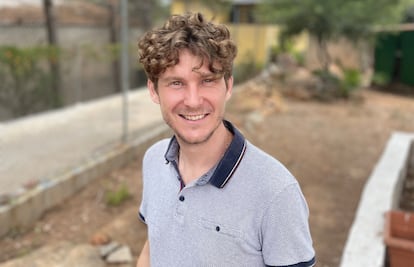

Tired of receiving 10 emails a day encouraging him to publish his studies in obscure scientific journals, last November the mathematician Pascual Diago decided to give it a try. His specialty is teaching school mathematics, but he accepted an invitation from the Clinical Journal of Obstetrics and Gynecology. It took him just a few minutes, using ChatGPT, to generate a delusional six-page text about supposed experiments to alleviate anxiety in 60 pregnant women and their fetuses with mathematical metaphors. In the article’s references, he included non-existent studies, four of them attributed to the fictitious author Me-Lo I Nvent O (“I Make It Up”). The paper was published a few days later.
Diago, an associate professor at the University of Valencia, explained by phone that his intention was somewhere between a joke and a denunciation of so-called predatory journals, fraudulent publications that present themselves as prestigious and publish anything in exchange for money. It’s a growing business. The list of predatory journals exceeded 20,000 this Tuesday, according to a count by the specialized firm Cabells. Five years ago there were 15,000. Seven years ago, 10,000. No serious institution takes them into account, but the figures show that they have carved out a niche in the global scientific system.
The study published by Diago, riddled with square roots, is unintelligible even to himself. “Even I don’t know what it’s about; it makes no sense at all. I’ve tried to understand it a couple of times, and I think it deals with the effect on children’s mathematical learning of teaching prime numbers during pregnancy,” he explains, laughing. The professor, born in Castellón, Spain 43 years ago, included explicit signs that the whole thing was a hoax, such as scientists’ surnames that were puns on English terms associated with cheating: Cheatillo, Sneakydez, Trickón, Sneakarez.
The Clinical Journal of Obstetrics and Gynecology immediately accepted the study, but asked Diago to include references to four studies by the same author: Jamshidkhan Chamani, a professor at Azad Islamic University, a private institution in Iran. Demanding unjustified citations is a typical tactic to artificially inflate a researcher’s resume, as demonstrated by the case of the current rector of the University of Salamanca, Juan Manuel Corchado, whose research group has had 75 studies retracted due to these fraudulent practices. Diago was asked to cite studies on the supposed medicinal properties of turmeric, jujube seeds, citrus peel, and a substance obtained from spinach and other plants. These studies had nothing to do with the one about pregnant women’s “fascination” with prime numbers that ChatGPT had written for Diago.
Furthermore, a certain Robbie Williams demanded an advance payment of $3,000 from Diago into an account associated with Heighten Science Publications, located at a house on the outskirts of East Windsor, Washington. The mathematician responded with a text peppered with song titles by the English singer and composer Robbie Williams and attached a fake payment receipt generated by artificial intelligence, bearing the logo of “Cheatbank” from Spain. “I told myself: I’m going to write something that’s impossible to believe,” he recalls. His study was nevertheless published immediately, and remains there more than two months later in the Clinical Journal of Obstetrics and Gynecology.
Diago first recounted his experience on January 30 on the website of Retraction Watch, a U.S. organization specializing in fraudulent practices in science. The mathematician cannot fathom the business model of predatory journals. “I don’t know if anyone is foolish enough to pay $3,000 to publish in a journal that is completely fake and obvious from the start,” he reflects. “Some private universities offer bonuses, production incentives, but I don’t know if they would accept this. At public universities, these studies certainly don’t count for anything,” he adds.
Professor Eva Méndez, director of the meta-research group for open science at Carlos III University of Madrid, encourages people to rebel against these scams. “I think that, increasingly, researchers should go ahead and waste their time doing things like this [Diago’s fake paper], not only because I find it terribly funny, though also terribly sad, but because we need to demonstrate that artificial intelligence only exacerbates a problem inherent in the system,” she says.
The global scientific community operates under the pressure of “publish or perish”: scientists must publish studies—“papers,” in scientific jargon—to aspire to promotions and salary increases. This culture of maximizing output has combined with the widespread commitment to open science: previously, readers paid to access studies available by subscription; now, researchers themselves must pay publishers, usually around €2,500, to publish work freely accessible to everyone.
“Fraud is not an accident, but a logical byproduct of how we evaluate and communicate research in an absurd 21st-century paper-centric system. We need to stop and reflect deeply on all of this if we don’t want tons of papers written and reviewed by artificial intelligence,” explains Méndez. The professor harshly criticizes the so-called Transformative Agreements through which public institutions pay hundreds of millions of euros to private publishers to publish studies in their journals. “The one who always loses is the same: the researcher. In this case, only time, but often also money, and incidentally, the good science we do loses credibility,” laments Méndez.
On January 20, the professor participated in a conference on the challenges that artificial intelligence poses to scientific integrity, organized by the Spanish Research Ethics Committee at the Ministry of Science in Madrid. The committee’s president, Jordi Camí, drew attention to the current staggering volume of scientific output: 3.5 million studies published each year in some 45,000 journals, with “a minimum of $2.5 billion” paid annually to publishers. “The fraud industry is flooding the entire classic universe of scientific publications. This fraud will grow because the major problem, the pressure to publish, continues to set the standard. And generative artificial intelligence has burst onto the scene like a miracle cure,” Camí warned.
Sign up for our weekly newsletter to get more English-language news coverage from EL PAÍS USA Edition









































