
The cave lion wasn’t a lion: DNA reveals a species with nearly two million years of its own history
A study analyzing 12 ‘Panthera spelaea’ genomes finds its lineage split from African lions far earlier than thought, with interbreeding shaped by glaciations
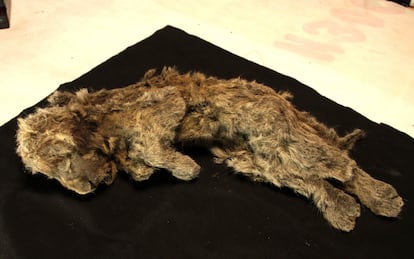

In 2018, Russian paleontologists discovered in Siberia the almost perfectly preserved frozen body of a cave lion cub. They named her Sparta. She was 32,000 years old, with blond fur, perfectly intact claws, and she looked as if she were asleep. What no one knew at the time was that Sparta carried a secret in her cells that would take years to decode: she and her kind were not, as previously thought, simply a larger, furrier version of the African lion, but something far more extraordinary.
A study published Tuesday in the journal Cell, led by Swedish and British researchers from the Center for Palaeogenetics at Stockholm University, analyzes for the first time 12 complete genomes of the extinct Panthera spelaea, the so‑called cave lion — including Sparta’s. The conclusion rewrites the identity of the animal, arguing that its lineage split from that of modern lions more than 1.7 million years ago — more than three times earlier than previous estimates.
“Cave lions have often been portrayed as just a larger, more rugged version of modern lions,” said David Stanton, lead author and paleogeneticist, in a press release. “But what we see in their genomes is something much more remarkable — a lineage that’s been evolving independently for over a million years, accumulating its own unique biological features.”
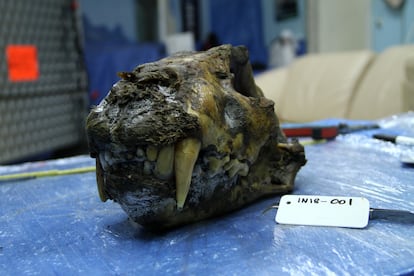
Love Dalén, a professor at Stockholm University and co-author of the study, explains the difference using an analogy. “It was a separate species, roughly like the Iberian lynx and the Eurasian lynx; they are distinct species that also hybridize occasionally,” he tells EL PAÍS.
Not as different as a tiger and a leopard, he adds, but still an animal with its own identity, its own demographic history, and biological adaptations built up over nearly two million years of evolution in the cold Pleistocene ecosystems.
Glacial cycles as a switch
Despite that deep separation, the two lineages did not evolve in complete isolation. The study detects several episodes of hybridization over tens of thousands of years. The proportion of modern lion DNA in the cave lion genome is small — between 3% and 4.4% — but it reveals a striking pattern: it increases during glaciations and decreases when the climate warms.
“Our results suggest that past climate change did more than reshape habitats. It actively brought these species together, creating brief opportunities for interbreeding that otherwise would not have occurred,” Dalén says.
The mechanism proposed by the study is particularly interesting: during colder periods, the tundra expanded southward, pushing cave lions into lower latitudes where modern lions from southwest Asia — the so‑called Mesopotamian lions, extinct since the 20th century — lived. When the ice retreated, the two species separated again. The great ice sheets were not the switch themselves, but a marker of a more complex process: it was the shifting ecosystems that brought into contact two lineages that had been separate for nearly two million years.
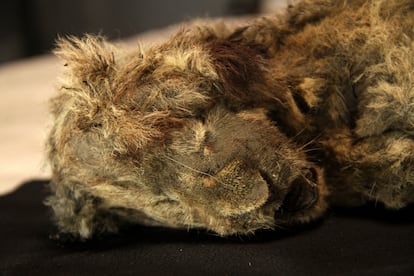
Those nearly two million years of independent evolution left a mark on the genome. The study identifies 33 mutations unique to the cave lion. More striking still is where those differences are concentrated: they are not randomly distributed but cluster in genes related to the brain, vision, the circulatory system and growth. It is a pattern that suggests adaptation rather than chance.
“They are candidate signals, rather than proven adaptations,” explains Dalén, “but they are intriguing because they fit the idea that cave lions were adapted to environments very different from those of the modern lion: colder and more seasonal.” That suggests changes in vision, growth or the nervous system that could be linked to hunting, cold tolerance or behavior.
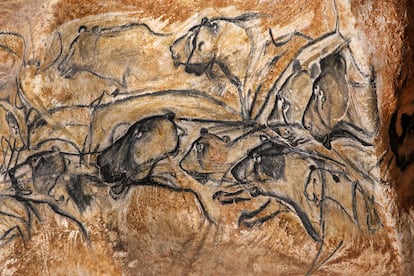
Cave art had already hinted that this animal was different: males appear to lack manes in the paintings from the Chauvet and Lascaux caves, and their size exceeded that of today’s African lion. Now the genome adds a new chapter to that story.
One of the study’s most unsettling findings is that just before going extinct, the cave lion’s population was larger than that of today’s African lion. They did not disappear because they were too few, nor because their genes had deteriorated in a spiral of inbreeding. Something wiped them out — rapidly and across their entire range — between 13,000 and 14,000 years ago.
“Extinction is not always preceded by a long genetic collapse,” Dalén explains. “The most likely explanation is that their prey declined, perhaps due to climate changes at the end of the last glaciation, to a point where numbers could no longer sustain a viable population. Large predators at the top of the food chain are especially sensitive to declines in their prey.”
The implications for today are sobering: African lions are now in a worse genetic and demographic position than cave lions were when they disappeared.
Love Dalén did his postdoc in Madrid in 2006, alongside Juan Luis Arsuaga, the paleontologist who has spent decades unearthing the secrets of the caves of the Sierra de Atapuerca. At the time, the revolution in DNA sequencing technologies was just beginning.
“But back then, it still seemed impossible to sequence several complete genomes of any species that had been extinct for a long time,” Dalén recalls.
The researcher is also an adviser to Colossal Biosciences, the U.S. company working on mammoth de-extinction that has claimed to have achieved the de-extinction of the dire wolf. The inevitable question follows: could the cave lion be next?
“There are no plans underway to attempt it,” Dalén replies. “But if it were to happen in the future, I would not have a firm objection, provided it were done ethically.”
What he considers more valuable, he adds, is using genome-editing technologies to eliminate diseases in species that still exist.
Sign up for our weekly newsletter to get more English-language news coverage from EL PAÍS USA Edition









































