
Oldest RNA recovered from a mammoth that lived 40,000 years ago
Scientists have managed to rescue the molecule, against all odds, from a calf that died after being attacked by cave lions


Every year, when the thaw arrives in Siberia, groups of explorers set out in search of the mammoth. Tusks and other bones from these extinct pachyderms surface so frequently that locals use them to prop up their tents or sell them on the black market. In the best-case scenario, those who find some of these carcasses are scientists, leading to extraordinary discoveries about the vanished fauna of the Ice Age.
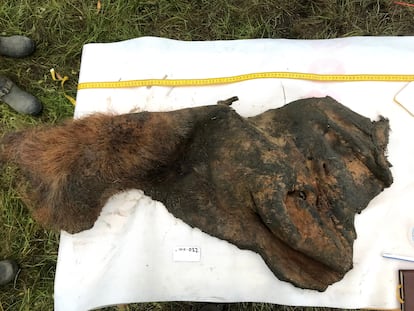
nounced a seemingly impossible discovery: the oldest RNA ever recovered. It was isolated from the body of Yuka, a mammoth calf that died after being attacked by cave lions some 40,000 years ago. Videos recorded by the scientists themselves show the reddish-brown fur of the animal, remarkably well-preserved, as if it had died just yesterday.
Until now, it was thought that RNA — a biological molecule essential for life — was too fragile to withstand the passage of time after death. Its discovery in a mammoth increases our understanding of how these animals’ bodies functioned to a new level, and may possibly help to de-extinct some of their traits, the s
“Isolating RNA allows us to understand much better what their biology was like when they were alive,” summarizes Emilio Mármol, lead author of the study. New molecular analysis tools allow for the recovery of much more biological information. Previously, DNA had been extracted from mammoths over a million years old. Sometimes the remains are so well-preserved in the frozen ground that they retain their original three-dimensional structure. And just a month ago, members of this same team managed to recover DNA not only from a mammoth, but also from the bacteria that lived in its intestinal tract.
Every cell in the body has a complete copy of the genome, made of DNA, but with that information alone it’s impossible to know if it’s a skin cell, a heart cell, or a brain cell. To do that, you need to know which genes are active, to what extent, and where, and that’s the information provided by RNA.
The molecule was isolated from the animal’s muscle. This allows researchers to determine which genes were active at the time of its death. “We see that it’s normal muscle tissue, but there’s also RNA associated with stress,” explains Mármol, a 35-year-old paleogeneticist from Málaga who works at the University of Copenhagen in Denmark. The finding aligns with what scientists who discovered Yuka’s remains in Siberia’s Yukaghir region proposed years ago: the animal was being stalked by predators, likely cave lions. The research was published Friday in the scientific journal Cell.
The discovery opens a new field. Until now, it had proven extremely difficult to extract RNA from ancient remains. In 2019, it was isolated from a canid extracted from permafrost that lived 14,000 years ago. The work was led by Tom Gilbert, Mármol’s current supervisor. The molecule appeared in remains of the liver, muscle, and skin, but it was very deteriorated. “It was the proof of concept we needed to start working on this,” recalls Mármol. This time, they analyzed tissue from 10 mammoths and obtained RNA from three of them. The RNA is also not completely preserved, but in the case of Yuka, these are the most complete and revealing sequences obtained to date. This study has made it possible, for example, to determine that this mammoth was a young male, and not a female, as was thought based on the study of its DNA.
Swedish geneticist Love Dalén is another of the study’s leading authors. In recent years, his team has successfully extracted DNA from mammoth remains dating back more than a million years. “The results demonstrate that RNA molecules can survive much longer than previously thought,” the scientist emphasizes in a press release issued by Stockholm University. “This means that we will not only be able to study which genes were active in different extinct animals, but it would also be possible to sequence RNA viruses, such as influenza or coronaviruses, preserved in Ice Age remains,” he explains.
Dalén is also an advisor to Colossal, the American company that aims to “de-extinct” the mammoth using the Asian elephant as a template. Mármol acknowledges that the company has shown interest in the tools they used to extract RNA from the remains. This advance could allow them to better understand mammoth biology, especially a more complete view of molecular processes beyond DNA, he notes.
But the Spanish researcher is “skeptical” about Colossal’s objectives. “I don’t think it’s possible to reintroduce populations of these animals and make them sustainable over time. The environment in which these Ice Age animals lived, the mammoth steppes, no longer exists, as they are now much more temperate. Furthermore, I don’t think it’s possible to de-extinct any species, only to bring back certain internal and external characteristics,” he adds. Mármol points out that recovering the Tasmanian tiger, a canid that went extinct in the 1930s, is more feasible given that its habitat remains intact. In 2023, his team managed to extract and analyze RNA from 130-year-old Tasmanian tigers that were taxidermied and on display in a museum.
Nicolás Rascován, an expert in ancient DNA at the Pasteur Institute in France, emphasizes: “Recovering this type of information is a significant achievement, because RNA is extremely unstable and doesn’t usually last very long.” The scientist, who was not involved in the study, also points out that “RNA, especially messenger RNA, opens the door not only to understanding an organism’s genetic information, but also to knowing how it reads it, how it expresses it, and what it can do.” One of the things that would already be possible is comparing these processes in mammoths and modern elephants, he explains. The study is limited by the fact that only muscle tissue was examined, and RNA is a highly organ-specific molecule, so the findings cannot be extrapolated, he concludes.
Sign up for our weekly newsletter to get more English-language news coverage from EL PAÍS USA Edition









































