
TikTok, Italian brainrot and trademarks: Who owns the rights to Tralalero Tralala?
Experts warn of the challenges in protecting copyright over these AI-generated characters, which have become a significant commercial phenomenon
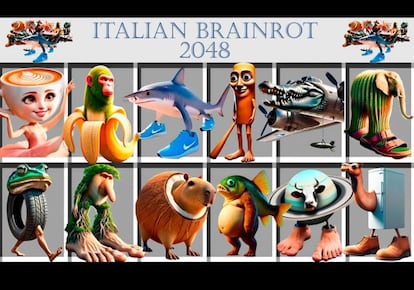
A three-legged shark wearing Nike sneakers named Tralalero Tralala; Tung Tung Tung Sahur, a stick with a face, arms, and legs holding a baseball bat; a cappuccino cup wearing a tutu and pointe shoes called Ballerina Cappuccina. They are all part of a singular family of surreal AI-generated creatures that have become the emblem of a phenomenon dubbed Italian Brainrot, which has gone viral thanks to TikTok users. A media wave — driven by Generation Z— now appears on trading cards, T-shirts, plush toys, and all kinds of merchandise, vividly illustrating the challenges creators and brand owners face in protecting their rights in the AI era.
Brainrot has quickly stormed into brand offices. The avalanche of applications threatens to trigger legal disputes over attempts to monopolize these names. For example, a European Union trademark has already been granted for “Tung Tung Tung Sahur,” and around 20 applications have been filed worldwide. Brands play with typography, colors, capitalization, and sometimes include images.
A search on TM View — an online tool that tracks designations in the EU and associated intellectual property offices — returns a total of 41 applications for “Italian Brainrot.” In August, the United States Patent and Trademark Office (USPTO) published an application for this trademark for toys, just days before a similar application (with the same name and products) was filed with its Australian counterpart.
In principle, anyone can register the names of these characters and capitalize on their popularity, but only the fastest filer in each jurisdiction will secure rights for each product and service category. The reason is that the European Union trademark systems follow the “first to file” rule, meaning exclusive rights go to whoever first submits the application to the European Union Intellectual Property Office (EUIPO), explains Enrique Jacobo, a lawyer at Elzaburu specializing in trademark and design protection.
Furthermore, applicants are not required to be the creator, since the primary function of trademarks is to indicate the commercial origin of a product or service, EUIPO emphasizes.
That said, the market is far from a free-for-all. The main limitation, Jacobo points out, is bad faith: “The law allows a registration to be challenged if it is made to harm the legitimate interests of third parties or to wrongfully appropriate preexisting rights.” Of course, the claimant must prove it.
The key question in the case of Italian Brainrot, notes Pablo López, director of trademarks and brand intelligence at Pons IP, “is whether the character names can be considered creations protected by copyright and, if so, who would hold the rights.”
The role of AI in this phenomenon, which turns the absurd into a new cultural code, can seriously hinder the recognition of authorship and, consequently, make practical control over the use of these creations impossible.
“This is a phenomenon that cannot be understood without generative AI and its ability to create on-demand content cheaply and instantly,” says Violeta Arnaiz, director of Intellectual Property, AI, and software at Pons IP. In this context, what rights can the prompters — the people giving instructions to the machine — claim? Are all contributors in the creative process considered authors? Experts agree that it is an extremely complex issue that exists in a gray area.
For creations generated by AI programs, “the key is to analyze the degree of human intervention in creating the characters and the presence of originality,” says Enrique Jacobo. The lawyer argues that prompters could have rights over the output if it results from precise instructions and creative control. The challenge will be proving it. Another factor to consider is the terms and conditions of each tool. “Many platforms include specific clauses regarding ownership and exploitation of results,” warns the expert.
Legal issues are growing due to the creative context. As Arnaiz points out, the fact that Italian Brainrot creatures were born in a collaborative environment — where users contribute ideas to the character’s narrative, music, etc. — “makes it more complicated to identify potential rights holders.”
Jorge Oria, director of legal services at ClarkeModet, takes a firmer stance. The lawyer argues that “human intervention in the process via prompts, unless there is post-editing, is irrelevant for authorship recognition.” According to Oria, the characters can be freely used and exploited without seeking approval, and subsequent adaptations cannot be restricted. The expert foresees potential conflicts over “opportunistic adaptations,” noting that eventually someone will step forward to claim authorship.
The issue is far from trivial. Should a legitimate creator manage to prove original authorship of one of these characters, “they could request the annulment of the trademark registration for copyright infringement,” says Pablo López. In that case, he adds, they could treat the character like an intellectual property franchise, licensing it out for profit, just as companies do with superheroes or cartoon mascots.
Unsurprisingly, the Italian Brainrot craze has also reached the world of trading cards and video games, where these characters already star in all kinds of adventures. Music videos featuring the characters on YouTube have received hundreds of millions of views. It wouldn’t be far-fetched to think that, sooner or later, a production company might try to ride the wave and bring this phenomenon to the big screen.
Trading cards and video games
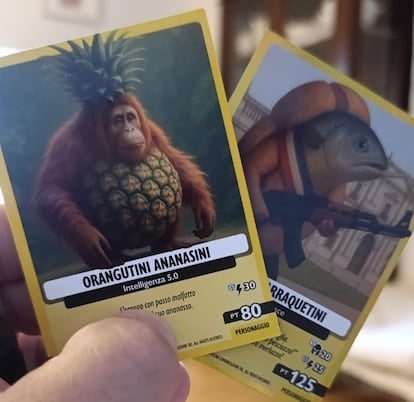
One of the first companies to capitalize on the craze has been Panini. The Italian multinational launched a trading card collection of this peculiar family under the brand Skifidol Italian Brainrot. The company is an expert at leveraging current hits. In 2022, its Iberian subsidiary came close to $100 million in revenue thanks to the success of the Qatar World Cup trading card collection, which doubled sales.
The new collection is marketed under the license “Skifidol Italian Brainrot” — displayed in capital letters and featuring the colors of the Italian flag — and was filed as a European trademark on June 30. The company notes in its advertising that the characters were created using artificial intelligence.
Another relevant case is that of the popular gaming platform Roblex, which in May of this year launched Steal a Brainrot, a game featuring characters from the saga. A recent report by Levelup noted that it broke all records, gathering over 24 million simultaneous players.
“Peaceful” coexistence and piracy
The proliferation of trademarks selling Italian Brainrot-related products can lead to commercial disputes, with applicants filing opposing claims. But Jacobo also believes that “simultaneous applications result in a peaceful coexistence of trademarks when they cover distinct market sectors.”
Brainrots are also vulnerable to plagiarism. To bring a plagiarism claim, the complainant must hold a trademark or a registered design that protects some visible aspect of this quirky universe. As Pablo López explains, “only a solid protection strategy and the active enforcement of rights by their owners can stop this kind of behavior through legal action.”
Fortunately, he adds, platforms like Amazon, eBay, and Google have fast-tracked systems for removing infringing products — or, in Google’s case, taking down the search results that link to them — without needing to wait for a court ruling. As long as proof of ownership is provided, the content can usually be removed within 24 to 48 hours.
López explains that protecting against counterfeits requires “active, ongoing monitoring of the market.” This means keeping an eye on both physical and online distribution channels and collecting evidence of possible infringements. He also advises businesses to register their trademarks in advance in key markets and to use technology that can spot unauthorized copies.
But what happens if the craze only lasts a season, and those trademarks end up unused? By law, a trademark can expire if it hasn’t been put to real, consistent use within five years of being granted or renewed. Still, as Jacobo points out, that five-year window is actually a grace period — time given to the owner to set up sales and start exploiting the brand.

Tralalero Tralala, the three-legged shark wearing Nike sneakers, is a clear example of how well-known trademarks are used in AI-generated character creation. Applicants for the new trademark must exercise extreme caution when including logos — such as Nike’s iconic tick, inspired by the wing of the Greek goddess Nike — if they want to avoid litigation. “The rights holder can oppose the registration or take legal action for unauthorized use in commercial activity,” warns Enrique Jacobo, a lawyer at Elzaburu. It is no coincidence that the shark figurines sold on Amazon feature sneakers without logos.
Not all uses are prohibited, however. “Especially when done in good faith and not for direct commercial purposes,” clarifies Pablo López, director of trademarks & brand intelligence at Pons IP. European trademark law allows the use of such marks as long as it is in good faith and “they are not used to distinguish products in the market or create confusion with the original brand,” explains the lawyer. In the case of trademarks, Jorge Oria, director of legal services at ClarkeModet, warns that “parody or pastiche are not recognized legal defenses, so reproducing a sign from a trademark — often a well-known one — without authorization remains unlawful.”
Sign up for our weekly newsletter to get more English-language news coverage from EL PAÍS USA Edition









































