
The REPAIRome: A catalog of DNA scars sheds light on a path to fighting cancer resistance
Researchers say the catalog has already led to the identification of genetic mechanisms involved in kidney cancer and will help develop personalized treatments in oncology
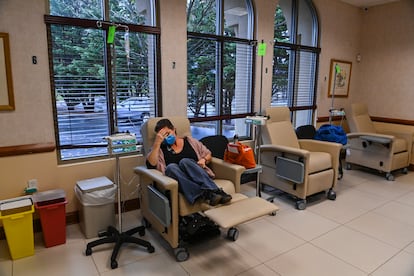

DNA is the molecule of life: this double-helix structure, present in every cell in the body and organized into fragments called genes, stores the instructions for making organisms function. It is a highly precise biological machine, but sometimes it breaks. This can happen spontaneously, due to failures in the cell’s own metabolism, or due to the influence of external agents, such as exposure to the sun, for example, or to other carcinogens like tobacco. When this essential molecule breaks, the cell must repair these breaks to survive, but sometimes, where there was damage, a kind of scar remains: genetic alterations with key information for science.
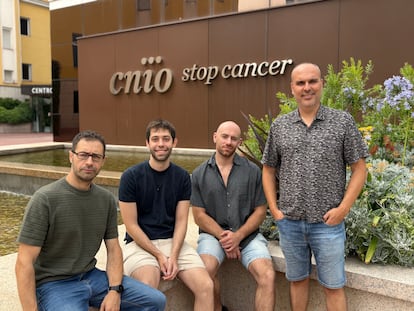
Felipe Cortés, a scientist at the Spanish National Cancer Research Centre (CNIO), explains that the cell is usually quite thorough when it comes to repairing DNA damage. Most of the time, it faithfully fixes the damage to this essential molecule, leaving no marks. However, when the repair mechanisms “make mistakes,” scars appear, a kind of mutational stitching that can reveal a lot of information about what happened there: they reveal, for example, what caused the damage, or how the break was repaired. These signals are so valuable to science that Cortés and his team have created a catalog of scars that they have called “REPAIRome”: it is an inventory that identifies how each of the 20,000 human genes affect DNA repair. According to the authors, who published their findings this Thursday in the journal Science, this list is “a platform for new discoveries.” Cortés claims that the catalog has already allowed researchers to identify genetic mechanisms involved in kidney cancer and will help develop personalized treatments in oncology.
The researchers focused on a specific type of DNA damage, which occurs when the characteristic double helix breaks. This damage can be caused by a random error in DNA replication, but also by external factors, such as exposure to X-rays or drugs. Chemotherapy and radiation therapy, for example, kill tumor cells by causing this type of break.
Sometimes, the authors explain, cancer therapies that target malignant cells by breaking their DNA fail because the tumor cells learn to repair the breaks caused by these drugs, and the cancer becomes resistant to the treatment. Researchers believe that DNA repair mechanisms are key to tumor development and believe it is essential to understand how malignant cells repair these DNA breaks and also how this repair can be prevented.
“This catalog will be useful to search for potential tumor vulnerabilities, but it can also help us predict how they will evolve, what types of mutations they will accumulate, and detect potential future resistances,” predicts Cortés, head of the CNIO’s DNA Topology and Breaks group and lead author of the study, along with researchers Ernesto López de Alba, Israel Salguero, and Daniel Giménez.
To build this catalog, the scientists took into account an important fact: that the pattern of scars left in the DNA after repairing the double helix break changes depending on which genes are missing or present in the cell. So they generated around 20,000 different cell populations, as many as there are human genes, and switched off a different gene in each one; they then caused breaks in all of them and observed the mutational imprint the cell left behind when repairing the damage. “This way, we identified how the absence of each of the 20,000 human genes affects scars,” Cortés points out.
There are genes more involved than others in this cellular repair machinery, the CNIO researcher points out: “What we’ve seen is that, in many cases, you remove one of those 20,000 genes and it has no impact. It continues to repair itself exactly the same. But we’ve also been able to identify cases in which, in the absence of a particular gene, that scar changes. And what does that tell us? That these are genes that influence how the cell will repair that tear, and we can also infer how [that gene] is contributing to the repair.”
To illustrate the findings, Cortés makes an analogy with a toolbox: “All your genes are the tools in the box. Imagine we have to do some work on a house, and we remove all the tools from the construction worker’s box, one by one. And then we see the final result. From the result, we can infer what tools were needed and what each one was used for.”
Abel González-Pérez, an associate researcher at the Biomedical Genomics Laboratory at IRB Barcelona, points out that the study of DNA alterations is “essential” to understanding, among other things, processes such as the development of tumors or the mechanisms of other diseases. This scientist, who was not involved in the research, underscores that the authors have addressed a type of alteration that has been less studied, and also underlines the importance of one of their findings: having identified “a few genes whose involvement in DNA double-strand break repair was not well validated or was previously unknown.”
Free access to the scientific community
The authors have made their REPAIRome available to the scientific community, and Cortés anticipates that it will be a key platform for new discoveries. For now, he says, they have already discovered that a scarring pattern found in kidney cancer is associated with the lack of a specific gene. “From a mechanistic perspective, this catalog will allow us to identify new genes involved in the repair of previously unknown DNA breaks. But we may also find an explanation for scarring patterns that had been associated with certain tumors,” he explains.
Another field in which they hope REPAIRome will contribute is genetic editing: techniques such as CRISPR-Cas, akin to molecular scissors, are based precisely on inducing breaks to cause specific changes in DNA, and the authors believe that delving deeper into how these repair mechanisms operate will help optimize genetic editing tools.
Cortés once again summarizes his entire work with another analogy, in which genes are the items in a medicine cabinet: “We remove each of these components. The medicine cabinet is used to treat a wound, and we see what characteristics the scars have depending on what was missing from the medicine cabinet. This way, we can identify which components of the medicine cabinet are important for healing wounds, infer what they are specifically used for, and which components serve the same purpose. As an application, you can see which components you need to eliminate so that the wound cannot heal (cancer treatment) or so that it heals leaving the scar you want (gene editing control).”
Sign up for our weekly newsletter to get more English-language news coverage from EL PAÍS USA Edition









































