Durotaxis: A new therapeutic target against metastatic cancer is discovered
A team of scientists describes how malignant cells use ‘highways’ of hardened tissue to spread to other organs, and how blocking two proteins can stop them
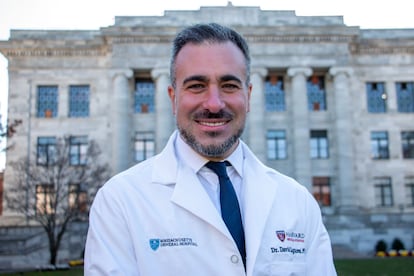

For centuries, doctors have known that an increase in the stiffness of an organ when palpated can be the first sign of a tumor, explains the biochemist and entrepreneur David Lagares. Now, his team has just demonstrated that this rigidity is not just a diagnostic sign, but is essential for metastasis: the spread of tumor cells to other organs, which is responsible for nine out of 10 cancer deaths.
Rigid tissue structures emerge around tumors, functioning as “authentic exit highways,” explains Lagares, who was born in Madrid, Spain 43 years ago. Cancer cells manage to anchor themselves to these pathways, gain traction, and escape to other organs. The team of scientists led by Lagares in the United States has identified that these highways function like a GPS that guides tumor cells, promoting their spread and progression. This is a process known as durotaxis, a Latin term meaning motion by hardness.
The team has shown that this biomechanical process is mediated by two proteins, FAK and paxillin, which act as mechanosensors of the stiffness of the surrounding tissue. If the interaction of these two molecules is blocked, cancer cells lose the ability to sense stiffness.
The researchers grafted pancreatic tumors from human patients into mice and then blocked the interaction of the two proteins. This completely halted metastasis to other organs. “We have seen that at the onset of metastasis, the first process that induces tumor migration is clearly durotaxis due to the rigidity of the cellular matrix,” explains Lagares. When this process is interfered with by blocking the interaction of the two aforementioned proteins, “the mechanical GPS is deactivated.” “The cells cannot leave the pancreas because durotaxis is not activated. The consequence is that metastasis to the liver is completely mitigated,” he adds.
Researchers have discovered an experimental drug, JP-153, that blocks the interaction of the two proteins. For a year and a half, Lagares has paused his work at Harvard and MGH to lead his company, Zenon Biotech, which hopes to begin the first clinical trials in pancreatic cancer patients within three years. “There is a tremendous clinical need in pancreatic cancer, in part because of this scaffolding, this tumor microenvironment filled with scar tissue, or hardened tissue, which makes chemotherapy ineffective and immunotherapy less than 1% effective,” he emphasizes. The results of the work have just been published in the journal Nature Cell Biology.
After 15 years of studying this biomechanical phenomenon at Harvard University and Massachusetts General Hospital (MGH), Lagares believes this opens a new dimension in understanding and blocking the spread of cancer, not so much through biochemical processes as until now, but rather through others based on the very physics of cells, or biomechanics. The researcher believes durotaxis probably exists in all solid tumors that generate this rigid barrier around them, including those of the breast, ovary, liver, and lung.
In the same study, the team demonstrated that durotaxis also plays a role in another condition characterized by scarring, idiopathic pulmonary fibrosis. In this case, the hardened cellular scaffolding acts as a highway into the lungs, causing cells that were meant to reach the lung to repair scarring to instead cause and expand the lesions.
This phenomenon, also due to durotaxis and controlled by the FAK–paxillin complex, opens the door to a new therapeutic strategy. Blocking this interaction with an experimental drug in preclinical models prevented fibroblast recruitment, reduced lung stiffness, and reactivated the lung’s self-repair capacity, with strong evidence of regenerative processes in mice.
Xavier Trepat, a researcher at the Institute for Bioengineering of Catalonia, explains: “Durotaxis, discovered in 2001, was a revolutionary discovery. It gave us the first clue that cells can detect and respond to their physical environment—in this case, the rigidity of their surroundings—and not just the chemical one, as previously believed.”
“Over the next 25 years, I think we’ve developed a good understanding of the underlying mechanisms, but most of the evidence comes from in vitro studies, in the laboratory. This new article demonstrates the importance of durotaxis in cancer and fibrosis in living animals, something we suspected was happening but weren’t sure about,” adds the researcher, who in 2016 published a key study in Science that showed the movement of groups of cells over long distances promoted by durotaxis.
University of Barcelona biophysicist Raimon Sunyer Borrell, co-author of that study, believes that Lagares’s new work represents “a turning point.” “The hypothesis was that these differences in stiffness acted as beacons that attracted fibroblasts or tumor cells to the stiffest regions, thus worsening the disease,” he explains. “This new research not only confirms that durotaxis is a key process in the development of these diseases, but also opens a new therapeutic avenue: stopping durotaxis could become an innovative strategy to halt serious diseases such as fibrosis or metastatic cancer,” he adds.
Daniel Lietha, from the Center for Biological Research (CSIC) in Madrid, believes that “it’s a very interesting study. Durotaxis is clearly very important in aggressive cancers, during invasion and metastasis. Although it’s not exactly a new idea, as its importance had already been seen in live animals in 2009, very important new information is now being presented,” he adds. But the researcher points out that more information is needed to demonstrate that the drug will work exactly as intended, blocking the two proteins involved in durotaxis.
Sign up for our weekly newsletter to get more English-language news coverage from EL PAÍS USA Edition