
The odyssey of three women and BO-112, the molecule that tricks cancer
A leading scientist, a businesswoman and a disease-free patient come together to tell the full story of the promising experimental Spanish tumor drug
Juana Santiago vividly remembers the day at the beach when her daughter stared at her and exclaimed, “But Mom, how awful! What is that?” Juana’s wet hair had parted, revealing strange spots on her scalp. Her dermatologist knew what they meant as soon as he saw them: melanoma. Metastatic melanoma.
It was 2017. Juana, a finance professor at Camilo José Cela University in Madrid, turned to her doctors for cancer treatment. But the worst news came soon after: Nivolumab — a drug that has saved hundreds of thousands of lives — wasn’t working for her. The tumor continued to spread across her scalp, despite 15 surgeries and a massive skin graft from her arm.
Eight years later, on a summer day in 2025, Juana walks through the halls of the Spanish National Cancer Research Center (CNIO) in Madrid. She stares, entranced, at the bland cover of a scientific journal hanging on the wall. It touches on the discovery that has led to her being cancer-free for almost two years.
Biologist Marisol Soengas, head of the CNIO Melanoma Group, speaks with frustration about the days when people went to the beach covered in carrot oil, without any sunscreen. Melanoma used to be a rare disease, but the now-fashionable tanning trend has caused cases to skyrocket, especially among people with fair skin. Over the past two decades, the incidence in Spain has risen from 12 to 15 new cases per 100,000 people per year. The World Health Organization expects around 100,000 deaths worldwide by 2040… almost 70% more than this year.
Melanoma is a cancer that begins in melanocytes — the cells that produce the pigment that gives skin its color. “Brown is a response to damage,” the biologist warns. She was born 57 years ago in A Aldea do Monte, a town of just 25 inhabitants in the northwestern province of Pontevedra.
Soengas’s group made a momentous discovery in 2008. Her team was testing a multitude of chemical compounds to see if any would get cancer cells to digest themselves, a phenomenon known as autophagy. One day, a tireless postdoctoral researcher, Damià Tormo, came to Soengas’s office and excitedly announced that one of the compounds had worked. It was BO-110, a synthetic RNA molecule that mimics the genetic material of many viruses. The compound tricked tumor cells into believing they had been infected by a virus. It induced their self-digestion, while also attracting the attention of the body’s defenses. On August 4, 2009, when half of Spain was at the beach or in the pool getting a tan, the discovery was published on the cover of the specialized peer-reviewed journal Cancer Cell.

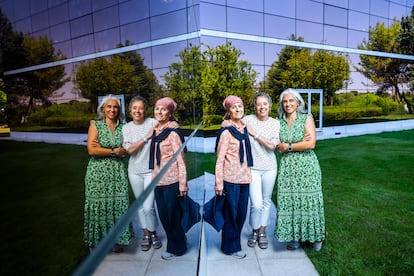
Juana Santiago and Marisol Soengas have teamed up to tell their story to EL PAÍS for the first time, alongside Marisol Quintero. She’s the pharmacologist who leads Highlight Therapeutics, the company that was created in Paterna, Valencia, to develop the experimental drug. It’s a venture with very few precedents in Spain. The company has already secured approximately €45 million in funding ($52.5 million) and has achieved promising results in seven clinical trials, with more than 150 participants afflicted with different types of cancer.
Soengas’s office is illuminated by large windows. It has spectacular views of the Cuatro Torres skyscrapers on Paseo de la Castellana, a major thoroughfare in Madrid. And it’s also filled with trophies, such as the Fritz Anders Medal, which is given to outstanding scientists conducting melanoma research. “I’m very proud of [my] awards, but the most exciting thing has been meeting Juana. When I was five years old, I already wanted to be a scientist… but I never would have thought that my results would reach a patient,” Soengas says. A year ago, she, too, announced that she had a tumor: it was breast cancer. The researcher, like her patient, has also been responding well to treatment.
The biologist dizzily recalls the day in 2010 when she and Damià Tormo went to a notary’s office to create the company, which was initially called Bioncotech Therapeutics. It was split 60% for him and 40% for her. It was the first company to emerge from the CNIO. Soengas recalls with a laugh that they resorted to “funding from the three Fs” — friends, family, and fools (the latter a reference to intrepid investors who back fledgling projects).
One of those madmen was Madrid-based mathematician Javier García Cogorro. At the time, he was vice-president of the American pharmaceutical company Eli Lilly. In 2016, García Cogorro and Damià Tormo founded Columbus Venture Partners, a fund that invested in 50 biotechnology companies and has since grown to exceed $550 million worth of advanced therapies and related infrastructure.
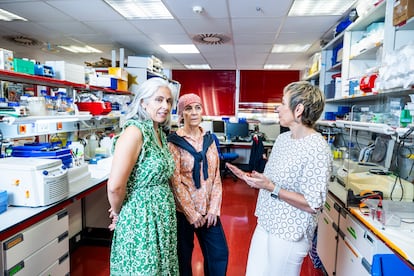
Juana Santiago, a 69-year-old Madrid native, listens to the story of the birth of Highlight Therapeutics with obvious personal — but also professional — interest. She teaches entrepreneurship, business and technology at Camilo José Cela University, a private institution in Madrid. In her faculty, years ago, she met an economics professor named Pedro Sánchez Pérez-Castejón; now the prime minister of Spain.
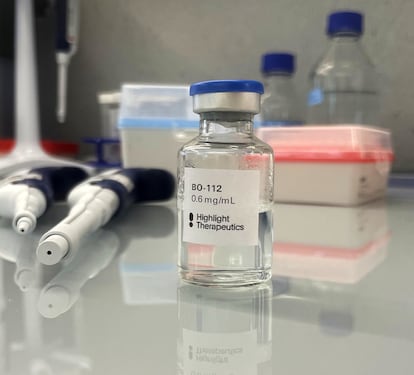
In October of 2020, Juana — who was already concerned about the lack of alternatives for treating her metastatic melanoma — read a story in a newspaper that changed her life. The Gregorio Marañón Hospital in Madrid had led a clinical trial of a molecule with the potential to reverse cancer resistance to immunotherapy. It was BO-112, the refined derivative of BO-110.
There’s fear of clinical trials, when it should be the other way around, because you have the possibility of accessing an innovative treatment.Marisol Soengas, biologist
In 1992, one of the fathers of immunotherapy, Japanese scientist Tasuku Honjo, discovered a human protein that acts as a brake on the body’s defenses: PD-1. By removing this natural containment — through PD-1inhibitor drugs, such as Nivolumab and Pembrolizumab — the immune system itself attacks cancer cells more aggressively and eliminates them.
Honjo would go on to win the 2018 Nobel Prize in Medicine. However, these treatments aren’t a panacea. Approximately half of melanoma cases with metastasis are resistant, including Juana Santiago’s tumor.
In the newspaper, the business professor read that the trial had been conducted on 28 patients — each suffering from either melanoma, lung cancer, or kidney cancer — in whom previous immunotherapies utilizing Nivolumab or Pembrolizumab had failed. The doctors then added BO-112, with doses injected directly into the tumor, an ideal delivery method for the skin. The combination of BO-112 and immunotherapy stabilized the disease in 10 participants and achieved remission in two patients with advanced melanoma. The trial’s co-director, oncologist Iván Márquez, stated: “This intratumoral treatment strategy with BO-112 — if the results are confirmed in larger studies — could help reverse primary resistance to immunotherapy.”
Juana Santiago saw an opportunity. She told her doctors. And, after insisting, she narrowly made it into the next clinical trial.
Soengas applauds the professor’s tenacity and courage. “There are many patients who are worried when they hear about a clinical trial. Many people think: ‘But how are you going to test something on me?’ They’re afraid of the concept of a trial, when it should be the other way around, because you’re getting the opportunity to access an innovative treatment,” the biologist emphasizes. In the European Union, Spain is the leading nation when it comes to researching experimental cancer therapies, with 350 ongoing trials. Soengas herself is a volunteer in a breast cancer clinical trial.
Oncologist Ilyas Sahin, from Massachusetts General Hospital, celebrated the results on social media: “This combo may help restore immune response in hard-to-treat patients.”
Soengas repeatedly laments “how difficult it is to set up a company like this in [Spain].” Marisol Quintero, born in Valencia 46 years ago, went from being the director of innovation at the CNIO to the CEO of Highlight Therapeutics in 2013. Under her leadership, the company became more professional. Today, its main investors are the Spanish fund Columbus VP, the British fund Advent Life Sciences, as well as the Belgian fund Droia. Several prominent families across the Mediterranean are also contributing money. “They have a three-pronged motivation. On the one hand, it’s clear that this is an investment, not a donation. But it’s an investment in an area that they consider very important: many people have a family member with a tumor and want to contribute to a treatment. And, on the other hand, there’s the proximity, the desire to participate in the development of a drug,” Quintero explains.
Spain’s Ministry of Science has provided €3 million to help fund the seventh clinical trial of BO-112, this time as a possible treatment for basal cell carcinoma. This is the most common cancer, which usually appears in sun-exposed areas of the skin, such as the face. There are more than four million new cases worldwide each year. Oftentimes, this tumor can easily be removed, but “it can’t always be removed surgically and it can be very disfiguring,” Soengas warns.
Both BO-112’s mother and Juana Santiago have to go to a dreaded medical checkup every three months: one for her breast cancer and the other to monitor her (seemingly) disappeared melanoma. “I don’t think you ever get used to that uncertainty [or] the fear… but when the checkup goes well, it’s another boost of energy,” Soengas says. Juana, by her side, has been disease-free since December of 2023, without any need for treatment. She’s optimistic: “I feel completely cured.”
Sign up for our weekly newsletter to get more English-language news coverage from EL PAÍS USA Edition









































