
Refilling the Aral Sea: A Spanish scientific proposal to avoid releasing millions of tons of CO₂
Researchers suggest in an article in ‘Science’ financing lake restoration with carbon credits
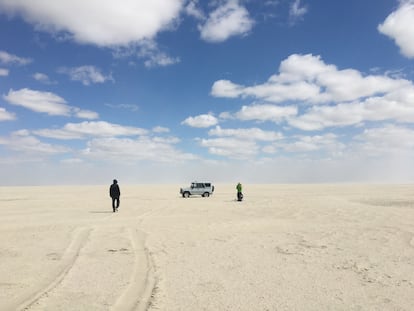

The drying of the Aral Sea, between Kazakhstan and Uzbekistan, is one of the largest agricultural-driven ecological disasters in history. It was the fourth-largest lake in the world until the early 1960s, when it began to shrink after river water was diverted for cotton cultivation under the then–Soviet Union. A study led by Spanish researchers published July 16 in the journal Science finds that its present dry bed is also a significant source of the CO₂ driving climate change. Since 1960, the authors estimate it has released 748 million tons of CO₂, the equivalent of one year’s emissions from Spain, France, and Belgium combined.
This is such a large amount of greenhouse gases that it upends emissions accounting for this part of Central Asia and is being reproduced in many other drying wetlands worldwide, such as the Great Salt Lake or Salton Sea (U.S.), Lake Urmia (Iran), Lake Chad (Chad), Lake Poopó (Bolivia), Mar Chiquita lagoon (Argentina), Lake Rukwa (Tanzania)… “And the Caspian Sea, which is going to be a catastrophe,” says Rafael Marcé, a researcher at the Blanes Center for Advanced Studies (CSIC) and an author of the study. “These ecosystems are disappearing across the world and nobody is paying attention,” the scientist stresses. “The entire northern Caspian Sea is going to dry up, including the Volga delta; it will be about four times the area of the Aral Sea,” he adds.
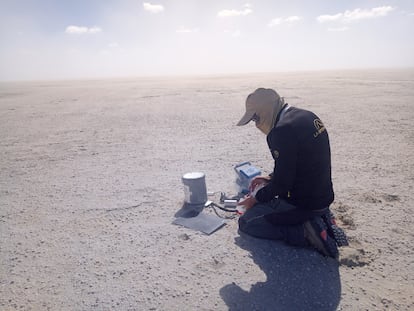
Measurements taken by the Spanish team in the saline desert that the enormous Kazakh–Uzbek wetland has become do more than question emissions accounting in the region or reveal the limited gas uptake of revegetation efforts there — they even open a route to fund its refilling.
The scientists estimate that another 605 million tons of CO₂ (more than twice Spain’s annual emissions) could still be released from the Aral Sea and propose that this not-yet-emitted quantity be converted into tradable carbon credits worth between €3.1 billion and €15.8 billion ($3.55 million-$18.07 billion) — the wide range reflects that carbon credits have no fixed price. This mechanism would allow companies to pay to prevent emissions from the Aral Sea and, in return, offset emissions they themselves produce elsewhere in the world.
That would secure international funding to cover the high costs of returning water to the ecosystem. “For decades we’ve been looking for solutions for the Aral Sea and haven’t found them. Well, now we have this capitalist instrument,” Marcé says. “You may be in favor of it or not — I’m not entirely convinced — but it’s there. In fact, on paper, if well used, it would be great.”
Lakes are usually CO₂ sinks: they retain atmospheric carbon that vegetation absorbed through photosynthesis, which then becomes deposited in sediments after being carried there by river networks. However, when these wetlands dry out, the exposed bed becomes a source, the exact opposite. As the Blanes Center researcher explains, removing the water is like pulling a plug because the water had been isolating the sediments from atmospheric oxygen. “When the water layer is gone, oxygen penetrates the sediments and wakes the microbial communities, which immediately begin to degrade the accumulated organic matter,” the scientist says. It is in that degradation process that CO₂ is released.
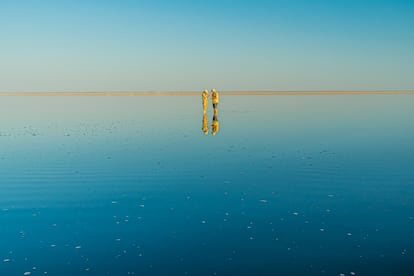
His research team has been studying these carbon-cycle processes in drying waters — rivers, lakes, reservoirs — for 15 years. The scientists began with reservoirs, small lagoons and rivers and thought their work would never attract much attention, until one day in 2016 when a news item changed their perspective entirely. “I remember exactly the moment the light went on,” the researcher says.
He recounts that they were on a bus heading to catch a flight when he picked up a free newspaper reporting the disappearance of Lake Poopó in Bolivia. “We thought: wow, this is what we do here on a small scale, but this is hugely relevant for emissions and nobody is looking at it.” They realized they had to think bigger and ended up studying the largest desiccated lake in the world, the Aral Sea.
To study the carbon balance from the wetland’s drying, they organized an expedition in 2022 to the area, now a desert where less than 10% of the lake remains. “Obviously, we cannot get a time machine and measure from when it began to dry in the 1960s,” Marcé explains.
But the drying process left marks on the bed. Instead of traveling back in time, they drove and took soil samples as they moved toward the center of the former wetland, following how the lake receded. They then analyzed the samples in the laboratory and found that beds that dried more recently retain far more organic carbon than those that lost water in the 1960s. That allowed them to estimate the CO₂ emitted since then and what remains to be released.
One striking element of the study published in Science appears when the scientists plug their numbers into emissions accounts for this part of Central Asia. Large tracts of arid land transformed into croplands are often treated as sinks today. However, when those same irrigated areas are linked to the emissions released by the lake that those rivers once fed (since they use the water from the rivers that emptied into it), the balance changes completely: they no longer subtract emissions; they add them.
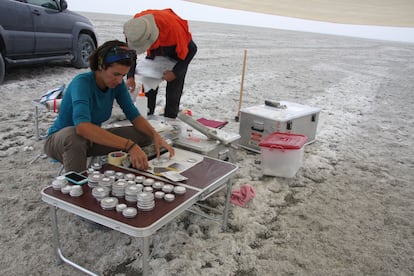
Meanwhile, the study led by the Blanes Center, which also includes researchers from Russia, France, Germany and other Spanish institutions, confirms the low CO₂ uptake of revegetation projects in the area. “We show that, at least in these ecosystems in arid zones, planting vegetation — which is what is being done in the Aral Sea — is useless,” Marcé emphasizes, insisting that the only way to stop the emissions is to re-cover the area with water.
Although full restoration of the Aral Sea remains an immense technical, social and political challenge, the researchers draw on other scientific work that says it is possible, mainly by modernizing the inefficient irrigation network in which 90% of the water is lost. The study estimates that an investment of about €8.5 billion ($9.72 billion) in improved water-resource management would allow restoration of roughly 50% of the lake’s 1960 surface, while at the same time generating some 323 million tons of CO₂-equivalent in tradable carbon credits.
Scientists often criticize the lack of rigor in using such credits to fight climate change, citing projects that, for example, aim to save forests that were not actually threatened. Nevertheless, the authors of the Science study argue that in this case it would be fully justified to try the system. “Here the science is robust and we want to put the conversation on the table,” Marcé says. “What do we do — do we try?”
Sign up for our weekly newsletter to get more English-language news coverage from EL PAÍS USA Edition









































