
Basel Adra, Palestinian filmmaker and Oscar winner: ‘Israelis don’t see us as human beings’
The director of the documentary ‘No Other Land’ took part in a cultural event in Madrid and explained how Israeli violence in the West Bank has increased after he won the statuette
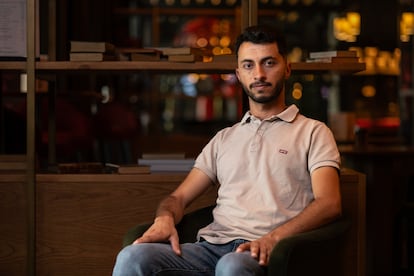

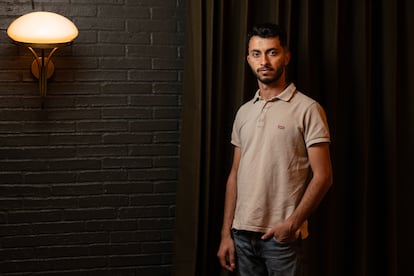
Wednesday morning at a Madrid hotel. Palestinian filmmaker Basel Adra, an Oscar winner for the documentary No Other Land, turned 30 on Monday after waiting hours in queues at border crossings and passing through checkpoints (“It’s inhuman, it’s another tool against Palestinians,” he says) in order to take part in the Ministerial Conference, co-organized by the ministries of culture of Spain and Palestine, which opened at the Museo del Prado on the afternoon of July 15 and where more than 30 international delegations will sign a declaration for the reconstruction of Palestinian culture. Thanks to his statuette and the trajectory of his film, Adra is one of the most visible faces among artists inside and outside his country, and he still lives in the village where he was born, Al Tuwani, a hamlet in Masafer Yatta, a harsh area of the southern West Bank depicted in his film. “They recognize me at every Israeli checkpoint, that scares me,” he explains. Serious — although he will smile when soccer or his 18-month-old daughter is mentioned — and accompanied by his wife, Adra sits down to talk. He makes only one request: that the chosen table be in the quietest area because he speaks softly and in a low voice.
Question. How is your family?
Answer. Physically fine. I have a one-and-a-half-year-old daughter, and she’s fine.
Q. What is your day-to-day life like?
A. It’s not easy to live in our communities. You can plan something for the next day, and suddenly Israeli forces arrive with bulldozers or settlers, and then your day changes. For example, I might plan to go to the city with my family, but we get up in the morning, something happens and the whole day is lost. So our daily life really depends on what is happening each day, on what they do to us.
Q. What do you expect from the Ministerial Conference?
A. I hope more attention is paid to Palestinian culture. That Palestinian artists and culture receive genuine support and backing from the international community; not just pity, but real assistance. That could help more filmmakers and artists show their work to the world. So we hope Palestinian artists find solid backing at that meeting.
Q. Do you feel Spain supports the Palestinian cause?
A. Absolutely. Both the government and ordinary people. For example, I remember a footballer did something small with a flag and caused a huge stir [he is referring to Lamine Yamal, who waved a Palestinian flag in May during FC Barcelona’s victory parade after winning La Liga]. Israeli ministers and officials had to comment on it, which drew even more attention.
Lamine Yamal 🇵🇸 💙 ❤️ 💛 https://t.co/pSoXggWDNR pic.twitter.com/BpyuA2CNKC
— State of Palestine (@Palestine_UN) May 11, 2026
Q. Europe is more hesitant…
A. We hope Spain doesn’t change because, you know, in Europe and other countries it’s easy to get support at first, but after a while the government changes or people within the government itself — as has happened in Sweden — change their minds and stop supporting the cause or even turn against it. The Israeli lobby always finds a way to influence official policies.
Q. Your father already had a camera with which he filmed both your childhood and attacks by settlers and Israeli forces. Is the documentary No Other Land — which portrays the daily struggle of Masafer Yatta families facing demolitions and forced displacement — the result of a legacy?
A. Not exactly. In my community, the camera arrived at the start of this century. It wasn’t common, it was unique, unlike today.
Q. Did you use it as a defensive tool?
A. Yes. My father and other people recorded those images. It wasn’t just him. There were others in the community who were learning and filming, as well as international activists. So we have a very large archive because many people have been filming in the West Bank for two decades.
Q. Do you feel a responsibility?
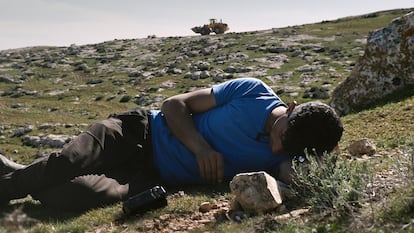
A. I feel a constant responsibility. Not only to bring my community’s story to film, but also to speak about it and try to help, you know? Filming and publishing is no longer enough; I have an even greater responsibility than before No Other Land.
Q. Are you shooting another documentary?
A. No, it’s a short animated film about movement restrictions in the West Bank. I’m making it with an Argentine animation production company. I found the company through friends in the U.S. I do it from my village and they do it from there. And the topic is a bit too complicated and dangerous for a documentary: if I wanted to shoot that film passing through checkpoints and filming with cameras, I would be in great danger… because of the Israeli soldiers and all that.
Q. What do you think of calls from filmmakers around the world to boycott Israeli artists and companies linked to their government?
A. That’s not an easy question because I work with filmmakers. For me it’s quite simple: those who publicly support, endorse and back the regime, the apartheid and all the atrocities committed by Israel, should be boycotted. You can’t accept people who support what their regime did in Gaza, the West Bank, Lebanon, or Syria. It’s not normal, you know? But I think those who raise their voices and defend humanity and international law should not be boycotted.
Q. Very few Hollywood stars, such as Javier Bardem or Mark Ruffalo, have dared to support Palestine. Do you understand that fear?
A. I don’t think this happens only in Hollywood. It happens in many other places around the world. People fear for their jobs, for their income, for their positions. They’re afraid of losing their work and, in other places, of course they fear for their safety. The Israeli regime has the backing of powerful regimes around the world; governments with great wealth and power that, in my view, lack moral standing. That’s why it’s understandable that people fear for their safety and salaries. We greatly value those who speak out against what is happening, and we always encourage others to overcome that fear and join the cause. However, it’s striking how fear takes hold of people who work in the film industry. They control your voice; they condition what you’re allowed to say and which topics you can make films about. Or even which films you can watch. For example, our film still hasn’t secured distribution in the United States.
Q. What do you remember about holding the Oscar in your hands?
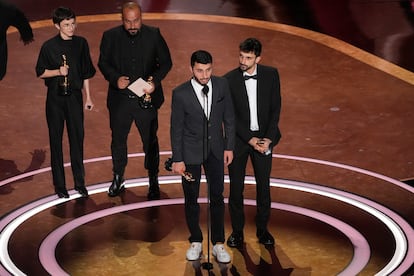
A. I knew that even if I won the statuette, I would return to my reality, because since we won the award for best documentary at the Berlinale in 2024 there had been a lot of uproar around the world. And things did not change; on the contrary, they got worse. On the other hand, there was what was happening in Gaza: people saw on their phones what was happening, but the genocide did not stop. I was firmly convinced while working on the film that when it premiered people would do something. I believed people simply did not know what we were going through. And I had a very unpleasant feeling when I discovered that this is not true, that people do know and see what we are suffering, and simply let it happen.
Q. Do you think a documentary can change the world?
A. No, I think it changes people. I’ve been to movie theaters and screening rooms many times, and I see how No Other Land affects the audience sitting there. I inform people about what’s happening. That’s why I also know it’s an educational film for people who don’t have a firm stance or who are unaware of what’s happening to the Palestinians: they’ll learn from it.
Q. With Donald Trump and Benjamin Netanyahu in charge, can one still be optimistic about the future of Palestinians?
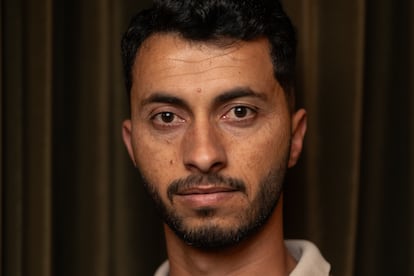
A. No, and regarding Israelis, it’s not only Netanyahu, the national security minister, Itamar Ben-Gvir, the finance minister, Bezalel Smotrich, or the settlers. Netanyahu, Smotrich and Ben-Gvir were elected by the people, and I believe they represent the majority of Israelis. For me, the problem is Israeli society. Even before [the Hamas-led attacks on] October 7 we lived under occupation, but Israelis in Tel Aviv lived their normal lives; the money from their taxes went to the settlers, to the settlements, and to the army, which killed Palestinians, although in smaller numbers than after October 7. But they do not see us as human beings. That’s why they accept the occupation and cannot claim ignorance; we live in the same territory and they cannot say they didn’t know what was happening. And now I think they have reached their worst moment in terms of racism and tolerance of the crimes committed against us Palestinians. So I don’t think change will come through elections in Israel or the United States. Europe must assume its responsibilities; to this day Europe, including Spain, allows products from the settlements to enter. Stopping that would be a small step toward change, although they aren’t even willing to do it. So what’s the point of speaking publicly about morality, international law, democracy, etc., if your actions say otherwise?
Q. As you said earlier, after the Oscar, Israeli attacks on your village increased. When was the last one?
A. This very morning they attacked the village of Susia in Masafer Yatta. I saw many people wounded, with bleeding injuries to the head and chest. Members of that family had already suffered attacks last March. Settlers came to their fields with their livestock; they called the police and the army to evict them, but no one came. The family decided to drive the animals away from near their homes; then two settlers, one of them in uniform, got out of their SUV, began shooting at the family and killed a man and wounded his brother, who has been left partially paralyzed. It was a nightmare and it still is. The killed man was 28 and had a wife and two daughters. And demolitions have increased with total impunity.
Q. You yourself suffered a raid at your home a month ago, didn’t you?
A. Yes, they entered at night and searched it. They even looked through my wife’s phone. And two months ago, settlers came to the house at four in the morning and smashed the cars of some activists parked in front of my building. I feel fear. But, to be honest, it’s a feeling all Palestinians share today.
Sign up for our weekly newsletter to get more English-language news coverage from EL PAÍS USA Edition









































