
Lamine Yamal: ‘I see myself as much better than how people see me’
Spain’s 18-year-old soccer star reflects on his journey from Rocafonda, the importance of being confident and the sacrifices behind his success
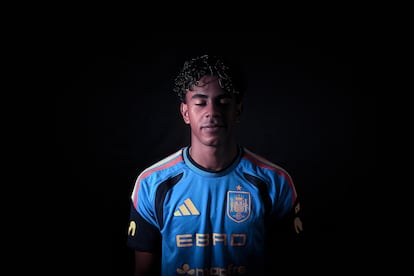
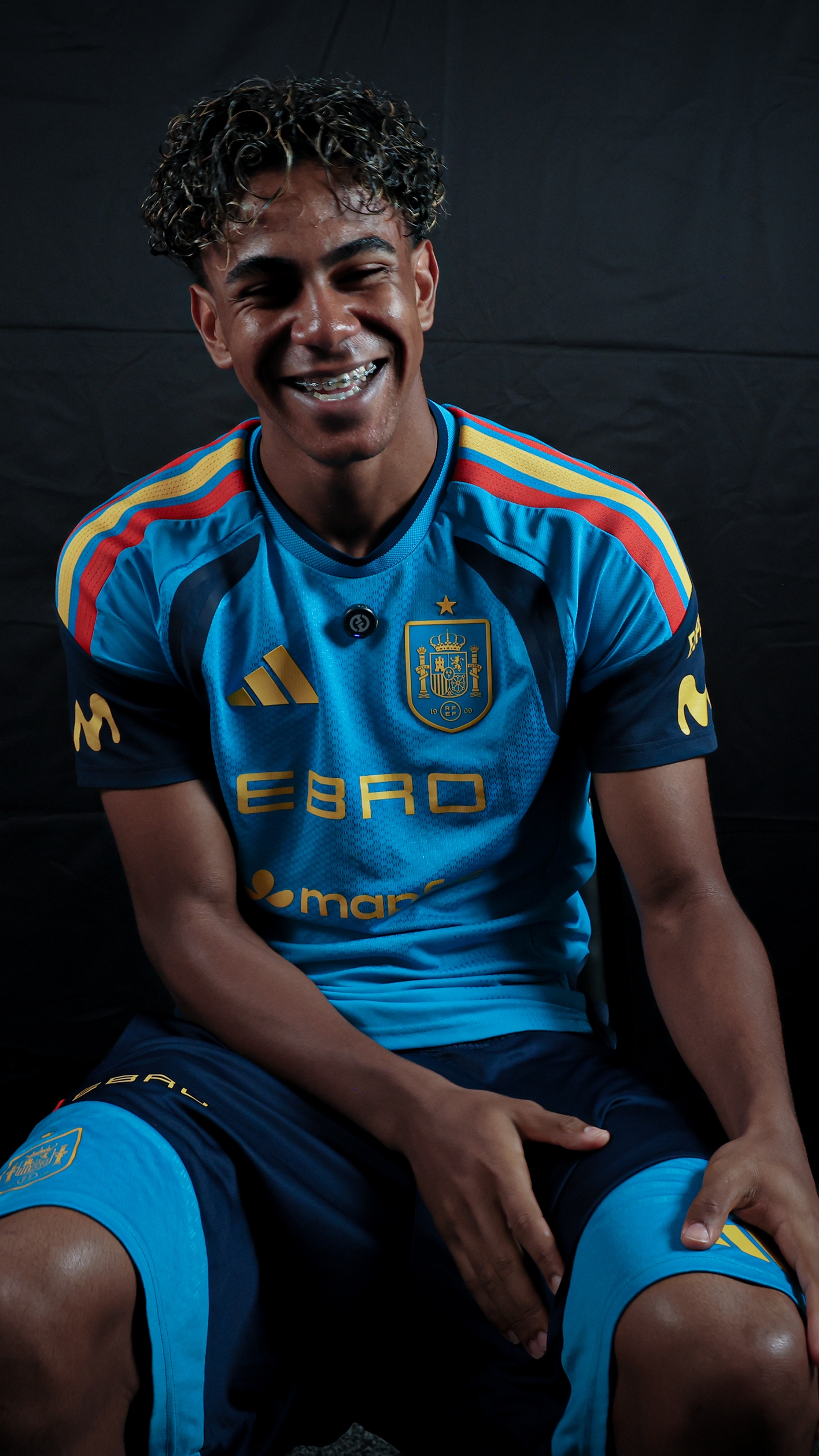
His father is from Morocco; his mother is from Equatorial Guinea. He was born 18 years ago in the tough Barcelona neighborhood of Rocafonda, and for the past three years his name has been making waves in soccer. His name is Lamine Yamal. A product of the streets and the academy, he has reached global fame — you only have to travel across Europe, and now also the United States, to see it. When he appears in the Spain training camp press center in Chattanooga to speak with EL PAÍS, he commands the room much like he does on the pitch.
He is cheeky and playful, intelligent and determined. And he seems unbothered by being labeled arrogant — he even appears to enjoy it. He takes a few seconds to think through each answer. At times more reflective, at others more impulsive, always natural. And approachable. He does not hide his past, nor his future — at least as he imagines it. And he knows he is central to Spain’s national team, which needs his talent to shake off the slight trouble it got into after drawing its opening match against Cape Verde at the World Cup in the United States, Mexico, and Canada.
Although he admits that his physique still wouldn’t hold up for a full match, Lamine scored the opening goal in Spain’s 4-0 win over Saudi Arabia on Sunday. Within the national team camp, confidence is high. Lamine, of course, feels the same. It’s in his nature.
Question. What is your first memory of a World Cup?
Answer. The 2014 World Cup. My mother was working and came back for the second half of Colombia-Uruguay, the match when James [Rodríguez] scored. She arrived, and we finished watching it together. Now she is here with me. She cried when I debuted. I told her, “How life changes…” My first World Cup memory is with her, and now we can experience it this way. It’s something I had dreamed of, but never this soon.
Q. Looking back, how important were your parents’ efforts in getting you to this point?
A. What my mother has done, what my father has done — I couldn’t have done that for anyone who was not my child. I’ve come to understand that only parents can make that kind of effort. To begin with, if you think about it, if you don’t have money, it’s very hard to get your child to play soccer. If you don’t have money, it’s very hard to give them a gift on Three Kings Day. When you don’t have money, many things are difficult. And my parents managed to make all that happen. I played soccer. I got gifts on Three Kings Day. It’s something I’ll never be able to repay them for.
Q. How do you process such a rapid change — from a modest life, with some hardships, to one of luxury?
A. I think there are two ways to see life. There are people who live a normal life and then move into luxury slowly. And then there’s me, who believes you should enjoy it. I think people overthink: what happens if I do this, what happens if I meet this person, what happens if this relationship ends, what happens if I buy this and then don’t want it. I think when I’m older I won’t spend all the money I make. I’ll be able to leave something to my children and, at the same time, enjoy life. Because you have to enjoy life.
Q. What do you mean by enjoying life?
A. Anything I feel like doing — since I couldn’t do it when I was little, I’m going to do it now, without worrying that it might be too much. Because I’ve earned it. I had nothing, and everything I have I’ve earned by playing soccer. It’s not something I was given or inherited. So I think I have the right to do what I want with my life. For me, that’s a principle: what you’ve achieved, you can do what you want with it. Of course, you need advice from people: “I wouldn’t do this” or “I’m not sure about that.” And that’s fine.
Q. You say you had to grow up very fast.
A. Everyone has problems in their life — everyone: you, me, anyone reading this interview. But there are things that are normal for a child and others that aren’t. I’ve had to live on my own from an early age. I’ve had to be away from my parents. When you’re young, sometimes you want things — you have wishes — and you can’t fulfill them. So you learn to accept that your life is like that and to appreciate everything your parents do. Going through all that, seeing my mother struggle, seeing her try everything to make me happy… all of it made me grow up earlier. It means that, at 18, I can walk into a dressing room full of veterans without seeming like a kid.
Q. Is the downside that you can’t live a normal life?
A. A lot of times, I’ll be out eating with my partner or my mother and they ask me, “Can I get a photo?” And, sitting there peacefully on a sidewalk café, I think, “Maybe this isn’t the right time.” People don’t realize the value of being able to go out for a drink or to the movies without any hassle. We can’t experience that. I think I’d trade a lot of what we have just to be a free person. Anyone can go into central Barcelona, buy some clothes, have a drink and go home. I can’t. So when I can do those things — for example, right now, when I’m in the United States, where nobody knows me — I really make the most of it.
Q. Do you remember the moment you realized you were famous, that everything had changed?
A. Yes. I was 13 and, like any kid, I wanted to go out. I went to a park with my friends and a boy recognized me. From that moment it began: “That’s the Barça kid, the one they say is very good.”
Q. What are your thoughts on ego?
A. I think there are two things: ego and confidence. Both are important. To some extent it’s important to be egocentric. I don’t see it as a bad thing. But above all it’s important to have a lot of self-confidence. People often confuse confidence with egocentrism. In the world we live in, if you’re not full of confidence, they can tear you down. And it is true that it’s fun to have a bit of ego. You go to press conferences and have a bit of a laugh.
Q. Did you plan that line, “as long as I win, no one can say anything to me”?
A. No, it came out in the moment. I know that if I say something like that, I’ll go home, lie down, and laugh while you guys keep talking about it. I like that part; I don’t mind. I think that’s what soccer is all about. I liked the soccer of earlier years, in 2010, when the Barça–Madrid [matches] and all that was happening. The important thing is having confidence in yourself, because otherwise you can get crushed.
Q. Where do you draw the line so you don’t overdo it?
A. Obviously, if I say I’m going to score six goals on Sunday, I know I’m not going to score them. That’s a problem. But if I say I’m going to play well on Sunday, I know I have the ability. It’s about knowing your limits, that’s all.
Q. Have you ever doubted yourself?
A. No. I see myself as much better than how people see me. I know the road ahead is long, and I have many things to improve. I know people see this as my level and that’s it. But all that confidence I have I can use for many things. I’ll say it again: I’ve still got a long way to go, a lot to improve. And a lot, a lot of soccer ahead of me. I’m 18.
Q. Your style of soccer is a mix of street and academy. Is that the perfect combination?
A. I think so. With players coming up now, the problem I see is that at four years old they’re already signed to a team and on the team, they’re told: “Well, the fullback has to control the ball and pass it to the winger; the winger has to control the ball and pass it to the center forward. Everyone has to defend, everyone has to attack, we all have to pass it around.”
But when I played in the street, it was: whoever scores two goals wins, and the other one’s out. So, it was about being crafty — I don’t know — just having fun. I miss seeing people enjoy watching soccer. I used to watch a lot of soccer, but now I find it hard, because to watch a gameI need players like Neymar [Júnior], Isco [Francisco Román Alarcón Suárez], [Karim] Benzema, Vinícius [Júnior], [Rayan] Cherki… players you like to watch. They don’t have to be Brazilian like Ronaldinho [Gaúcho]. I never saw [Thierry] Henry live, but I loved watching him on videos.
Q. Do you visualize a move, a dribble, a play — or do you just go with the moment?
A. Before, I didn’t think about anything. Now it’s true that I already know what I’m going to face before the match. I mean, I know I’ll have three players on me.
Q. Three?
A. At least three, always three. If I’m lucky, two. But one-on-one never, never, never. So I start thinking about plays: I talk to the fullback and tell him, “If I give it to you, do this.” The coach tells me: “If you’ve got three players on you, there are three open teammates.” So it’s about playing deep, obviously, but when it comes to dribbling, you just have to improvise. You don’t plan it. It’s impossible.
Q. You don’t practice any tricks or flashy moves?
A. That’s the problem with today’s players: they might practice doing a step over. But that only comes out naturally when it hits you: the step over just comes out. Practicing it won’t make it natural. There are things in soccer you don’t practice.
Q. What do you make of the World Cup?
A. I’ve been watching, of course. And I’ve drawn a conclusion.
Q. What is it?
A. That journalists are in a big hurry to finish their work. It’s only the first round. Spain drew, Portugal drew, Argentina won 3–0. France won 3–1. And you already think the final will be France vs. Argentina? I don’t understand. Instead of enjoying the matches, you want to jump to conclusions straight away. Now Spain is supposedly terrible — but those of you who really understand soccer know that’s not true.
Q. What’s your conclusion?
A. That until July 19, you won’t know who will win, and you want to know today.
Q. Do you see yourself playing at 40 like Lionel Messi?
A. Impossible. Impossible. Impossible. Playing maybe, but at that level it’s very, very, very difficult. And you also have to really want it. For me, he’s the best, and he keeps proving it. He has an advantage over everyone, and he’s 40 years old.
Q. What about playing in the center?
A. I think Leo was also marked by three defenders. And the only place where three defenders can’t mark you is in the middle. There are a lot of players there. Over time, I’ll end up there, because on the wing it’s very easy to mark me with three, but in the middle they can’t do that.
Q. Won’t fans miss your dribbling?
A. I can still have one-on-ones in the middle. I’m a more decisive player when I turn in the middle than when I turn on the wing. Obviously, right now for the team I think it’s better for me to be out wide. But there will come a time when I’ll be more decisive in the middle. And that’s where I’ll end up.
Sign up for our weekly newsletter to get more English-language news coverage from EL PAÍS USA Edition









































