
‘México ’86,’ a satire about the inner workings of a World Cup, complete with a scheme to deceive FIFA
Diego Luna plays a bureaucrat who will do everything in his power to ensure his country hosts the World Cup for a second time in a Netflix film directed by Gabriel Ripstein


Diego Luna was seven years old in 1985. A devastating magnitude 8.1 earthquake struck Mexico City just nine months before the start of the FIFA World Cup. He recalls that the overall feeling among residents of the capital was “really intense,” “very sad,” and that there was a “sense of helplessness” because of the state’s absence. Amid that, as in other tragedies that have hit the country, the actor says there was also a “very beautiful” feeling of solidarity and community response — but “it seemed like the destruction made it impossible to imagine a World Cup.” What lay behind Mexico becoming the first nation to host the tournament twice is a mix of true events, anecdotes, acts of corruption, and a few urban legends. Or at least that is how Netflix movie México 86 frames it: a satirical account of how those who run soccer off the field focused national efforts to turn the event into a symbol of unity and recovery after mourning, but which also helped trigger the Mexican national team’s ban from the 1990 World Cup in Italy.
The film, now in select theaters in Mexico and arriving on the streaming platform on June 5, is inspired by real events (so astonishing that they sometimes read like fiction). When a last-minute opportunity arises to host the 1986 World Cup, Martín de la Torre (played by Luna), a crafty, mid-level Mexican bureaucrat armed only with nerve and audacity, schemes to trick FIFA and beat out Canada, Brazil, and the United States. But in a country ruled by power games, every victory has a price, the synopsis says.
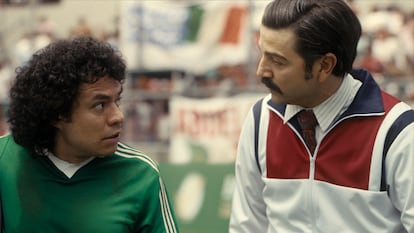
Luna (Toluca, 46) still vividly remembers how the country suddenly turned into a “very cool” celebration full of “intense excitement.” He recalls even going to a match at the Olympic Stadium that pitted France against Italy. “The Mexican national team gave people hope. The thing is, I didn’t remember that other team that seemed to play only to lose by a narrow margin, but I did see how excited the adults got about El Tri,” he says via video call.
Directed by Gabriel Ripstein, the film takes as its inspiration Rafael del Castillo, president of the Mexican Football Federation (FMF) in the 1980s, along with other officials of the time and the behind-the-scenes story surrounding them. Luna says they tried to condense these characters into the essence of his role and what the FMF represented, which, according to the actor, took a “frankly bad and losing” team to a position of success and achievement. But at the cost of that success, anything was permitted to meet the objectives. “That same arrogance, that same total lack of ethics in the Federation’s actions, ultimately drowns what was probably the best Mexican team up to that point — debatably, arguably the best Mexico squad to have played the game. In that quest to achieve it, at all costs, they end up betraying everything and suffering a terrible collapse that culminates in Mexico not going to Italy ’90 and receiving that punishment,” he adds.
The punishment the actor refers to is the “Cachirules” case, over which FIFA suspended the FMF from all competitions for two years after it was discovered the federation falsified birth certificates and other documents for several players to make them appear younger, allowing them to participate in the CONCACAF Under-20 qualifying tournament held in Guatemala in 1988.

As a result of that action, Del Castillo was expelled from soccer for good. “The writers had the freedom to create a fictionalized character in which we could include anecdotes we’d heard here and there, things where you know who did them, others where it’s not known, and others that are legends. That gave us a lot of freedom to play with the tone, because we wanted to make a kind of satire where we could have fun and use humor as a vehicle for reflection and critique,” Luna says.
According to Luna, México 86 is a portrait of the social and political context in which that World Cup took place. He is joined by co-stars Memo Villegas as the historic forward Hugo Sánchez and Karla Souza as Susana, Martín’s lover — a woman who becomes his accomplice, adviser, and moral compass during the fraught negotiations for Mexico to host the World Cup for a second time. Within that tableau, of course, is Emilio “El Tigre” Azcárraga, a media magnate and known at the time as “the power behind the power,” played by veteran actor Daniel Giménez Cacho.
Luna says México 86 is a story with a critical edge and that it’s the kind of film he likes and always ends up being part of. “After all, it’s a critique of the system — of how the PRI [Institutional Revolutionary Party] ends up collapsing or destroying itself. After the ’85 earthquake, the PRI lost all popular support because of the state’s abandonment in such a grave crisis. All of that is reflected in the 1988 election, which they lose heavily. The PRI’s debacle has a lot to do with the 1986 World Cup as well, the boos the president [Miguel de la Madrid] received at the stadium,” he adds.
The film is Luna’s second production set in the world of soccer. The first was Rudo y Cursi (2008), co-starring his friend and colleague Gael García Bernal. While both use comedy as their vehicle, he says neither captures what soccer tells us every Sunday from the pitch.
“A soccer match is already a great audiovisual spectacle. A match is itself a perfect dramatic structure: 90 minutes with a halftime to breathe and regroup, and a second half that is always better than the first. What a film can aspire to is to tell what’s hidden behind, below, in the offices, in dead time, the characters we don’t know — and that’s why I like Gabriel Ripstein’s approach. He approaches the world of the suit-and-tie side of soccer, and, by returning to ’86, he makes a very nice comment on the social and political context in which that World Cup takes place,” Luna concludes.
Sign up for our weekly newsletter to get more English-language news coverage from EL PAÍS USA Edition









































