
‘Mamdani Wave’ sweeps the US as Abdul El‑Sayed aims to become first Muslim senator
The Democratic primary victory of the physician, son of Egyptian immigrants and a staunch critic of Israel, displays the growing strength of the party’s progressive wing
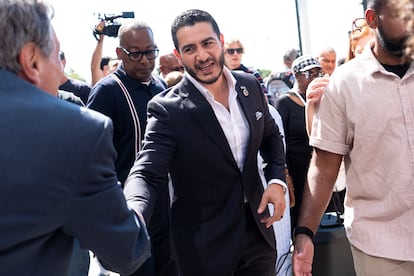

It’s worth remembering the name Abdul El-Sayed. The 41-year-old doctor, a son of Egyptian immigrants, has just achieved a major victory that few would have predicted — one that promises to have profound consequences for the future of the Democratic Party. The wave of progressive candidates following in the footsteps of Zohran Mamdani in New York — who are committed to issues such as the struggles of the working class in a country with a skyrocketing cost of living and denouncing Israel’s actions in Gaza — has now reached Michigan, one of the swing states where the next president of the United States will be decided.
By an extremely narrow margin, and after a recount that stretched through the night, El‑Sayed ultimately won the Michigan Democratic primary for the Senate. The milestone can be explained by two factors: his personal charisma, as he aims to make history by becoming the first Muslim senator in U.S. politics, and the winds of change sweeping the party of Barack Obama and Joe Biden. “My story in America is about as unlikely as it gets,” he said Wednesday upon learning of his victory.
Despite all he has accomplished so far, El‑Sayed now faces a herculean task. It will not be easy for a candidate with his profile to win over Michigan voters on November 3. His first job is to unify a party that split in two in this contest: 48.5% of Democrats voted for him — he wants to end military aid to Israel — while 47.5% backed Haley Stevens, the congresswoman supported by the party establishment and the pro‑Israel lobby, which flooded the campaign with $30 million. In the end, the gap between them was fewer than 15,000 votes.
Healing the party’s wounds will not be easy. But both El‑Sayed and Stevens set to work as soon as the results were known. The winner, who had described his rival during the campaign as “the least qualified candidate” in the country, now says she is one of the “most dedicated public servants” and that they have far more in common than things that divide them. The congresswoman, who had suggested El‑Sayed showed signs of antisemitism, confirmed after the results that she will do everything possible to help the Democrats win the Senate.
Complicated demographics
El‑Sayed also faces complicated demographics in a state with a large Muslim population that turned out to vote for him en masse. He also drew strong support from young people and college graduates. But he faces tougher headwinds with the Black community and voters without higher education, who largely supported his rival. He will also have to convince the public that criticism of Benjamin Netanyahu’s government in no way amounts to a concession to antisemitism. He answers those concerns with replies such as: “I want you to know that my commitment to your safety, my commitment to Jewish safety, is the same commitment that I have to the safety of my own daughters.”

Working in his favor, he has a charisma he demonstrated throughout this campaign. Stevens seemed drawn from the playbook of a traditional politician and only stood out with a video in which she adopted a strong — some called it affected — Midwestern accent to prove she was as much a Michigander as anyone. He, by contrast, filled the campaign with footage of himself meeting all kinds of people in videos that felt more natural, sometimes showing him bench‑pressing — he says he can lift 350 pounds — or dancing to songs by artists such as Whitney Houston and Taylor Swift.
Republicans are already rubbing their hands in anticipation. They believe they have a better chance of winning the state against a candidate like El‑Sayed, whom they are already accusing of every atrocity imaginable. Their attacks tie into party rhetoric that socialism is currently the greatest danger facing the United States. President Donald Trump was quick to react. Minutes after the final results were known, he posted on Truth: “Great news for the Republican Party. El-Sayed, a Communist loser who hates Jews and Israel, is the projected winner in this race with the Socialist […] Now, the Dumocrats crazy policies will only get worse!”
This race is especially important because the Senate seat at stake is currently held by the Democrats. If they lose it, their plan to take control of the upper chamber in the November midterms would become much more complicated. Conventional political theory would hold that a centrist like Stevens would have a better chance in an election in a state like Michigan. But Trump’s two victories and the wins by progressive or socialist politicians across the country cast doubt on whether that rule still applies.
El‑Sayed prevailed in Michigan with the backing of leftist icons such as Senator Bernie Sanders and Representative Alexandria Ocasio‑Cortez. For Ocasio‑Cortez, what happens in three months’ time will be a useful test to see whether there is room for her to launch a presidential bid in 2028. Because if a candidate of foreign origin and with ideas that until recently seemed radical to a majority of Americans can win in a swing state like Michigan, it may not be far‑fetched for a socialist like her to try something similar nationwide. The answer to that question will have to wait until November 3.
Sign up for our weekly newsletter to get more English-language news coverage from EL PAÍS USA Edition









































