
Taylor Swift teaches botany: a Brazilian university accuses a Spanish one of plagiarizing a teaching method
Universidad Miguel Hernández opens an internal investigation after the Federal University of Rio Grande do Norte demanded explanations, amid a social media campaign
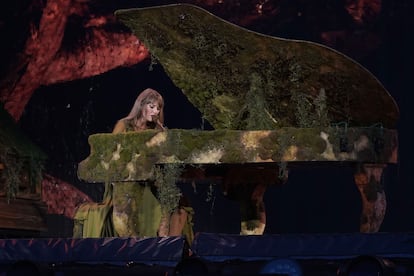

Brazil, academic year 2021. A handful of teenage students confined by the Covid pandemic listlessly stare at their screens from home. They are in Biology class. Professor Gláucia Silva, 32, knows it is urgent to find a strategy to engage them with the biology syllabus. The topic is plants. While she is working on that, she remembers an unlikely connection that came to her mind in 2020 when she saw a Taylor Swift video (Silva is a swiftie, a fan of the American singer). In Cardigan, the star plays a grand piano completely covered in moss. Silva says in an interview that this planted the seed for her project to teach botany using the artist’s videos, a project that culminated in a presentation at the International Congress of Botany in Madrid in 2024 and in a scientific article published in 2025 in Annals of Botany.
The Federal University of Rio Grande do Norte (UFRN) and its researcher now accuse Spain’s Miguel Hernández University (UMH) of appropriating her work and failing to cite her as academic norms require. The Spanish university has opened an internal investigation, according to documents reviewed by this newspaper. Both institutions are public.
“In the middle of the pandemic, during remote teaching, I remembered the piano video. I wondered: are there others? I reviewed her videography with the eyes of a scientist, not a fan. I found a gold mine,” says Silva, a biologist and PhD candidate at the Brazilian university, by video call from Natal. “I use the piano scene to explain bryophytes, mosses, non-vascular plants that cling to surfaces and require a moist environment with water to live and reproduce.” Ferns also appear in the scene. To teach about angiosperms (flowering plants), she uses Willow, where the global artist sings among willow trees.
On May 25, the head of the Brazilian university, José Daniel Diniz Melo, sent a formal letter to his Spanish counterpart, Juan José Ruiz Martínez; to Professor Joaquín Moreno Compañ of the UMH; and to the publisher Octaedro, stating that “allegations of academic plagiarism of a scientific article” produced at his university are “a cause for concern and require the adoption of appropriate measures.” He gave them 10 days to reply, according to the letter.
According to the documentation, Diniz Melo intervened after three months of fruitless contacts from Silva and UFRN with the Spanish counterpart to point out the similarities and request that full authorship of the method be attributed to Silva.
When the deadline passed without a response, the Brazilian PhD student considered the institutional route exhausted. On June 15 she turned to Instagram and TikTok. She posted a video denouncing the alleged plagiarism and asked for donations to take the case to court. Alongside a wave of solidarity, there was a digital avalanche of accusations and insults directed at the Spanish university, the publisher and the professor.
Four days after the video denunciation, the Spanish university rector informed his Brazilian counterpart that the UMH “has initiated appropriate proceedings through its Office for Responsible Research,” that it has contacted the complainant, and also criticized the deadline they were given, “as if this were an international tribunal.” He added: “May I suggest that you evaluate the situation internally at UFRN before an independent committee in charge of ethical matters.” The day before, the publisher had replied to the Brazilian rector that the case is in the hands of the Spanish university, and requested that “the coordinated harassment cease.”
“What more do they want from me? Everything was there in the rector’s letter,” the Brazilian PhD student says when asked why she has not responded to the Spanish internal investigation. She also points out that they misspelled her surname.
At the center of the conflict is an idea and a method, scientifically tested, whose parentage Silva claims for herself. Her method for teaching botany includes four Swift videos, one to explain each plant family. She explains and details its benefits for student learning in the article Dancing with plants: Taylor Swift music videos as tools for meaningful learning in botany.
Her research, published in August 2025 in the Annals of Botany of Oxford University, concludes: “The use of audiovisual material with botanical visual cues, as a cognitive bridge between prior knowledge and new information, fostered meaningful learning in botany.” In other words, popular culture familiar to any millennial is an effective tool to teach the functions and relevance of plants, omnipresent yet overlooked in our lives. Silva presented the method at the botany congress in Madrid in July 2024. In August a summary of her presentation was published.
In March 2025, before the Brazilian researcher’s article appeared in Annals of Botany, Professor Moreno presented research on the use of Taylor Swift videos to teach botany, without mentioning the Brazilian researcher, according to the presentation available on YouTube.
Later, Moreno signed a chapter titled Learning botany with Taylor Swift: assessing the use of music videos as knowledge activators in a collective volume. The UMH professor calls it an “innovative methodology” and mentions Silva’s work in a way that she and her university consider partial and outside accepted academic practice. At the end of his article, Moreno notes that “it is important to acknowledge the inspiration of Gláucia Silva” at the Madrid Congress.
The similarities start with the title and continue. After comparing both texts, ChatGPT concludes: “It does not point to direct textual plagiarism,” but “if an academic reviewer analyzed the intellectual originality, (...) most of the methodological innovation of the Spanish article derives from the original [Brazilian] work.”
Miguel Hernández University did not answer this newspaper’s questions; Ediciones Octaedro did. Its managing director, Manuel León, writes in an email that “plagiarism is not established,” that he will act once the UMH’s report is known, and that the project published “was peer reviewed.” He also says the publisher “will withdraw the chapter if it is finally concluded that plagiarism occurred.”
In February 2026, the Spanish university issued a press release in Spanish and English to promote Moreno’s work, “a teaching innovation experience developed at Miguel Hernández University,” featuring Taylor Swift videos but with no mention of the Brazilian researcher. In an interview with UMH radio, Moreno says the idea arose “upon hearing Dr. Gláucia Silva at the congress.” He says his project “expands that methodology.”
During the dispute, the two protagonists had only one direct contact, on March 2, the day after Silva discovered the alleged plagiarism by chance while googling. The Brazilian wrote to the Spaniard: “We observed that the full peer-reviewed article [referring to the one in Annals of Botany] (...) was not cited in the article published [by Moreno]. We also noticed certain similarities in the content of your work, which makes the citation even more important." She asked that he cite her paper in Annals of Botany in the future and make clear “the origins and prior development” of the Taylor Swift method.
Moreno replied that day: “First, please accept my sincerest apologies,” and claimed he was unaware of the scientific article’s existence. The Spanish academic tried to include an attribution in the book, according to documents reviewed by this paper, but by then the book had already been published.
What followed was a detective mission by Silva, backed by the Federal University of Rio Grande do Norte. An intense exchange of emails began across the Atlantic. Silva considers that the citations to her work used by the Spanish side are partial and insufficient.
The Brazilian biologist stresses that she tried to resolve the matter through institutional channels. At this point she says: “I want the chapter withdrawn from the book, I want Professor Moreno to admit his mistake and for the university [Miguel Hernández] to acknowledge that it presented my work as if it were its own. I only want justice.” With the money raised in her digital campaign, she is preparing the complaint with a law firm specialized in intellectual property. They have not yet decided whether to bring the case in Brazilian or Spanish courts.
This Friday, Silva received the support of President Lula’s wife. Janja Lula da Silva, on an official visit to Natal at the UFRN, met the researcher at the rector’s office and posed with her for a photo. “She wanted to hear me, she listened and said she will help me,” Silva says.
Universidades News, a Brazilian outlet that reports on plagiarism and fraud in academic articles, has dissected the case forensic-style. From the Brazilian perspective, the dispute also offers a second reading: colonialist appropriation. The appropriation of a pedagogical method created by an Afro-Brazilian researcher by a European peer. Silva is a Black woman from a poor region of Brazil who studied on scholarships her whole life, managed to enter a good university and is building her professional career there. An achievement within reach of few.
Brazilians have other appropriation examples in mind, such as the fossil Ubirajara jubatus, returned in 2023 by a German museum, or the Tupinambá indigenous cloak, restituted by a Danish institution in 2024.
Sign up for our weekly newsletter to get more English-language news coverage from EL PAÍS USA Edition









































