
Trump’s attack on the International Criminal Court tests nations’ support for humanitarian justice
Under threat by the US government, the legal institution in The Hague is pressing ahead to try former Philippine President Duterte for crimes against humanity

The political pressure exerted by the United States on the International Criminal Court (ICC), through sanctions imposed on eight of its judges and three prosecutors, as well as on the entities and NGOs that collaborate with them, is testing its very resilience. All individuals involved are carrying on with their work, even though the degree of interference from Washington goes so far as to prevent them from even using a credit card. For a court like this one, without its own police force, the only way to defend itself is through its legitimacy and the support of other countries.
Therefore, President Donald Trump’s offensive in connection with investigations related to Israel and Afghanistan has also revealed the degree of courage and resistance that democratic governments, which declare themselves defenders of justice, are willing to display. These are the same governments that, 24 years ago, established the ICC to try the suspects of the worst crimes: genocide, war crimes, crimes against humanity, and aggression.
Throughout its history, the court has not been without its critics, as Reed Brody, an American lawyer specializing in war crimes, explains by phone: “The only defendants ever convicted of international crimes by the ICC in its 24 years of existence have been African rebels,” he states. Things, he acknowledges, have changed with the arrest warrants issued against Israeli Prime Minister Benjamin Netanyahu and his former Defense Minister, Yoav Gallant, over the war in Gaza. “For the first time, an international tribunal has indicted the leader of a Western-allied state.”
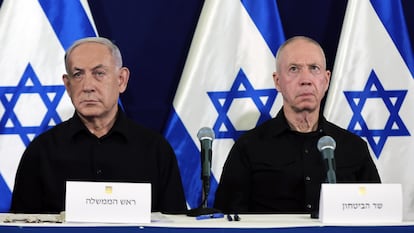
“Since the Nuremberg trials [against Nazi leaders], only defeated enemies, outcasts, or adversaries of the West had been tried,” Brody points out. Hence, President Trump “has decided to restrict the lives of jurists and other supporters of international justice, without so far there having been a united response from the other countries that are members of the ICC.” For this lawyer, “Trump is trying to destroy international institutions, including the United Nations, in that case with the Board of Peace he created [for Gaza].”
Opened in 2002, the ICC is governed by the Rome Statute, to which 125 states are party. During its early years, it was criticized for focusing too heavily on Africa. In its first completed case, the ICC sentenced Thomas Lubanga to 14 years in prison in July 2012 for the war crime of forcing children to fight. He was a former Congolese warlord who recruited them between 2002 and 2003, and it was a landmark case. In 2021, a 25-year sentence was handed down to one of those former child soldiers: Dominic Ongwen of Uganda, who was one of the commanders of the extremist Christian organization Lord’s Liberation Army.
Currently, the tribunal is also investigating international crimes in Georgia, Bangladesh, Myanmar, the Philippines, Venezuela, Ukraine, Lithuania, Belarus, Palestine, and Afghanistan. These last two cases are the ones that triggered the sanctions.
Major powers such as the U.S., China, Russia, India and Israel, are not parties to the ICC, but their nationals can be tried if they committed a crime on the territory of a member country. Trump rejects this possibility for troops deployed in Afghanistan. Furthermore, he considers the arrest warrants for Netanyahu and Gallant an intrusion against an ally.
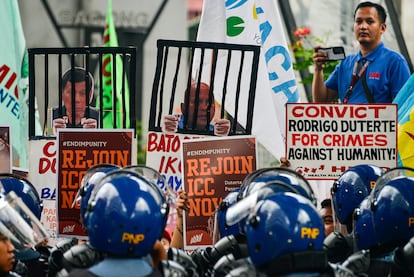
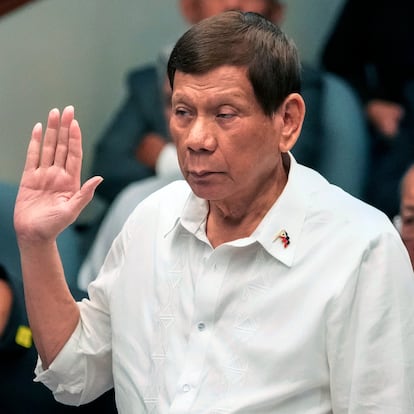
The ICC has also requested the arrest of Russian President Vladimir Putin for the illegal deportation of Ukrainian children. And it is preparing to try former Philippine president Rodrigo Duterte for the deaths of at least 78 people in anti-drug campaigns that resulted in the deaths of thousands in his country. Despite the tensions, the court, based in The Hague, continues its work.
Larissa van den Herik, a professor of international law at Leiden University in the Netherlands, believes that the current challenge “is representative of a broader crisis of the international legal order.” In her opinion, “this order cannot be invoked sometimes and not others depending on political interests.” In this context, the ICC “is the most intrusive international organization, because its targets are state leaders.” “It was inevitable that there would be a lot of resistance from the beginning,” the professor explains.
The restrictions imposed by the United States extend to Palestinian NGOs that contribute to the work of the ICC, “and they are out of the spotlight even though they are affected even more heavily and have repercussions for the victims, and that is unprecedented,” says Van den Herik. She believes that “private entities, such as banks, should support the rule of law, on which the economy, investments, and financial structures also depend,” and that this would alleviate the burden imposed on the targets of sanctions. And while she admits that it is “a critical moment for the court,” she warns against judging its success or failure “in the short term.”
Ligeia Quackelbeen, an expert in international criminal law at Tilburg University, argues that the ICC’s recent activity underscores both its vulnerability and its strength. “It is vulnerable because it lacks a police apparatus and depends on the cooperation of states,” she explains. “The Italian handling of the arrest warrant for Osama Almasri [a Libyan general wanted by the ICC for war crimes] shows how problematic that dependence can be,” she notes. Italy arrested him and then let him escape, and an investigation revealed that Justice Minister Carlo Nordio lied to Parliament.
Despite this, Quackelbeen emphasizes that what happened does not render the arrest warrants irrelevant. “Even if those issued against Putin or Netanyahu are not executed immediately, they still restrict their ability to travel and act in the political and diplomatic spheres,” she asserts. “That effect is not merely symbolic.”
The same expert adds that “going after the biggest criminals is essential,” and believes that the trial against Rodrigo Duterte for crimes against humanity “will set the course for the ICC in the coming years.” She also offers this further reflection: “The court has been redefining its role within the global justice system, and is increasingly supporting national courts in their efforts to prosecute the perpetrators of international crimes.” For the ICC, immunity does not apply to a head of state or prime minister when they have committed the most heinous crimes. Therefore, it only intervenes when a country is unable or unwilling to administer justice.
Van den Herik emphasizes that the weight of the sanctions should prompt reflection, “because the concept of justice, and also the equality of states, as well as the checks and balances of power, are under pressure.” Hence, she believes it is necessary to remember that we must choose between “perhaps protecting an ally or ensuring accountability.” Brody, for his part, believes that states cannot act as if they only believe in the court’s efforts when they like what it does. And Quackelbeen argues that, in a way, “being criticized is in the court’s DNA.” But when there are “courageous states,” the ICC has an effect.
Sign up for our weekly newsletter to get more English-language news coverage from EL PAÍS USA Edition









































