
North Korea, the latest stage in the Russian indoctrination of Ukrainian children
A human rights organization documents the journey of two minors living in occupied Ukraine to a North Korean camp
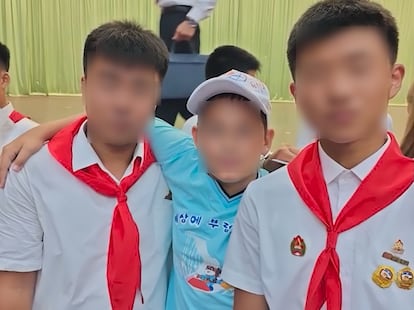

Their names are Yelizaveta and Mykhailo. She was born 16 years ago in Simferopol (Crimea); he, 12 years ago in Makiivka (Donetsk). Both were born in a free Ukraine, but have lived for more than a decade in territory occupied by the Russian army. Last week, Ukrainian lawyer and international law expert Katerina Rashevska showed their photos before the United States Senate. She denounced that the organization she works for in Kyiv, the Regional Center for Human Rights (RCHR), has documented 165 camps where Ukrainian children are subjected to a process of Russification. The case of Yelizaveta and Mykhailo is particularly noteworthy. Moscow temporarily sent the two children to the Songdowon camp in North Korea. They are the first identified Ukrainian minors to travel to the Kremlin’s major Asian ally as part of its campaign of child indoctrination.
According to records from Kyiv, Russia has forcibly transferred more than 19,500 Ukrainian children, either to Russian territory or to areas occupied by its troops in the east of the country, which was invaded in February 2022. Yale University, which closely follows the horrific journey of these children taken from Ukraine, estimates that the number could exceed 35,000. Whichever figure is higher, it far surpasses the number of adult Ukrainian civilians in Russian prisons or the number of captured soldiers held in the custody of the invading army.
It is one of the most painful wounds inflicted by Russia’s massive offensive against Ukrainian society. Because, as the organization Save Ukraine, headed by Mykola Kuleba, who also attended the U.S. Senate meeting, denounces based on accounts from repatriated individuals, it involves the forced transfer of children, indoctrination, militarization, deportation, family separation, mistreatment, torture, and even, in some cases, sexual violence.
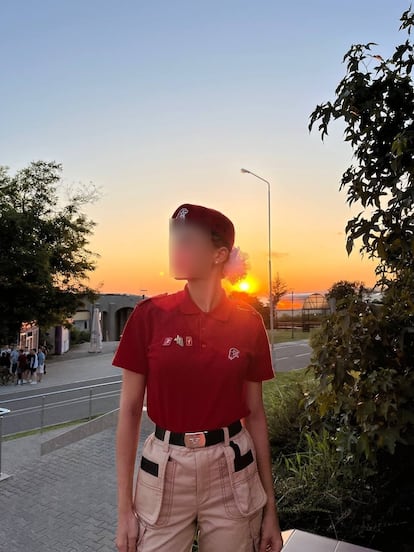
The journeys of Yelizaveta and Mykhailo to North Korea are similar, according to the description provided by the RCHR to EL PAÍS. She resided at the Songdowon camp, on the Sea of Japan, during July and August of 2024. She did so through the Russian youth organization Movement of the First, successor to the Soviet Young Pioneers. Yelizaveta traveled to Kim Jong-Un’s iron-fisted dictatorship as a participant in this nationalist movement. “Although she was born in Crimea, Ukraine, at first glance it appears that her identity has been completely erased and replaced with a Russian one,” the RCHR maintains.
Mykhailo visited the Songdowon facility from July 21 to August 1 last summer as part of a program between Moscow and Pyongyang. The boy is also a member of Movement of the First. Mykhailo was just a baby when the Russian army took over his hometown in the Donbas region. “He didn’t even have time to form his Ukrainian identity,” the RCHR stated.
With due caution, the RCHR, which originated in Crimea but moved its offices to Kyiv after Russia’s conquest of the peninsula, acknowledges that in neither case would we be dealing with an “illegal deportation because the coercion consisted of 11 years of propaganda within the occupied education system.” We would, however, be at the final stage of a long process of “indoctrination and militarization” that could constitute a war crime and a crime against humanity. Last Thursday, a day after Rashevska’s testimony before the U.S. Senate, Ukrainian Ombudsman Dmytro Lubinets accused Russia of sending “abducted” Ukrainian children to North Korea.
Only 1,850 of the children abducted from Ukraine have been able to return to their country — the last seven just last week, with the mediation of U.S. First Lady Melania Trump — in three and a half years of war. This is a low number when compared, for example, to the more than 7,000 prisoners of war exchanged between Kyiv and Moscow. The United Nations General Assembly adopted a resolution last Wednesday demanding that Russia return the children, the same demand that Ukrainian President Volodymyr Zelenskiy has maintained in successive, and so far unsuccessful, dialogue processes aimed at ending the hostilities.
The RCHR has located 165 Russian indoctrination camps across occupied territory in Ukraine, Russia itself, its ally Belarus, and now North Korea, which in the last year has sent soldiers and weapons to Moscow to support the major offensive against Kyiv. It is a growing and well-established structure of cultural assimilation that in many cases culminates in a change of name, a new identity document, and ultimately, the individual’s naturalization. Behind this network allegedly is Russia’s commissioner for children’s rights, Maria Lvova-Belova. She and Vladimir Putin are subject to an arrest warrant from the International Criminal Court (ICC) for alleged war crimes.
The Songdowon camp, built in the 1960s with the nationalist pomp typical of the North Korean regime, is a recreational center known for housing foreign minors on its premises near a beach resort close to the port city of Wonsan. Last year, CNN reported on the testimony of a young Russian man who had voluntarily visited Songdowon. Among the activities that caught his attention were the daily cleaning of statues of the Kim dynasty and playing video games in which the White House was blown up.
Rashevska testified before the U.S. Senate that Yelizaveta and Mykhailo learned at the Songdowon camp, among other things, how to “destroy Japanese soldiers.” They also met North Korean veterans who, in 1968, attacked and captured the U.S. spy ship Pueblo in the Sea of Japan. “The militarization and Russification cause severe trauma and violate the dignity of children,” Rashevska stated in Washington. “The ultimate goal,” the lawyer continued emotionally, “is for Ukrainians to kill each other.”
Yelizaveta and Mykhailo were sent to the camp as a reward for their “proactive” attitude, according to the RCHR. The investigation names other Ukrainian children, including some from the occupied Luhansk province, but it is unknown whether they were ultimately selected to participate in the program in North Korea. There is no evidence that the children who did travel were unable to return home after their stay in Songdowon ended.
Sign up for our weekly newsletter to get more English-language news coverage from EL PAÍS USA Edition









































