
Gazans struggle to survive while the US designs its future behind their backs
Life has barely improved for Palestinians in the Strip in the almost four months since the ceasefire came into effect
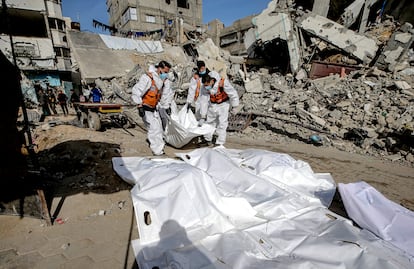

The presentation that Donald Trump’s son-in-law, Jared Kushner, gave last Thursday at the Davos Forum, envisioning Gaza’s future as a kind of Dubai filled with skyscrapers, dedicated a slide to the committee of Palestinian technocrats who will manage the Strip’s day-to-day operations. But the megalomaniacal project was conceived so far removed from the reality in Gaza that no one noticed the committee’s Arabic name was incomprehensible: written from left to right (Arabic is written in reverse) and with the letters disconnected. While Kushner spoke of investment opportunities, Israeli bombings in Gaza (which is officially under a ceasefire) killed five people that same day, a baby died of hypothermia, and hundreds of thousands sought refuge from the rain and cold in tents.
Faiza — a relatively privileged Gazan, because she lives in a rented apartment — was that day doing all the tasks she was not “used to”: lighting a fire to be able to cook (there is still no electricity), moving around the capital “dodging sewage and floods,” and paying to charge each of her electronic devices.
“Here in Gaza, we joke about the ‘master plan’ [presented by Kushner]. We laugh at the fact that he promised us we’d be rich and be living the Riviera of the Middle East […] Actually, we’re running away from our feelings because what’s happening is out of our hands, out of the hands of ordinary people. Others make crazy, stupid decisions, and we pay the price. I’m just waiting for them to open the Rafah crossing so I can leave and reunite with my family [who left in 2024, in the early months of the invasion]. Many people feel the same way,” Faiza explains in a voice message, as Israel has prevented free access to Gaza for the foreign press since the beginning of the war more than two years ago.
The reopening of Rafah — the border crossing between Gaza and Egypt that has been closed since Israel seized it a year and a half ago — is a ceasefire commitment that Israeli Prime Minister Benjamin Netanyahu’s government has repeatedly violated. Part of his Cabinet is pushing to open it only for outbound traffic, in order to promote the ethnic cleansing of Gaza, instead of in both directions as stipulated in the agreement Israel signed with Hamas last October through U.S. mediation.
On Thursday in Davos, it was announced that the border crossing will finally reopen next week in both directions, but Israel (which will control who is able to cross) wants to restrict the number of entries to be lower than the number of exits, in order to gradually empty Gaza, Reuters reported on Friday, citing three sources familiar with the decision.
Kushner and Trump’s Middle East envoy, Steve Witkoff, have been in Israel since Saturday to discuss the future of Gaza. Earlier this month, the U.S. president announced the implementation of the second and final phase of the ceasefire, which is theoretically supposed to include the reconstruction of the Gaza Strip, the disarmament of Hamas, the withdrawal of Israeli troops, and the deployment of a multinational force.
On the ground, however, the situation is not much different than it has been over the previous two years. The Israeli army continues to cause daily fatalities in bombings and shootings. Three people died on Saturday, including two children. Eleven — among them three journalists and two minors — died last Wednesday, on the eve of Kushner presenting his plan, with the disarmament of Hamas as a priority and without mentioning Israeli violations.
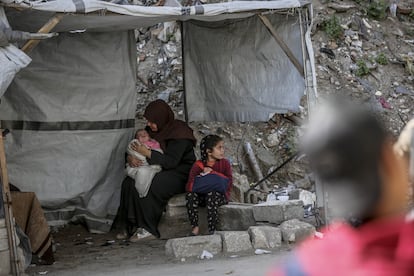
Netanyahu’s troops have not withdrawn from the enclave, as they should have, and there is no date set for a multinational force to secure control of the area of Gaza — almost half of the territory — that is still in the hands of the Islamist movement. “I think,” Faiza elaborates, “that we have reached a point where we no longer feel anything. It’s like a mixture of anger, fear, and sadness. People in the street, my friends, neighbors, and colleagues at work — we all feel lost.”
With all this around him, another Gazan, Tamer Nahed, rails against U.S. plans to transform the Strip into a vibrant hub with full employment. “They are the ones who destroyed [Gaza City] with their missiles and their relentless support for Israel, and murdered more than 100,000 innocent people here,” he emphasizes, adding the estimated number of those missing under the rubble to the more than 71,500 Palestinians whose deaths have already been confirmed by health authorities.
It is the same weariness with plans designed from the outside that a displaced mother, Manal al-Quqa, conveyed to Al Jazeera: “Every time they announce something about the Palestinian people, our suffering only increases. What peace are they talking about, if on the ground there is neither peace nor security?”
Floods
Nahed, for example, lives with her entire family in a rented, one-room apartment after years of living in a tent. She pays the equivalent of almost $715: with so many houses in ruins, prices in Gaza for a place to live exceed those in some European capitals. Her family’s two homes are now rubble, she says. “We haven’t been able to go near them to try to salvage any furniture, clothes, or blankets. Nothing. They won’t let us in because it’s considered a danger zone, even though it’s completely destroyed.”
That “danger zone” is beyond the Yellow Line where the U.S. intends to begin rebuilding. “We thought it would be better to live in a house than in a tent, but, since the windows were completely destroyed in a bombing, the rain still floods the house and it can’t be heated,” he laments in WhatsApp messages.
The account of their daily hardships is very similar to that of the worst days of the Israeli offensive: “We lack blankets. I have three or four T-shirts, two of which a friend lent me. We cook with firewood because there is no gas, and when there is, it is very expensive. I have to carry drinking water two kilometers so we can drink, and to wash ourselves. I carry it by hand up to the seventh floor of the building four days a week,” Nahed recounts.
Yes, some scenes have changed in the 42% of the Gaza Strip under Hamas control, where virtually the entire population lives. There are fewer people carrying the wounded amid screams, or skeletal children dying of hunger. The most noticeable improvement has been in the markets, after months of a complete blockade on food supplies, which was among the reasons an independent UN-appointed commission of inquiry concluded last September that Israel was committing genocide in Gaza, in line with the majority of experts in the field.
Although Israel continues to renege on its October commitment to deliver humanitarian aid (a minimum of 600 trucks per day), Gazans agree that the situation has improved, with more products available and lower prices. Meanwhile, basic medicines, for example, are still in short supply. Faced with shortages, pharmacists and assistants are informally negotiating barter deals, exchanging medicines they have a three-month stock of for those they are lacking, in order to meet the most basic needs, explains a foreign humanitarian worker in Gaza. “Health units are starting to disinfect gauze pads for reuse. Antibiotics, paracetamol, ibuprofen, and medicines for non-communicable diseases (antihypertensives, insulin, etc.) are out of stock or almost out of stock. Some health units that depend on the Ministry of Health [run by the Hamas government in Gaza] have not received supplies for more than five weeks, when they should receive them weekly,” he adds.
These are all things that shape the lives of more than two million people, yet they aren’t even mentioned in Kushner’s plan. For example, how will the removal of unexploded ordnance be managed in a territory where the highest number of bombs per square meter have been dropped since World War II? Every day, children are injured playing among the vast amounts of rubble. Just this week, a video showed a young boy in Rafah searching a dumpster for paper and plastic so his family could fuel a fire and cook. Wood is expensive, and several children have died under Israeli fire while trying to obtain it on the other side of the Yellow Line.
Kushner also did not explain where Gazans will live during the reconstruction, which will theoretically begin with a “new Rafah” (now a blanket of ruins controlled by the Israeli army) and end in the capital, Gaza City, currently under Hamas rule. Most of the population lives in a strip of land encompassing parts of Gaza City and most of the coastline.
The Under-Secretary-General for National Affairs and Executive Director of the United Nations Office for Project Services, Jorge Moreira de Silva, stressed this week, after returning from Gaza, that the Strip remains “basically rubble and unsafe tents,” with more than 60 million tons of debris (an average of 30 tons per person) that could take more than seven years to remove. “The real issue is the timeline […] What they need in Gaza are basic services immediately. While we wait for the reconstruction, let’s not procrastinate.”
Sign up for our weekly newsletter to get more English-language news coverage from EL PAÍS USA Edition









































