
Hamas ‘leaning toward accepting’ Trump’s plan for Gaza
The Islamist group will respond to the ceasefire proposal on Wednesday, a spokesperson told CBS News

Hamas, the Palestinian party-militia that now has the power to accept or reject Donald Trump and Benjamin Netanyahu’s plan for a ceasefire in Gaza, “is leaning toward accepting” the U.S. president’s plan, to which it will respond on Wednesday, according to a source close to the negotiations who spoke to CBS News. That spokesperson also said that the group will respond this Wednesday to a document it claims not to have received until Monday night and in which it had not even played the role of a mere bystander, as it was drafted without their participation. The proposal practically requires their surrender in exchange for vague promises with no deadlines. Shortly after this initially positive disposition became known, Trump gave the Palestinian militia a “three or four day” deadline to respond.
The group had expressed its reservations Tuesday morning about a project that is “completely biased to Israel” and imposes “impossible conditions” aimed at eliminating the group, another of its leaders told Reuters. Ismail al-Thawabta, director of the Islamist movement’s media office, also rejected the plan, which he likened to “an attempt to impose” on Palestinians a “new form of guardianship that legitimizes the Israeli occupation.”
Hamas has few — if any — options other than to comply with a plan that does not include several of its conditions for a ceasefire. In particular, it does not provide any solid guarantees that Israel will stop its attacks or fully withdraw its troops from the Gaza Strip. Even so, the proposal is receiving broad international support. Not only from the West — including France, Germany, the EU, and, in a less enthusiastic tone, Spain — but also from powers such as Russia and China and, very significantly, from the main Arab and Muslim countries.
On Tuesday, the foreign ministries of as many as eight Muslim countries, including Turkey, Saudi Arabia, Egypt, and, dismayingly for Hamas, its former supporter Qatar — which hosts its political headquarters — released a joint statement endorsing the plan. From that document, they highlight what is considered the biggest concession these countries obtained from Trump and Netanyahu: the renunciation, at least on paper, of the ethnic cleansing of Palestinians.
This grave war crime did figure in previous plans put forward by the Republican, such as the so-called Riviera of the Middle East, which sought to turn the Gaza Strip into a beach resort for millionaires — an idea welcomed enthusiastically by the Israeli nationalist far right that supports Netanyahu’s government.
In the video released on Tuesday by the prime minister, he boasts about Hamas’s isolation. In the nearly two years of the invasion, the militia has been decimated by an offensive that even an independent U.N. commission now defines as genocide. It has also lost the support of its main regional allies, who have also been hit by Israeli attacks.
Above all, Hezbollah in Lebanon, now almost as weakened as Hamas, a situation confirmed on Tuesday by the Lebanese prime minister Nawaf Salam’s support for Trump’s proposal. Such support would have been unthinkable until Israel triggered a war against Lebanon in 2024, which also stripped the party-militia of political power in its country.
Hamas can no longer rely on support from Iran, which Israel and the United States bombed in June, and which has again been subject to a severe international sanctions regime since last Saturday.
Even the Palestinian Authority (PA) welcomed Trump’s plan and his “sincere and determined efforts” for peace. This is despite the fact that, at Monday’s press conference, Netanyahu launched a harsh diatribe against the PA, sarcastically claiming it is as capable of reforming itself as a leopard is of losing its spots.
“Most of Gaza”
With Hamas cornered and isolated, the Israeli prime minister began on Tuesday in his video to downgrade — or even deny — what is stipulated in Trump’s proposal, including some promises it contains, similar to others Netanyahu has broken before. He asserted that his army will remain in “most of” the Gaza Strip and that there will be no Palestinian state. On Monday, at the press conference in Washington, Netanyahu had already described the gradual withdrawal of the Israeli army outlined in Trump’s plan as a “modest retreat.”
On Tuesday, he went further. In a video released Tuesday on his Telegram channel, the Israeli prime minister went further. He boasted that this agreement will allow his army to “remain in most of Gaza,” something not included in any of the 20 points of the proposal, which only envisages a permanent presence of troops in a buffer zone around Gaza.
He also denied that the document paves the way for a future Palestinian state. “Absolutely not, and it is not written in the agreement either. But one thing we did say: we are firmly opposed to a Palestinian state,” he concluded. In fact, Trump’s proposal does mention a Palestinian state in Point 19, but only hypothetically and, again, without specific timelines or conditions.
While Hamas has yet to officially respond to the proposal, which places it between a rock and a hard place, the second-largest armed group in the Gaza Strip, Islamic Jihad, has done so. Its leader, Ziyad al-Nakhalah, on Monday described Trump’s plan as “a recipe for continued aggression against the Palestinian people.”
This stance is not insignificant. Islamic Jihad took some of the 251 hostages captured on October 7, 2023, and still holds several of the 48 captives, both alive and dead, whom the Palestinian factions must hand over to Israel within 72 hours as a precondition for the ceasefire proposed by Washington.
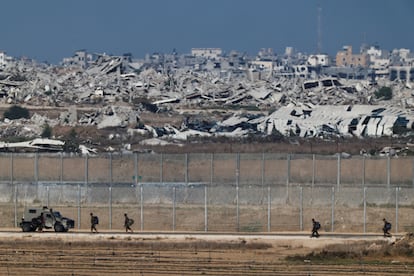
Meanwhile, the destruction of the Gaza Strip continues, and Israeli attacks continue to kill its inhabitants. According to Palestinian hospital sources in the enclave, between midnight Monday and Tuesday morning, another 29 people died.
Sign up for our weekly newsletter to get more English-language news coverage from EL PAÍS USA Edition









































