
Ana Fernández-Sesma, biologist at Mount Sinai: ‘We have regressed 30 years in a single year of the Trump administration’
The head of Microbiology at the New York hospital reflects on the next pandemic and the dismantling of the scientific system in the US
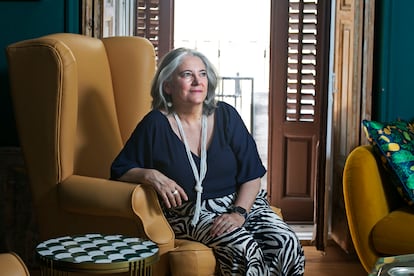

Ana Fernández-Sesma, 61, is a virologist and immunologist who heads the Department of Microbiology at the Icahn School of Medicine at Mount Sinai Hospital in New York, where she has worked since 1991. Born in Spain, she moved to the United States after marrying the virologist Adolfo García-Sastre, an expert on pandemic influenza who works at the same institution, and she never returned. The couple still own a home in Madrid, which they visit whenever they can, and where she met EL PAÍS for this interview.
Recently honored by the Margarita Salas Foundation and the Spanish Society for Virology, Fernández-Sesma reflects on whether the world is prepared for the next pandemic. She also gives an insider account of the dismantling of the U.S. public science system carried out by the Donald Trump administration, and how scientists are evading it in surprising ways, such as turning to research funds from the Department of War, which unexpectedly offer more freedom than those controlled by Trump ally and Health Secretary Robert F. Kennedy.
Question. Are we better or worse prepared for the next pandemic?
Answer. From a scientific and medical standpoint, better. Coordination among professionals is much improved. But as a society we are worse off. The pandemic response has become politicized and there is growing rejection. The concept of public health has been lost. We enjoy a high quality of life and we don’t realize it’s thanks to vaccines. I remember seeing children with polio in Spain. We don’t understand that avoiding those tragedies requires individual sacrifice for the common good. Now it seems the only thing that matters is the self, and to hell with everyone else.
Q. Were mistakes made?
A. Some people did a poor job because they gave categorical, 100% opinions that couldn’t be sustained. We failed by giving too much hope about the vaccine. We didn’t communicate that, given the available time, you couldn’t produce one that would prevent infections. Vaccines were developed that prevented hospitalizations and deaths, but some people stopped believing in scientists.
Q. Can that trust be regained?
A. During the Covid pandemic a woman asked me: “Should I vaccinate my child?” All I could tell her was: there are 800 children dead from Covid in the United States, and none in the vaccine clinical trials. For me, the risk–benefit balance is worth it, but it’s your choice. You won’t convince hardcore antivaxxers, but people who have doubts can change their minds. Then there are many macho types who pose as antivaxxers but do get vaccinated and keep quiet, because they feel they must project that image. How many children have to die before you decide to get immunized?
Q. We recently saw a hantavirus outbreak originating from rodents, and we are in the midst of an Ebola epidemic possibly originating from contact with bats. What are your views on that?
A. Ebola is a ticking time bomb. It is adapting. In 1976, everyone who was infected died. Now more and more people are surviving infection. It may become less lethal, but every outbreak gives it an opportunity to change, mutate and spread further.
Q. Can we know what the next pandemic will be like?
A. They tend to be caused by respiratory viruses because those spread much faster and are far harder to control. What matters is having a strong epidemiological surveillance network, diagnostics, people who know what they are doing and at least have outbreaks located, monitored and able to sequence variant genomes. Viruses are like a lottery. We shouldn’t be gambling. Yet we are, for example, with deforestation and tourism.

Q. In what sense?
A. I recently ran a project in Pantanal, Brazil. A company wanted to build a luxury hotel for photographic safaris in the middle of the wetlands. The idea was to use it to save the jaguars. They funded us to see what viruses were present. We used sentinel animals and found highly lethal viruses that hadn’t been seen in 40 years. Workers there would stay a month and then travel to cities of hundreds of thousands of inhabitants. It’s in those border zones where dangerous spillovers happen. In Asia it happens in markets selling exotic animals. In Brazil it’s in deforested areas. The last yellow fever epidemic in that country happened because monkeys had no habitat left to flee to, and went to the coast and cities. Twenty-three million people had to be vaccinated and there weren’t enough doses.
Q. How are budget cuts at the National Institutes of Health (NIH), the world’s largest public biomedical research agency, affecting things?
A. The NIH has already been dismantled. They have destroyed the infrastructure and there is no reconstruction plan. Research will become merely survival. They cut all the antiviral research overnight. The money couldn’t be touched. Democratic states sued the government. Courts took months to rule. In the end they returned the funds, but we only had 14 days left to spend them. Now they have halted the universal flu vaccine research program, including clinical trials. On the other hand, they are giving out $500 million to make a vaccine based on 1940s-era technology as if it were cutting edge, without any scientific justification.
Q. Can top-quality science continue under those conditions?
A. What we are doing now is seek funding from the Department of Defense. They deploy troops around the world, so they fund research into infectious diseases that could affect the troops. Those grants fall outside RFK’s purview, and curiously they are filling the infectious disease gap left at the NIH. The problem is this is the Department of War [renamed by Trump], and we fear they will use this money to sustain a never-ending war.
Q. Are there any taboo words?
A. Yes: climate change, diversity, gender. It’s reminiscent of the censorship under Franco in Spain. But just like then, it can be circumvented. Some people engage in direct resistance. I practice positive resistance, trying to dodge these issues. If I can avoid putting those words in a grant application, I won’t include them. The Trump administration is hostile, particularly to science, but you have to work with them. I won’t say what’s happening is good, but it has made us rethink how to communicate and make science visible. We had grown complacent. You feel your work is more important when the wind is against you.
Q. Who benefits from all this?
A. China. Chinese scientists and those who collaborate with them are being scrutinized to absurd levels. China is taking advantage and attracting top researchers, not just Chinese ones. What was meant to prevent this country from overtaking the United States has accelerated that process. And the capacity of the United States has been destroyed. We have regressed 30 years in a single year of the Trump administration.
Q. What role do you see for Europe?
A. I sit on the scientific council of the Institut Pasteur. In one year, applications to join have multiplied tenfold. Many of them are European scientists who want to return from the United States. The French government has launched specific calls for French researchers who want to repatriate. Europe can now choose the best and should do so.
Q. How is Spain doing?
A. It has limited capacity, but the government is investing well in science. Spanish postdocs are in high demand in the United States. What’s needed is less bureaucracy and more sustained funding.
Q. Would you return to work in Spain?
A. Not right now, because I have spent three years leading a department in which I have brought in young people, and I have to make sure they can start their careers. If I leave when things get tough, what kind of leader am I?
Sign up for our weekly newsletter to get more English-language news coverage from EL PAÍS USA Edition









































