
From Eurovision boycott to import bans: Israel faces rising global condemnation
Calls for a boycott over the Gaza massacre are spreading throughout the worlds of culture, sports, and economics in more and more countries
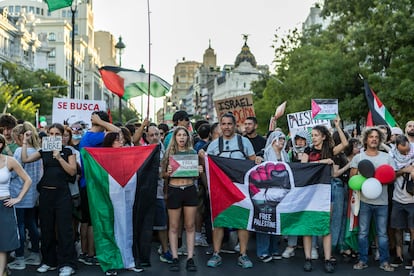
The brutality of the invasion of Gaza has led to increasing expressions of disapproval toward Israel in more and more countries around the world. Although Benjamin Netanyahu’s government is not facing widespread vetoes and sanctions — as Russia has been subjected to following its large-scale invasion of Ukraine — culture, sports, and measures taken by some states are increasingly focused on condemning the Jewish state for the massacre in Gaza, in which at least 66,000 Palestinian civilians have already died as a result of the Israeli army’s actions. The direct call by Spanish Prime Minister Pedro Sánchez for Israel to be banned from sports following the protests at the Vuelta a España cycling race is the latest example of a global movement that is making progress, albeit very slowly.
The suspension of the final stage of the Vuelta in Madrid on Sunday due to massive citizen protests offered up powerful images. Beyond the political arena, culture, sports, and economics are becoming parallel arenas for protesting Israel’s atrocities against Palestinians in Gaza and the West Bank and for pressing for an end to them.
Economic sanctions
In recent months, as the massacre in Gaza has escalated, several countries and blocs have adopted or proposed economic measures against Israel in an attempt to pressure Benjamin Netanyahu’s government. These actions range from direct sanctions to the suspension of trade agreements, import bans, and restrictions on maritime and air transport.
At the European level, the European Commission proposed last July to partially suspend the participation of Israeli entities in the Horizon Europe research program, specifically in the area of innovation related to dual-use technologies, such as drones, artificial intelligence, and cybersecurity. The initiative sought to penalize Israel for blocking the entry of humanitarian aid and food into the Gaza Strip. However, the proposal stalled in the council due to a lack of consensus: several member states, including Germany and Italy, requested more time to study it and prevented it from moving forward. On Tuesday, Brussels announced it is moving forward with plans to suspend parts of the EU-Israel Association Agreement, specifically the trade component, as well as sanctions against Israeli leaders considered responsible for the escalation of the war.
At the national level, some European countries have taken independent decisions. Spain announced that it will ban ships and planes carrying weapons bound for Israel from using its ports or airspace. It also announced that it will ban the import of products manufactured in West Bank settlements and restrict entry into Spanish territory of individuals implicated in what the government considers war crimes. In the Netherlands, the government is preparing a decree to ban the import of goods produced in Israeli settlements, while strengthening controls on military exports and dual-use goods.
Outside the EU, Turkey has taken the most drastic step. In May 2024, it suspended all exports and imports with Israel, a measure that covered metals, chemicals, construction materials, and industrial goods. Since then, it has expanded the restrictions, closing its ports to Israeli ships and limiting access to its airspace, especially to aircraft carrying military equipment. Ankara makes the resumption of trade conditional on Israel guaranteeing the safe and continued passage of humanitarian aid to the Gaza Strip.
Before October 7, 2023, virtually the only actions against Israel were consumer campaigns targeting brands, which have gained momentum in the last two years. There are several, but the Boycott, Divest, Sanctions (BDS) movement stands out. Founded in 2005, it advocates putting pressure on companies considered complicit in Israel’s actions and claims achievements such as the closure of Carrefour subsidiaries in the West Bank due to mounting economic losses or the decline in McDonalds’ global sales, among others.
Culture takes a stand
Within the cultural world, there have been numerous actions against Israel. For now, Eurovision 2026 is the latest battleground: countries such as Ireland, the Netherlands, Slovenia, and Iceland have declared that if Israel participates in the competition, they will not attend. In Spain, Minister of Culture Ernest Urtasun stated that Spanish participation will only take place if Israel is expelled from the competition. The latest to take a position has been Spanish state broadcaster RTVE itself, whose president will propose to the Board of Directors that Spain withdraw from the festival if Israel participates.
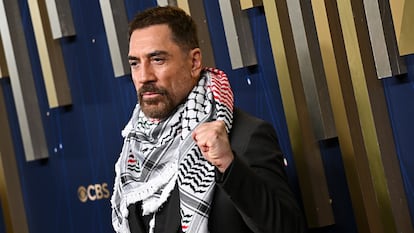
These actions have been echoed in various sectors. In film and television, 1,400 figures (including Yorgos Lanthimos, Mark Ruffalo, Tilda Swinton, and Javier Bardem) have declared their commitment not to work with Israeli institutions and companies “involved in genocide.” And at the recent Venice Film Festival, pro-Palestine groups called for a boycott of actors Gal Gadot and Gerard Butler for having previously adopted pro-Israeli positions, demanding that the Mostra withdraw their invitation to the festival.
In the musical field, a Belgian festival canceled a performance by the Munich Philharmonic due to its Israeli conductor’s “ambiguity about the war,” and in Spain, dozens of artists from festivals such as FIB in Benicàssim and Sónar in Barcelona withdrew their participation after the pro-Israel investment fund KKR’s links to industry giants like Superstruct came to light.
Dance, especially contemporary dance, is a highly supported discipline in Israel, with many internationally recognized artists. However, some of its most prestigious companies, such as the Batsheva Dance Company, the Kibbutz Dance Company, and the Vertigo Dance Company, increasingly face an international desert after being rejected in countries like France and Mexico.
Unequal condemnation in sport
In the world of sports, there have been no major measures taken against Israel for its actions in Gaza, as was the case with Russia’s invasion of Ukraine in 2022, which resulted in the exclusion of Russian and Belarusian teams, national teams, and individual athletes from international competitions.
The first internationally visible boycott took place in Spain, during the Vuelta cycling race. A month earlier, on August 14, UEFA took a stand against the conflict during the Super Cup final with a banner on the stadium pitch that read: “Stop killing children; stop killing innocent people.” However, it did not explicitly condemn Israel’s actions. Both FIFA and UEFA banned Russian teams from participating in all their competitions, including the 2022 World Cup in Qatar, for its invasion of Ukraine.
There are other precedents for boycotts, although on a smaller scale. The first was when the Arab League countries refused to play the 1958 World Cup qualifying matches against Israel, then a member of the Asian Football Confederation (AFC), allowing Israel to qualify despite not playing a single match. This led FIFA to decide on a playoff, which Israel lost to Wales. In 1974, it was also expelled from the AFC, and the Israeli federation was not a member of any confederation until UEFA admitted it in 1994.
Another boycott was that of the United States at the 1980 Moscow Olympics, in response to Cold War tensions. Russia invaded Afghanistan in 1979, and the Carter administration ordered the U.S. Olympic Committee not to attend the Games in the Russian capital. Germany, Norway, Argentina, Canada, Chile, Japan, Turkey, and China, then at odds with the USSR, were among the 60 countries that also supported the U.S. initiative. The response to the U.S. boycott by the USSR and the Eastern Bloc came four years later, at the Olympic Games held in Los Angeles, which they too refused to attend.
Sign up for our weekly newsletter to get more English-language news coverage from EL PAÍS USA Edition









































