
Madrid turns final stage of Vuelta cycling race into a demonstration against Israel
‘The debate that has opened up about what happened in Spain should grow and reach every corner of the world,’ said Spanish Prime Minister Pedro Sánchez
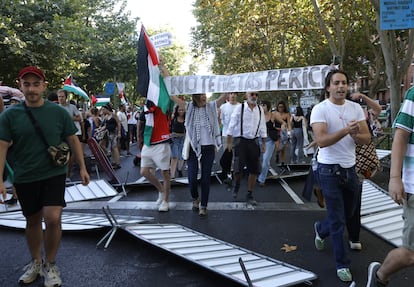
At 7:15 p.m. on Sunday, the peloton was scheduled to enter the final stretch of La Vuelta, a 3,100 kilometer (1926 miles) race that takes place across Spain, similar to the Tour de France. The cyclists were pedaling along Madrid’s Paseo del Prado, heading toward the finish line at the Cibeles roundabout. But nobody finished the race.
At that point, the stretch located between Atocha and Cibeles was already a pressure cooker on both sides of the wide avenue. More than 2,000 officers had been deployed to the area. Despite the police presence, members of the Anticapitalistas collective — which, along with BDS (Boycott, Diversion, and Solidarity), coordinated the call to boycott the end of the Spanish cycling tour — attempted to invade the circuit near the finish line before being pushed out by the police. Protesters then moved to Paseo del Prado, constantly moving the security barriers as riot police tried to hold them back. Suddenly, the news spread like wildfire: the final stage of the race and the podium ceremony had been canceled.
The decision was greeted with joy by protesters. The Vuelta this year has experienced several disruptions along the route as people protested against the presence of the Israel-owned Premier Tech team, waved the Palestinian flag and occasionally tried to leap over the security fence. Anticapitalistas hailed the cancellation of La Vuelta as a victory: “It shows that it is possible to force our governments to completely sever relations with Israel,” they said in a statement.
Earlier this month, Spanish Prime Minister Pedro Sánchez for the first time openly used the word “genocide” to describe Israel’s military offensive against the people of Gaza — something the Spanish government had avoided for many months, generating an internal debate within the coalition made up of Sánchez’s Spanish Socialist Party (PSOE), which had resisted using the term, and the smaller left-wing party Sumar, which advocated it openly.
On Monday, The Spanish PM defended the exclusion of Israeli teams from international sports competitions in the same way that Russia was excluded for its invasion of Ukraine.
“The debate that has opened up about what happened in Madrid, Spain should grow and reach every corner of the world,” he said at a meeting in Congress with Socialist lawmakers. “It is already happening; we have seen how European governments are saying that as long as the barbarism continues, Israel cannot use any international platform to whitewash its presence. Sports organizations must consider whether it is ethical for Israel to continue participating in international competitions. Why was Russia expelled after the invasion of Ukraine yet Israel is not being expelled after the invasion of Gaza?”

After the final stage and podium ceremony were suspended, protesters blocked all the northbound lanes between the Prado Museum and Cibeles Palace. The fences used as a barrier between spectators and cyclists were used instead to block the passage of police vans.
Riot police attempted to disperse the protesters with tear gas, stun grenades, and batons. Some protesters threw water bottles, sticks, and stones at them. The Thyssen-Bornemiza Museum closed its doors with visitors still inside, some of whom were watching events unfold from behind the museum entrance gate.
A central government official said two people have been arrested. It is estimated that more than 100,000 protesters took to the streets. Some 22 uniformed officers were injured, according to police sources.
Juan Carrique, 57, and Carmen García, 64, are residents of the Villaverde district who came to the final stage of La Vuelta to protest the Israeli team’s presence. “It’s a sporting event that Israel is using for propaganda purposes,” said Carrique, before defending the storming of the road as a legitimate form of protest. “Israel’s participation is in itself a provocation. So, entering the road is a logical consequence of what they’ve done.”
Unsustainable pressure
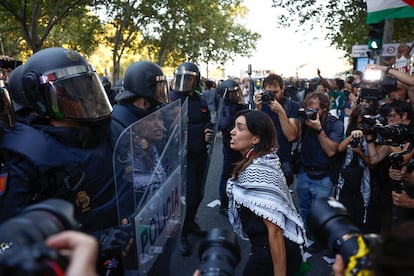
There had already been tension between protesters and law enforcement ahead of the start of the final stage of the Vuelta. At 5:00 p.m., a faction of the Anticapitalistas collective attempted to break into the finish line located at Cibeles Palace. Víctor F., a member of the collective, told this newspaper: “There was a passageway where the cars accompanying the cyclists enter. We had it as a reference point, and we tried to get in through there. There was a bit of tension, and some police officers used their batons.”
The group dispersed southward, near the Prado Museum, where they turned the last 200 meters of the race into a battleground. Vuelta organizers tried to hold the barriers together. There were two police charges. A man in his 60s split his head open during the scuffles.
Then, a sports commentator at Cibeles Palace announced over the PA system: “The peloton is completely stopped [...] The fact that they’re cutting in front of a cyclist truly pains us to the core.” Protesters reacted with shouts of joy and high-fives.
As the first protesters reached the center of Madrid earlier that evening, a National Police unit attempted to block anyone carrying pro-Palestinian symbols, such as flags or keffiyehs. “Don’t they say this is a democracy and that we have the right to demonstrate? So much for that right!” shouted a woman in her 50s wearing a white mask with Gaza statistics written on it.
Ester P., 32, and Alberto, 31, were detained at this point. “They told us that those of us with any visible Palestinian symbols had to go to Plaza Reina Sofía, but no one can see us there,” said Ester. “I came to denounce the genocide, I didn’t come to fight anyone or block the cyclists.”
Sign up for our weekly newsletter to get more English-language news coverage from EL PAÍS USA Edition









































