
Tate Modern fails in its attempt to save Frida Kahlo from ‘Fridamania’
The exhibition, which has broken ticket sales records, explains the construction of the universal icon the Mexican artist represents today
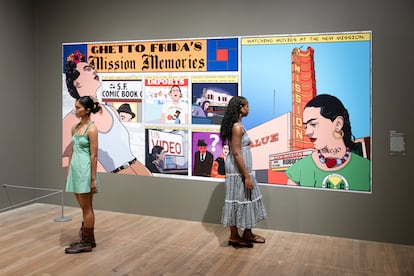

The fact that visitors must pass through the museum shop—filled with T-shirts, tote bags, mugs, costume jewelry, scented candles and even a skateboard bearing the unmistakable face of the Mexican artist—before leaving the exhibition Frida: The Making of an Icon at London’s Tate Modern can only be read as a provocation.
It is an increasingly common practice in many museum exhibitions, but it feels especially jarring in a show expressly aimed at exposing how commercialization has overwhelmed artistic work.
The exhibition, which has the highest advance ticket sales in the history of this contemporary art center and will remain open until January 3, 2027, is not a retrospective of Magdalena Frida Carmen Kahlo y Calderón (Coyoacán, Mexico, 1907–1954), who chose to call herself Frida Kahlo and is now known simply as Frida. There have been plenty of those over the past decades.
Rather, it is an attempt to explain her transformation into a secular saint, an icon venerated by generations around the world, an image now reproduced on more than 100,000 items for sale on any given website, and one of those painted wooden cutouts with a hole for the face that people pose behind to become the Frida they identify with.
The intellectual, avant-garde artist; the supreme surrealist who always rejected that movement; the educated, liberated woman in revolutionary and post-revolutionary Mexico; the suffering, complicit companion and, ultimately, more immortal than the muralist Diego Rivera himself; the self-taught painter; the woman who displayed her pain; the feminist, the bisexual, the queer, the indigenist, the communist, the radical Frida.
“No other artist has provoked such a peculiar response across several generations of followers,” explains Puerto Rican art historian and curator Mari Carmen Ramírez. She adds that this response stems from “the challenges she faced throughout her life, the eccentric construction of her identity—something that resonates strongly with a global, multicultural audience that knows her simply as Frida—and a singular body of work that synthesizes elements of the Mexican School with vernacular sources and an obsessive exploration of the self,” she says.
Rivera embodied the Mexican revolution and the nation’s indigenous roots. Siqueiros represented class struggle and the advance of the proletariat. Orozco denounced violence. But few people of current generations could put a face to any of the great Mexican muralists. Through her relatively small number of works, Frida encompasses all those themes and many more intimate and contemporary ones. Few could recall a painting by her whose principal subject was not herself.
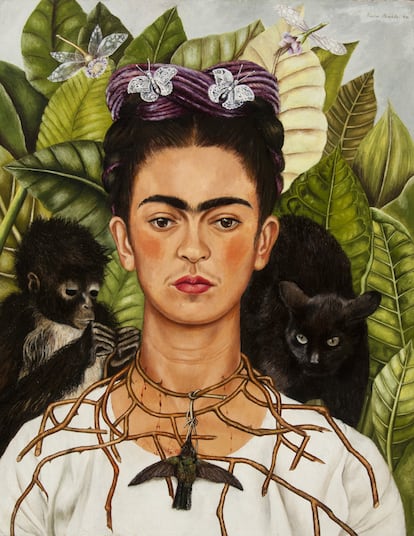
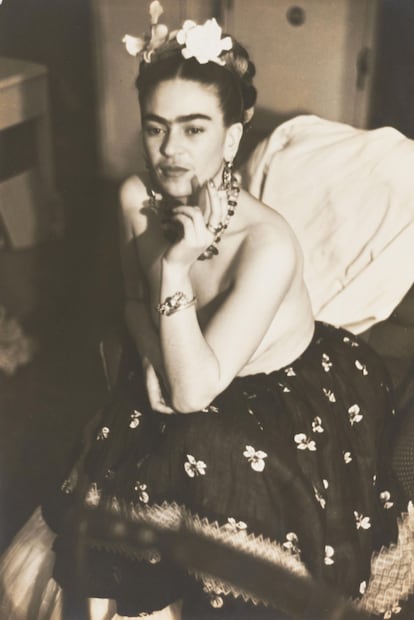
The queen of the selfie — daughter of a distinguished German-born photographer with whom she was closer than with her mother and from whom she learned technique — allowed many to capture her image, such as the gallerist (and possibly her lover) Julien Levy, who revealed a nude Frida increasingly at ease in her own skin; the colorful photos by Nickolas Muray; and the intimate images by Lola Álvarez Bravo. Hundreds of anonymous and credited snapshots exist of a woman who, when she chose to represent herself, chose painting.
“Frida never photographed herself. She let others interpret her through that art form. She chose to paint herself,” says Tobias Ostrander, the exhibition’s lead curator. “Perhaps because of her own physical limitations, but we can also interpret it as a way of connecting with the artistic medium that had the greatest intellectual stature at the time. Rivera, whom she admired, loved and with whom she, in a jealous way, competed, only painted,” Ostrander recalls.
Artistic influence and ‘Fridamania’
Even more central to the show than the roughly 30 Frida paintings are the 160 works by nearly 80 artists who over the years have felt the need to follow in the artist’s wake and incorporate the icon into their own visual language.
Paintings by Frida’s contemporaries, such as Olga Costa and Manuel Rodríguez Lozano, help contextualize the avant-garde milieu in which she shone like no other.
And works and murals from the Chicano Movement—the resurgence of the Mexican immigrant community in the United States in the 1960s as part of the struggle for civil rights—illustrate how activists embraced Frida as a model of political resistance and cultural pride. Her painting Allá Cuelga Mi Vestido, created during the artist’s unhappy stay in New York, shows one of the traditional Tehuana dresses from the state of Oaxaca that she loved to wear, set against a bleak industrial landscape. It is the vivid image of the nostalgia for Mexico felt by many immigrants of that era.
The prostheses and orthopedic devices by sculptor Berenice Olmedo, which reveal a “process of self-construction,” as the artist explains in the exhibition catalogue, recall Frida’s endured suffering—from the polio she contracted as a child to the catastrophic traffic accident that destroyed her spine, pelvis and uterus and forced her to live with an artificial framework for the rest of her life.
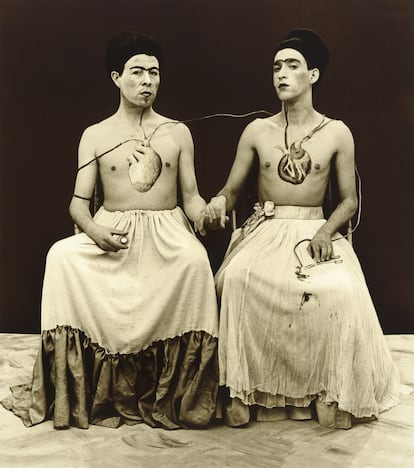
Las Yeguas del Apocalipsis by artist Martine Gutierrez, a queer homage during the terrible years of AIDS to Frida’s iconic painting The Two Fridas, explains better than any other work how an entire tribe of marginal and heterodox people embraced the legacy of Mexico’s most universal artist.
But the exhibition’s great success lies in how it gradually distances itself from the artist and her work as visitors move through the rooms, stepping instead into the construction of an icon that has taken on a life of its own—and not always an attractive one. The final display cases are a crowded compendium of tacky, trite Frida merchandise: slippers, soap boxes, assorted tableware, rag dolls, T-shirts, handbags and posters. Pure marketing akin to that surrounding images of Che Guevara or Albert Einstein, now completely divorced from the message Frida sought to convey in her painting and her life.
The Tate Modern has complemented the exhibition with works by contemporary artists displayed in busy areas of London to coincide with Pride: papel picado motifs decorating Carnaby Street in Soho, and several large murals inspired by Frida across Bankside, south of the Thames.
‘Fridamania takes over London,’ proclaims the gallery in a press release that says it has already sold nearly 40,000 advance tickets for the exhibition. On a hot morning this week in July, dozens of people were lining up for the Tate’s doors to open. The exhibition’s attempt to save Frida from an irrational canonization seems to have failed completely, but everything suggests the organizers knew from the start that it was an impossible mission.
Sign up for our weekly newsletter to get more English-language news coverage from EL PAÍS USA Edition









































