
Group of lawmakers ask Trump to lift sanctions on Venezuela to help respond to earthquake devastation
14 Democratic representatives send a letter, backed by 17 NGOs, warning that financial restrictions are hampering relief efforts and threatening the country’s recovery
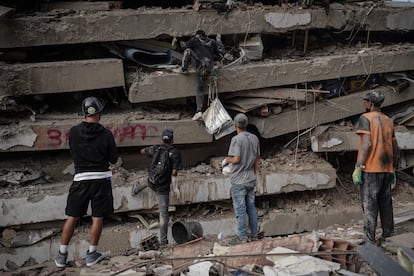

A total of 14 U.S. lawmakers sent a letter on Tuesday to President Donald Trump, Secretary of State Marco Rubio and Treasury Secretary Scott Bessent asking for the removal of economic sanctions on Venezuela so the country can better respond to the devastation caused by the two earthquakes that struck the north of the country on June 24.
The Democratic members of the House of Representatives — Alexandria Ocasio-Cortez (New York), Jesús Chuy García (Illinois), Rashida H. Tlaib (Michigan), Eleanor Holmes Norton (District of Columbia), Delia Ramírez (Illinois), Nydia Velázquez (New York), Yvette D. Clarke (New York), Greg Casar (Texas), Mark Pocan (Wisconsin), Jonathan L. Jackson (Illinois), Ilhan Omar (Minnesota), Shri Thanedar (Michigan), Summer L. Lee (Pennsylvania) and Mark DeSaulnier (California) — demand “to immediately lift the United States’ broad economic sanctions on the country and do everything in your power to facilitate Venezuela’s access to its frozen assets abroad.”
The toll from the quakes that hit La Guaira and Caracas is devastating: 4,561 dead and 16,740 wounded with fractures and amputations, Jorge Rodríguez, president of the National Assembly, confirmed on Monday. Some 300 bodies remain unidentified. In addition, nearly 18,000 people have been left homeless by the quakes.
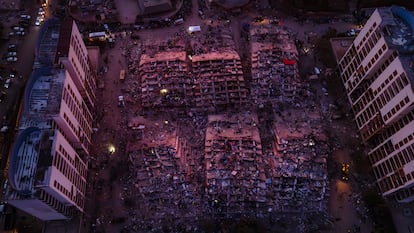
“These economic restrictions are severely hampering urgent relief efforts, and will continue to threaten Venezuela’s recovery and long-term reconstruction if allowed to remain in place,” warn the letter’s signatories, a copy of which was obtained by EL PAÍS. “The June 24 earthquakes were the most powerful to hit Venezuela in more than a century,” the letter says, describing the quake’s devastating effect and the more than 1,250 aftershocks recorded over the past three weeks. “Some 1,400 buildings collapsed or were damaged, including many schools and hospitals.”
The damage is hard to estimate. The U.N. raises the cost of physical destruction to $6.7 billion, the equivalent of 6% of Venezuela’s GDP. The U.S. Geological Survey estimates total economic losses could reach $100 billion.
“The June 24 earthquakes were unpreventable natural disasters. But the U.S. government’s farreaching economic sanctions and asset freezes that have severely undermined the country’s response and reconstruction efforts are man-made and avoidable,” the letter notes. “And given the President’s decision to launch military strikes, forcibly detain Nicolas Maduro, and proclaim that his Administration ‘runs’ the country, you bear additional responsibility for the humanitarian response.”
The Democratic lawmakers’ letter has been endorsed by about 20 NGOs, including Just Foreign Policy, Demand Progress Education Fund, Center for International Policy Advocacy, Latin America Working Group (LAWG), World BEYOND War, September 11th Families for Peaceful Tomorrows, RootsAction, Peace Action, Peace Action New York State, Charity & Security Network, We Are CASA, Global Exchange, Global Health Partners, Doctors Against Genocide, United for Peace and Justice, NWMI DSA and the Center for Economic and Policy Research (CEPR).
A decade in recession
The country needs access to blocked resources for reconstruction and to stabilize its economy, which has been hard hit by the earthquakes and a recession that has lasted a decade. Financial restrictions from sanctions imposed since 2017 are hampering the efforts to clear rubble from hundreds of buildings, schools and other public facilities destroyed in the quake and are slowing recovery in the areas affected by the catastrophe. The situation risks unleashing a public health crisis. The Pan American Health Organization (PAHO) warned last week that the emergency has entered a critical stage. It said Venezuela’s health system has collapsed and faces a crisis “that is far from over.”
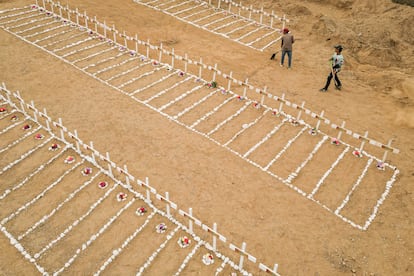
Along the same lines, UNICEF warns that 1.8 million people, including 680,000 children, need humanitarian assistance. “ In this moment of crisis, a robust state-coordinated response, unhampered by sanctions, is essential for preventing a humanitarian collapse and addressing the vast civilian and infrastructure needs that exceed the capacity of non-governmental approaches alone. The removal of sanctions will also allow state institutions to more effectively coordinate and deliver emergency healthcare, shelter, and food, clear debris, and rebuild roads, schools, and homes,” adds the lawmakers’ letter.
The United States imposed economic sanctions on Venezuela in 2017, at the height of Nicolás Maduro’s administration. Since then, the Latin American country has suffered the harsh effects of the financial blockade, enduring successive economic crises, runaway inflation and deterioration of its energy industry. Venezuela holds the world’s largest oil reserves but has been unable to exploit them because of problems in its oil sector.
The IMF estimates that the country’s economy contracted by 74% over the past 10 years. “This was three times as severe as the Great Depression in the United States and it has greatly undermined the country’s ability to adequately respond to natural disasters such as these,” the letter emphasizes.
“Indiscriminate effects”
“The existing sanctions regime on Venezuela has far-reaching indiscriminate effects. Restrictions on the central bank, financial system, oil industry, mining industries, and debt transactions impact all of Venezuela’s economy and society,” the signatories write.
The letter from the 14 lawmakers and the roughly 20 NGOs comes days after more than a hundred prominent economists and academics released a manifesto also calling for the removal of economic sanctions on Venezuela and urging the Trump administration to act immediately to free up the humanitarian response and reconstruction of Venezuela from ongoing economic and financial sanctions, asset freezes and debt burdens.
The economists called on the United States to lift restrictions so Venezuela could access IMF aid mechanisms, including about $5 billion in Special Drawing Rights allocated to Caracas and another $4 billion under the Rapid Financing Instrument. To access these instruments, the Treasury Department would need to issue certification 25B to allow the Central Bank of Venezuela to access financial assets. They also requested cooperation from the governments of the United Kingdom and Portugal to return frozen funds that total more than $6 billion.
They also asked creditors of Venezuela’s debt for a moratorium to ease the country’s financial burdens so it could focus on reconstruction and recovery in the areas affected by the earthquake.
A lasting relief
Although the U.S. government has approved an aid package of about $300 million and has lifted certain restrictions to temporarily facilitate humanitarian donations, both economists and the lawmakers consider that “these [measures] are entirely insufficient to meet the urgency and scale of Venezuela’s need. Not only are these licenses and exemptions limited in scope and in some cases time-bound, but they imply burdensome paperwork and largely fail to shift the incentives of businesses and financial institutions that overcomply for fear of punishment.”
After the U.S. military operation to capture Maduro, the U.S. administration launched an operation to manage the Latin American country’s oil revenues. Following the military intervention, Trump convened executives of the world’s largest oil companies at the White House to divvy up the business. The congressional signatories and the NGOs that backed the letter demand “ the immediate release of billions of dollars of Venezuelan oil income currently held in Treasury-controlled accounts, and the termination of U.S. custodial control over the proceeds from the sale of Venezuelan oil.” They say those measures are essential for the interim government of Delcy Rodríguez to manage reconstruction and stabilize the country’s economy.
Sign up for our weekly newsletter to get more English-language news coverage from EL PAÍS USA Edition









































