
Over 100 economists ask US to lift sanctions on Venezuela to ease the impact of the earthquakes
Academics call for a moratorium on Venezuelan debt, and urge the IMF to restore Caracas’ access to the Fund: ‘The emergency is human before it is political’
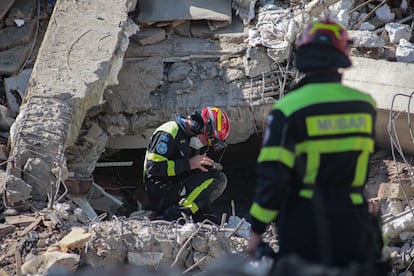

More than a hundred economists and academics have signed a letter calling for relief from economic sanctions on Venezuela to help the country mitigate the impact of the two consecutive earthquakes that struck Caracas and the La Guaira region on June 24, 2026, leaving at least 3,535 dead and 16,740 injured, according to the latest official tally.
A total of 113 distinguished economists, including Isabella Weber, Jeffrey Sachs, and James K. Galbraith, among others, “urge immediate action to unfetter Venezuela’s humanitarian response and reconstruction from ongoing economic and financial sanctions, asset freezes, and onerous debt burdens.”
The earthquakes that hit Venezuela two weeks ago have been devastating. Hundreds of buildings, schools, hospitals, and other facilities have been affected. The quakes struck a country mired in a years-long economic crisis and in a complex political situation. The interim government of Delcy Rodríguez has been under a kind of tutelage by Washington since last January, when the U.S. military launched a lightning operation to capture Nicolás Maduro while he slept in Caracas.
The academics are asking the U.S. Department of the Treasury “to lift all broad economic sanctions on Venezuela, including any that may impact the Banco Central de Venezuela (BCV), government institutions, Petróleos de Venezuela, S.A. (PDVSA), public financial institutions, the oil and mining sectors, banking, transportation, shipping, telecommunications, travel, and all related activities.”
“The emergency is human before it is political. Rescue, shelter, hospitals, water, power, transport, food, and medicines cannot wait for diplomatic bargaining, creditor committees, or sanctions paperwork. Every hour of delay transforms a natural disaster into an avoidable social catastrophe,” the manifesto says.
“It is a barbaric act that the United States and Europe are withholding billions of dollars in funds that belong to Venezuela and that the country desperately needs,” says Mark Weisbrot, co-director of the Center for Economic and Policy Research (CEPR), one of the platforms behind the manifesto.
Lift financial restrictions
“It is often ignored that U.S. sanctions destroyed the Venezuelan economy,” Weisbrot notes. “Venezuela suffered the deepest peacetime recession in history between 2012 and 2020, when it lost 74% of its GDP, a record figure that is more than three times the magnitude of the U.S. Great Depression of the 1930s. Eighty-eight percent of this loss occurred after the sanctions imposed by the U.S., which, from 2017 on, increasingly and drastically isolated the country from international financial markets and its foreign exchange revenues,” he concludes.
The economists also call on the United Kingdom to work with the Bank of England to ensure the unfreezing of the Central Bank of Venezuela’s gold reserves, valued at about $5 billion and representing one-third of the central bank’s assets. They ask Portugal to work with Novo Banco to return $1.2 billion belonging to Venezuela’s development bank (Bandes), under a 2023 court decision. “Whatever one’s position on Venezuela’s internal politics, the current set of coercive economic measures directed at the country is an indiscriminate instrument,” the signatories argue. “This is precisely the moment to remove any economic and financial obstacles to relief and reconstruction.”
The manifesto also appeals to the International Monetary Fund (IMF). The academics urge the Washington-based multilateral institution to facilitate Caracas’ access to the Fund’s financial mechanisms and to allow use of the roughly $5 billion in Special Drawing Rights (SDRs), an international reserve asset issued by the IMF that Venezuela could use to manage the catastrophe. They also ask the institution led by Kristalina Georgieva to “approve a $4 billion Rapid Financing Instrument (RFI) disbursement immediately, using its emergency and natural disaster rationale, with no conditions.”
Although the IMF announced last April that it had restored relations with Venezuela after seven years of suspension, the U.S. Department of State, which Marco Rubio heads, still maintains some restrictions on the Central Bank of Venezuela (BCV) that prevent access to the IMF’s financial instruments, CEPR researcher Andrés Arauz explains. “The BCV needs the 25B certification that recognizes it as a government bank. That small detail is vital; it would allow them to have liquidity immediately not only for a better disaster response, but to improve Venezuela’s exchange rate stability,” he adds.
Debt moratorium
The signatories also call on lenders to grant a moratorium on Venezuelan debt. They ask creditors to cancel or suspend debt service, interest, penalties, and arrears, and to seek a comprehensive debt reduction consistent with a rights-based recovery and climate-resilient reconstruction. “A debt crisis in these conditions is a developmental and humanitarian crisis,” they note.
Venezuela’s debt is held by three major groups of creditors: companies that sued the country over expropriations; holders of bonds issued by the government and PDVSA in the 1990s; and official creditors such as China, Russia, and others, whose amounts are smaller, Arauz explains.
“Venezuela’s people must not be made to pay twice: first through disaster, and then through sanctions, frozen reserves, and unsustainable debt servicing,” the academics and economists stress. “We urge governments, international financial institutions, and creditors to act now, on the principle that lives, public health, and economic recovery take precedence over coercion and collection.”
The researchers believe the measures approved by the United States to try to help the government of Delcy Rodríguez manage the catastrophe are insufficient. Washington offered $300 million in financial assistance, sent specialized teams to help save people trapped under the rubble and machinery to remove collapsed buildings. It also issued a temporary license to allow transfers to Venezuela exclusively for humanitarian purposes. But all this is insufficient, according to the manifesto’s signatories.
The faster, the lower the cost
Andrés Arauz, a CEPR researcher, knows the suffering and difficulties of responding to an earthquake. In April 2016, when he was a minister in Ecuador, he experienced the Manabí earthquake that left nearly 700 dead and about $3 billion in losses. “These proposals would help post-earthquake recovery. Estimates of the economic impact on Venezuela’s situation are very large, around 10% of Venezuelan GDP, and that requires a great reconstruction effort,” says this economist who specializes in finance and international economics.
“The sooner reconstruction takes place, the more damage can be avoided, the more lives can be saved from the economic impact after the disaster. Not only because of collapsing buildings, but because of the economic paralysis that often follows,” says Arauz, who served as Minister of Knowledge and Human Talent from 2015 to 2017. “Rebuilding infrastructure, rehabilitating residences, housing and a variety of critical projects is indispensable, and for that you need to import a lot of machinery, a lot of technology and so on,” he says.
Arauz explains how the manifesto originated: “When I was minister in Ecuador, I lived through the Manabí earthquake in 2016. I remembered the immense efforts any state must make if it wants to receive international aid and, moreover, deploy it urgently on the ground in the disaster zone. And for that it requires maximum flexibility.” The economist adds: “When I saw the earthquake in Venezuela, aware that the country’s situation due to sanctions impeded that kind of agility, a group of colleagues and I got in touch to propose an initiative asking that sanctions be removed and that a rapid response be allowed to attend to and try to save as many lives as possible and then to enable rehabilitation and reconstruction as soon as possible.”
Sign up for our weekly newsletter to get more English-language news coverage from EL PAÍS USA Edition









































