
Roman funerary sphinx found embedded in a stairway in Spain
The sculpture was carved in the first century AD and probably stood over the tomb of a prominent citizen of Elche, as it was believed that these winged creatures would carry the soul to the afterlife
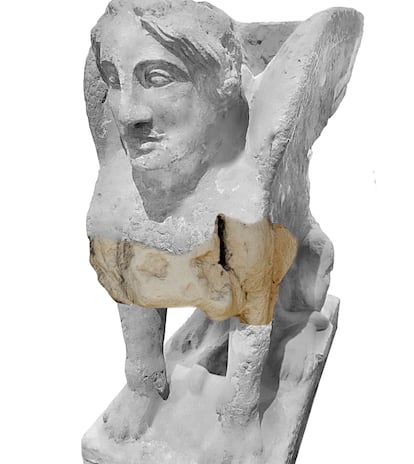

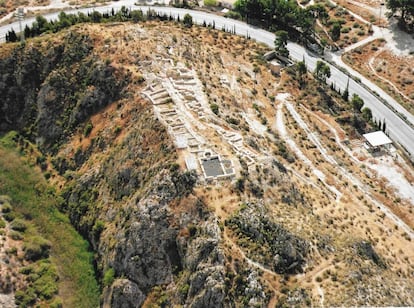
The archaeological site of El Monastil, located in the town of Elda, in Spain’s Mediterranean province of Alicante, has been occupied by all the principal cultures that inhabited the Iberian Peninsula from the Bronze Age through the Andalusi period, including the Roman, Byzantine and Visigothic eras. Each one of them left an extensive archaeological record behind. Now, the site’s managers have announced the discovery of a Roman funerary sphinx from the first century AD, which was later reused in a 5th or 6th-century wall.
Antonio M. Poveda Navarro, director of the dig, describes the figure as “a stone sculpture that corresponds to part of the torso and the base of the forelegs, which were stretched in a vertical line. Its posture and anatomical features allow it to be identified as a Roman-period sphinx, a hybrid being that in funerary contexts served a protective function for the tomb and for the person buried there.”
“But as a winged animal,” he adds, “it also had a psychopomp value; that is to say, in its hypothetical flight it carried the soul of the deceased to the afterlife, ensuring their eternal rest in the sacred place where the deities resided, such as Olympus for the Greeks.”
It was during the 2000 archaeological campaign, while work was being done on the Roman wall at El Monastil, that a small three-step staircase was unearthed. The following year, after very heavy rains, part of the ashlar blocks collapsed. When assessing the damage, archaeologists discovered that “one of the ashlar blocks corresponded to a large sculpture that was very partially preserved, since it had been reused as a simple rectangular ashlar to build one of the staircase steps, a clear example of spolia [reuse],” Poveda recalls.
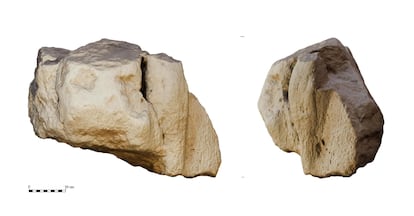
The sculpture was moved with the utmost care to the Archaeological Museum of Elda for conservation, but identification was very difficult because of knocks and trimming to its surface. It appeared to be “a mythological winged creature, of which at least one wing was preserved; the abdomen showed bulges we interpreted as being breasts, and between the one on the left side and the preserved part of the wing, a vertical element was identified that could be an arm or upper limb,” the archaeologist explains. It was thought it might be an Iberian work of art from the pre-Roman necropolis of El Monastil. In other words, “this large sculptural fragment could belong to a winged Iberian female figure that had been placed in the necropolis,” Poveda says.
Last year the Archaeological Museum of Elda began cleaning and consolidating the sculpture. A team led by Poveda and one of the Iberian Peninsula’s foremost specialists in Roman sculpture, Ferrán Arasa i Gil, a professor at the University of Valencia, carried out new analyses and sought typological and stylistic parallels with other sculptures in the group of Egyptian, Greek, Roman and Iberian sphinxes.
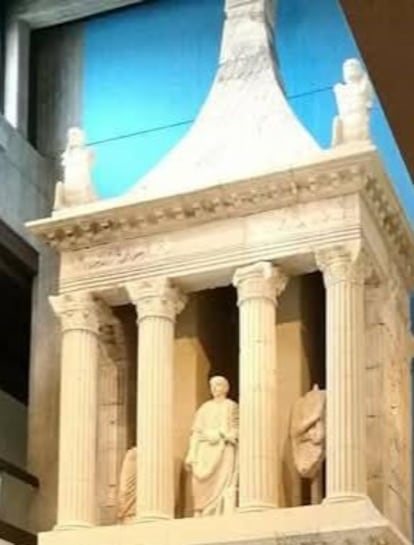
They concluded that it strongly resembled a number of Roman funerary sphinxes found in the northern part of the Italian peninsula, along the Germanic limes, and in Dacia (Romania). “We are looking at part of a monumental Roman-period sculpture belonging to a funerary building of a person connected to El Monastil, likely placed in its necropolis near the access road to the Via Augusta,” the archaeologist says.
According to analyses, the sculpture was carved between the reign of Augustus and the middle of the first century AD. Its owner was probably an important member of the rural elite of the nearby Roman colony Ilici Augusta (modern-day Elche). The sphinx may originally have been accompanied by another mythical beast. It was possibly produced in a workshop in Elche.
The figure, carved from the local beige limestone, measures roughly 31 cm in height, 55 cm in width and 25 cm in thickness, about one third the size of the original piece. It is missing approximately the upper third, which would have included the head and most of the wings, and the lower third, with the forelegs and the rear part of the body.
The sphinx is a hybrid creature of Egyptian origin with a woman’s head and a lion’s body that spread widely across the Near East and reached the Greek world, where it had a funerary role from the archaic period. On the Iberian Peninsula it is prominent in Iberian culture with a similar function. The Roman funerary world also adopted the sphinx’s Greek iconography and generalized the depiction of anatomical attributes such as breasts and the udders typical of the lion from which the body is taken.
Examples of Roman-period sphinxes on the Iberian Peninsula are relatively few and include Baetulo (Badalona, Barcelona), Segobriga (Cuenca), two in Albacete (Ontur and Mata de la Estrella), Caraca (Drieves, Guadalajara), Carissa Aurelia (Espera, Cádiz), Cortijo del Álamo (Jódar, Jaén), Obulco (Porcuna, Jaén), and Setúbal and Faro (Portugal).
“The Elda sphinx enriches a small but growing set of representations. In the Valencia region it is the first known example. At a regional level, it is a notable discovery in the Vinalopó river valleys, where Roman-period sculptural finds are scarce, and it is also, so far, the oldest Roman-period example there,” Poveda concludes.
In recent years El Monastil has become one of the most interesting archeology sites on the peninsula because it overlies a Byzantine monastery, a Pompeian military base and a Visigothic church. The numerous materials Poveda’s team recovers are sent to the Archaeological Museum of Elda. The volume of objects is such that studying them can take decades, as in this case.
Sign up for our weekly newsletter to get more English-language news coverage from EL PAÍS USA Edition









































