
The neuroscientist who had a near-death experience and now investigates the afterlife: ‘There’s no evidence it doesn’t exist’
After publishing more than 100 articles in scientific journals, Álex Gómez Marín has shut down his animal lab and now works with hospitals to study human consciousness
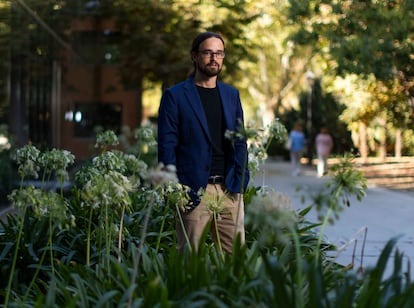
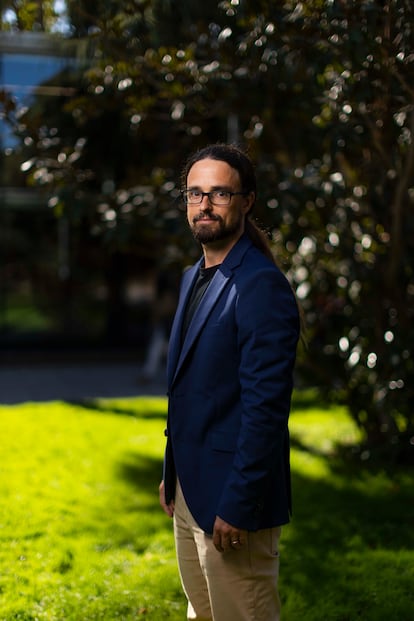
Álex Gómez Marín, 44, believes in the usefulness of family constellation therapy for overcoming trauma, that it’s possible to speak with deceased relatives through a medium, and that there are indications that reincarnation is real. He also holds a PhD in physics and has had a successful scientific career, publishing more than 100 articles in journals covering fields from theoretical physics to neurobiology, as well as cognition and human consciousness. This led him to become a senior scientist at Spain’s national research center CSIC and to direct his own laboratory, the Behavior of Organisms Lab at the Alicante Institute of Neurosciences. Now, there is no one in his laboratory, and he is the only member of the team; he receives almost no funding, and none through the usual channels.
Gómez Marín was never satisfied with the answers provided by the worms, flies and mice that he worked with, nor with the narrow, constrained questions that science typically demands to produce reliable results. He was never a materialist, at least not entirely, but one experience led him to abandon that scientific approach for good. In 2021, uncontrolled bleeding in his stomach brought him to the brink of death. According to the scientist himself, he went even further. Since then, he has sought a new path of knowledge, one that tackles the fundamental questions of life, death, and consciousness that usually lie beyond the reach of conventional science.
“I was in a well (a well very similar to one I am quite familiar with). I looked up. I saw three figures waiting for me lovingly in the light, this light was yellow (similar to the light of mythological animals of the inner encounter). The contours of each of these figures’ faces and hair were perfectly outlined against the light. Their heads formed a perfect triangle in the circle of the opening. I knew who each of them was; they weren’t deceased relatives, but spirit guides. I felt no fear. They offered me a kind of reed to climb out of the well.” This is how Gómez-Marín recounts his life-changing near-death experience in La ciencia del último umbral (The Science of the Last Threshold), a recently published book in which he questions the narrow scope of conventional science, which does not recognize these phenomena as valid subjects of study.
In an interview in Madrid’s El Retiro park, Gómez Marín says he has closed his animal research and now works with humans. “Many of these experiments can’t be done in a laboratory, and we collaborate with hospitals to be able to conduct, for example, studies of near-death experience testimonies,” he explains. Now, he says, he carries out research as cheaply as possible, “because in this country [Spain] it’s still difficult to obtain funding to study the consciousness, and even more so, to study topics that are on the fringes.” Gómez Marín consoles himself with the thought that “often, the bulk of the funding goes to maintaining your mice or having microscopes, and we don’t need that.”
When asked about his dreams, he says, “If I had a lot of money, I would create an Institute for the Study of Consciousness,” because currently, scientists interested in these topics are “hidden in different institutes. Neuroscience in Spain has a legacy from [neuroscientist Santiago Ramón y] Cajal — very focused on anatomy, molecular science, on the minuscule — and I’m at the other extreme: consciousness. An institute would allow us to bring together not only studies on NDEs [near-death experiences] but many other marginal and varied experiences. There’s a history of parapsychological studies in Spain — people who did it well in their spare time — if it were professionalized, we could separate the wheat from the chaff.”
In his book, Gómez Marín talks about people who believe in life after death or paranormal phenomena as a minority he wants to help come out of the closet. However, the reality is that a large part of the population believes that death is not the end. He acknowledges: “Yes, in reality we are the majority, but a silent majority who, in school or in the media, come up against the materialistic, orthodox scientific vision. When people go to science to look for answers on these issues, because they are no longer looking for them in religion, they have encountered a somewhat dismissive response: How can you believe in this? And those people have felt small.”
Gómez Marín’s premise is that, unlike the most widely accepted neuroscientific theories of consciousness, which treat it as an emergent property of the brain — where neuronal processes generate our thoughts and emotions — the brain is in fact a kind of filter for a consciousness that exists independently in the universe. This hypothesis, he says, could explain phenomena such as near-death experiences, which occur when there is no brain activity, or certain experiments with psychedelic substances, in which consciousness expands as brain activity decreases.
The Barcelona researcher was transformed by his journey to the brink of death, but he argues he approaches his work with caution and skepticism. “I realize that, personally, I have experience and a feeling that weighs heavily, but as a scientist, I must maintain methodological doubt. In my book, there are sections where I say, ‘It looks promising,’ or ‘There is evidence that points in that direction,’ but I don’t claim metaphysical certainties. Some hypotheses are very complicated and cannot be disproved with a single experiment. I’m not saying that science proves that when you die, you’ll go to heaven. What I am saying is that for a long time, in the name of science, it has been said that believing in these experiences was madness. There has been a kind of materialist conceptual dictatorship that has closed the space for research. Now I am satisfied with having two options on the table: the brain as the producer of consciousness and the brain as permissive.”
Curiosity about the afterlife is nothing new, but what may be more novel today is the desire to prove scientifically that it is real. The successes of materialist science — from formulating the law of gravity to developing cancer drugs — have made science an almost irrefutable source of authority. People have long believed in all kinds of incredible mysteries without needing to verify them, but now there is also a demand for science to validate what is felt to be true through subjective experience.
Manuel Sans Segarra, a retired Spanish surgeon who has become famous for defending the existence of a supraconsciousness that survives death, wrote the foreword to Gómez Marín’s book. With his usual mix of arguments in which he recalls near-death experiences of his patients, Sans Segarra criticizes the idea that science is the only path to knowledge. Drawing on quantum scientific theories far from empirical verification, Sans Segarra expresses a much greater confidence in the final outcome of this journey than Gómez Marín does. Although there is no evidence that supraconsciousness is real, the foreword asserts that it has already been scientifically demonstrated.
What is well documented is that many people who undergo near-death experiences come back transformed — with less fear of death, a stronger connection to others and to nature, and more hope. As Gómez Marín himself notes, the experience is perceived as “hyperreal,” very different from a dream. This benefit is one of the reasons researchers want to demonstrate, through new science, that the phenomenon is not a hallucination. It also raises questions about whether these scientists could accept, if such an experiment were possible, that when the brain ceases functioning, no form of consciousness persists.
“For a long time, science has instilled hopelessness. In the name of science, people used to say: ‘When your grandfather dies, that’s it, you’ll never see him again; this is a scientific fact.’ No, my dear friends, in the name of science, you can’t say that,” says the researcher, who laments: “We come from a desert of despair.”
In the conversation with Gómez Marín, a common conflict emerges between those who adhere strictly to materialist science and those who believe in something beyond it — whether the God of Christians or a supraconsciousness independent of organized religion. The scientist rightly points out the limited success of conventional science, which only deals with the measurable and treats humans as complex machines, in explaining consciousness. He also notes the long-standing rejection, dating back to Galileo, of subjective experience as a valid source of knowledge.
However, the gaps left by cosmological theories do not prove that God had to exist to create everything, nor do the shortcomings of neuroscience prove that near-death experiences constitute an actual visit to the threshold between life and death.
Spiritualism
Gómez Marín’s need for hope, and his acceptance of all kinds of paranormal phenomena, opens the door to practices like spiritualism. Although the ability of mediums to communicate with the dead has been dismissed by all kinds of experiments, Gómez Marín believes we shouldn’t dismiss the possibility that real mediums may exist. “What if there is?” he asks. “And if there are people who contact real spirits, and a person who needs to contact their deceased relative actually does, who are we to tell them not to? There are also con artists among lawyers and journalists,” he argues.
Gómez Marín alternates appearances on Cuarto Milenio, a Spanish show that mixes proven scientific findings with crude hoaxes and outlandish conspiracy theories, with publications on consciousness theory in a prestigious journal like Nature Neuroscience. This apparent inconsistency is not unlike that of great figures who led the scientific revolution, such as Isaac Newton or Johannes Kepler.
Philosopher John Grey states that “modern science begins when observation and experiment come first, and the results are accepted even when what they show seems to be impossible.” In his book The Immortalization Commission, Grey writes: “In what might seem a paradox, scientific empiricism — reliance on actual experience rather than supposedly rational principles — has very often gone with an interest in magic.”
However, until new methods are developed to test the nature of reality, the hypothesis that the brain does not produce reality but filters it seems as difficult to test as string theory.
Carl Sagan famously said that extraordinary claims require extraordinary evidence. The idea comes from philosopher David Hume’s reasoning on miracles, included in his An Enquiry Concerning Human Understanding (1748). Hume argued that “no testimony is sufficient to establish a miracle, unless the testimony be of such a kind, that its falsehood would be more miraculous, than the fact, which it endeavours to establish.” The Scottish skeptic’s statement leaves plenty of room for subjectivity.
For Sagan’s audience, it was likely clear that the evidence for miracles or consciousness surviving death was far from extraordinary. For a believer, however, even a small opening is enough to cling to the existence of the supernatural.
Sign up for our weekly newsletter to get more English-language news coverage from EL PAÍS USA Edition









































