
Judit Polgár, the chess master taught to beat men
The Netflix documentary ‘Queen of Chess’ does a good job of showcasing Polgár’s talents, but fails to examine the fact that she never went to school or that there were very few women in the sport
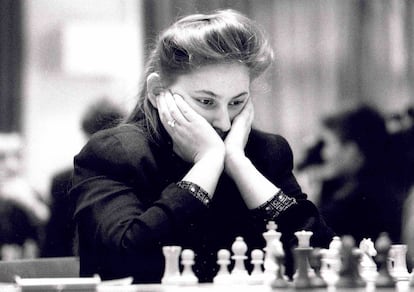

Since the Spanish cleric Ruy López de Segura became the first unofficial world chess champion in the 16th century, only one woman, Judit Polgár, has been among the world’s top 10 players while there are few among the top 100. Having retired from playing tournaments in 2014, the 49-year-old Hungarian has intelligence, sympathy, and culture in spades. No one would guess she had never been to school, except for exams. The Netflix documentary Queen of Chess focuses on her success on the chess board but does not say much about this. Nor does it flag up the scarcity of women in a sport where physical strength is irrelevant.
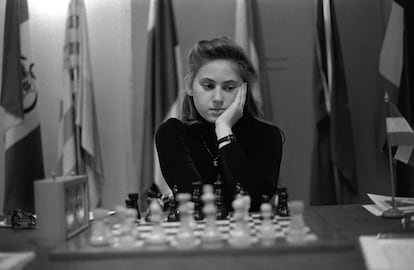
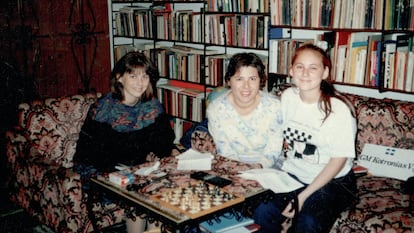
I will never forget that November 12, in 1988 in the press room of the Chess Olympiad in Thessaloniki in Greece. Reviewing the lineups of the women’s national teams, I was stunned to see four young girls in Hungary’s lineup, which consisted of Susan Polgár, 19, Judit Polgár, 12, Sofia Polgár, 14, and Ildiko Madl. Three sisters on the team of a leading country in chess? I investigated, and I came face to face with a cracker of a story: the three of them had been guinea pigs in an experiment conducted by their parents, who home-schooled them with chess central to that education.
Those four girls achieved something literally incredible: beating the Soviets to gold, which they had won for the past 30 years. Judit’s individual performance was also an almost unrepeatable feat: 12 wins, a draw with the Soviet Levitina and no defeats. At 12 years old! You didn’t have to be clairvoyant to predict that this girl was going to revolutionize chess.
To a lesser extent her sisters also came up trumps: Susan was a women’s world champion and has contributed significantly to the popularity of chess; Sofia stopped competing very early, at the age of 22, but had already won the Rome Open aged 14, one of the most notable results by a woman in history. But there was something even more amazing about the three sisters, which suggested their parents’ experiment was worthwhile — once they had overcome the shyness of adolescence, the three were extroverted, polyglots (Susan speaks seven languages, and her sisters four or five), friendly and cultured. How was that possible, given they had hardly had a social life growing up?
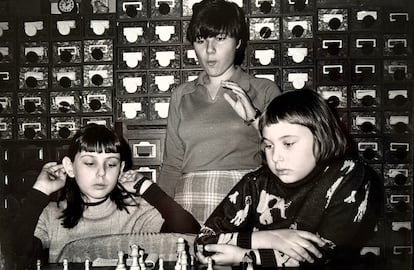
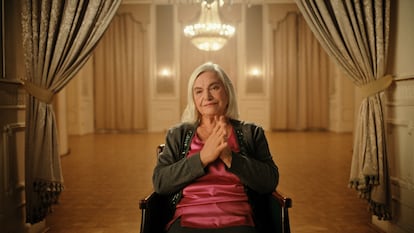
After 40 years wrestling with the question, journalists including myself believed we had reached a conclusion. Lazslo and Klara’s experiment aimed to show that geniuses are not born but are the result of education and hard work. The idea had come to them while dating and developed into an obsession. What they weren’t expecting was that they would only have daughters. They then decided to prove that women can play chess as well or better than men, despite the fact that almost none had been successful in the elite — at least since the 16th century.
But Lazslo and Klara also made sure their daughters had frequent contact with chess players from Budapest, both children and adults, and that they traveled as much as possible from childhood. I believe the traveling and mingling could explain everything: after visiting 115 countries, it is clear to me that traveling is the best school of life.
Shortfalls
The documentary, however, has a serious omission: at no time is it stated that Lazslo and Klara had studied pedagogy. This would indicate that they knew what they were doing. Judit also reveals that every day, including Sundays and holidays, three coaches visited her home to work with them; 10 hours each day: “From 10:00 a.m. to 1:00 p.m., from 2:00 p.m. to 5:00 p.m., and from 5:00 p.m. to 9:00 p.m.,” she says. I asked Judit about this, and she replied: “Yes, normal days were like that. However, in the weeks before exams we did prepare the different subjects, in a very intense and concentrated way. And of course, the schedule was very different when we traveled to play tournaments.”
Despite their success, it is notable that none of the three sisters has repeated the experiment with their own children. But this could be due to the difficulties they faced in choosing this route. Not only was the family Jewish and poor, both the government and the Hungarian Chess Federation were radically against it: “The police came into the house with machine guns and threatened to take us parents to jail or to an insane asylum, and our daughters to an orphanage,” Klara recalls. But, after the gold at the Chess Olympiad in Thessaloniki, everything changed, and the Polgárs became national heroes.
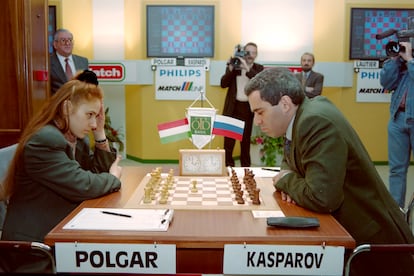
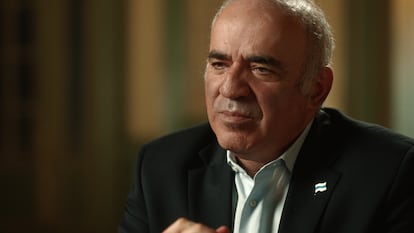
Judit Polgár’s merit in ranking eighth in the world is extraordinary and the documentary portrays this well. Since childhood, she realized that in order to make progress she had to measure herself against men and avoid women-only tournaments. But that decision implied an abrupt landing in a masculine world. In the Linares tournament in Jaén in 1994, considered the Wimbledon of chess, Judit went to the ladies restroom during the first round and encountered the world champion, Garry Kasparov. It was not confusion. It was simply that there had been no women in the four previous tournaments and Kasparov preferred the ladies bathroom to the men’s.
A block and a blessing
Integration into the male elite was hard. The opponents defeated by Judit tended to react badly. Some even left the arena without shaking hands to congratulate her, a sacred custom in chess, both among professionals and amateurs. But Judit’s brilliance was so consistent that she broke through that particular glass ceiling. And one day, Viswanathan Anand, who was a five-time world champion and highly respected by his colleagues, publicly blessed the new star: “Judit is already one of us,” he said.
Directed and produced by Rory Kennedy, Queen of Chess focuses largely on the relationship between Judit and Kasparov, who psychologically blocked Judit when she played him. Kasparov only lost to Judit once. The other tournaments gave him 12 wins and four draws.
The documentary fails to specify that Judit’s only victory against Kasparov in those 17 games was in a rapid tournament (Moscow 2002), where the element of surprise is greater than in the classical slow mode. Another shortfall of the documentary is that, rather than examining the education of the three sisters and the absence of women in chess, it focuses on a minor scandal during the Polgár-Kasparov game in Linares in 1994 when the Russian grabbed a knight, put it on a square, then released it for a fraction of a second before changing his mind and moving it to another square, violating the regulations. The false move can only be seen in slow motion; and when it was checked, the next day, Judit had already admitted defeat. If the champion had gone through with the initial move, Judit would possibly have achieved a draw. Kasparov denies making the false move so it is impossible to know if there was bad faith.
Her photographic memory aside, Judit is, without a doubt, one of the most intelligent people I have ever met. Since 2014, when she retired from competition, she has dedicated time and energy to promoting chess as an educational tool. She and her sisters seem to agree with their father that geniuses are made not born, although their results are so amazing that the genetic component should not be discarded.
In the documentary, Lazslo confesses that he had a hard time when his daughters got married: “Their husbands took them down different paths from mine, and I stopped being their manager. I suffered because of it,” he said. And in the final minutes of Queen of Chess, he adds: “Judit did not become number one because, to have achieved that, she would have had to have trained three or four more hours every day.”
Meanwhile, Judit shows signs of having fully overcome her father’s obsession. After the documentary’s release, she forwarded one of the messages she received from viewers to EL PAÍS: “I had never heard of you until I saw you on Netflix. When my daughter was seven years old, I gave her a chess set. So I understand how proud your father is of you,” it read.
“That’s the kind of reaction I was hoping for,” Judit said. “I hope that many children will start playing chess after the documentary.”
Queen of Chess
Director: Rory Kennedy
Genre: Documentary. U.S., 2026.
Running time: 95 minutes.
Platform: Netflix
Premiere: February 6.
Sign up for our weekly newsletter to get more English-language news coverage from EL PAÍS USA Edition









































