
Manolín, the world’s oldest active chess player at 104
Manuel Álvarez Escudero triumphed over significantly younger rivals in an official tournament in Madrid
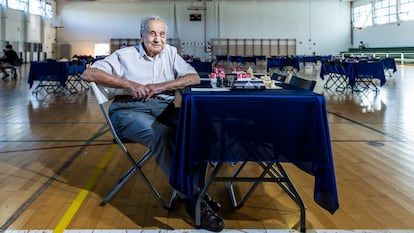

The record-breaking man enters the tournament without TV cameras, influencers, or fans. He’s about to beat his own record for another year, yet no one pays him any attention on this sunny late-summer afternoon in Madrid.
The man — small in stature and slightly stopped — gets off the No 8 bus, and pushes his walker into the Mortalaz sports center. He passes by the youngsters on the athletics track and enters the tournament hall, where 75 chessboards await on tables covered with blue cloths.
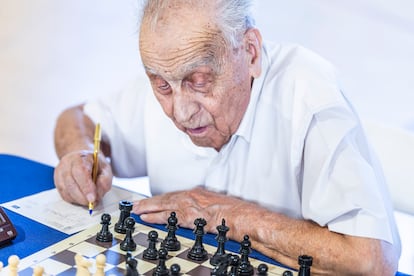
His colleagues greet him with pats on the back and affectionate nicknames: “Manolín,” “Manolillo,” “maestro.” He is Manuel Álvarez Escudero, the oldest active registered chess player in the world. Today, on October 12, he turns 104.
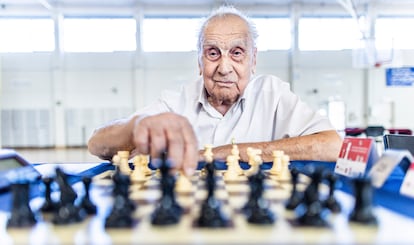
Álvarez competes every year in the XXVIII Mortalaz Open in Madrid, which welcomes players from around the world and is recognized by the International Chess Federation —commonly known as the FIDE after its French initials. Little has changed since last year. He has a new great-grandchild, his second, and is a little harder of hearing.
In the mornings, he plays pocha, the Spanish card game, and in the afternoons, he watches the TV game show Pasapalabra. He has been giving interviews for years and is internationally recognized as the oldest active chess player, but that extraordinary achievement has not changed his life, nor has it brought greater visibility to the tournament held in his neighborhood.
Though he may seem fragile and slow during our interview, appearances can be deceiving.
“How do you find yourself?”
“I find myself very quickly,” he jokes with a smile.
The first thing he wants to know is which rival the computer has assigned him. That information is shared by Luis Mansilla, the president of the Moratalaz chess club, who is acting as the tournament’s deputy arbiter. Álvarez’s competitor will be 38-year-old Madrid resident Daniel Ortega Sutil, an audiovisual technician. In theory, he is a tough opponent, ranked 35th out of the 149 chess players in the tournament, who are ordered according to their Elo rating accumulated in previous FIDE-regulated tournaments. Álvarez is ranked 91st. Another drawback is that Álvarez will play the black pieces, meaning Ortega will have the first move. “Well, let’s see what we can do,” replies Álvarez, who pushes his walker forward in search for his table, number 28.
He walks through the room, which is usually full of people playing basketball or indoor soccer. He is among the first to arrive to the tournament, which doesn’t start for another 50 minutes. Álvarez approaches a table and holds up a small metal sign proclaiming its number. He brings it very close to his face to be able to see what it says. “This is No. 12. Let’s keep going,” he says.
Today is Thursday, and the fifth round of the tournament, which took place from Monday to Sunday in mid-September. Álvarez has already played two games, winning one (against a 67-year-old) and losing one (against a 39-year-old). He did not compete in two rounds — in these tournaments, players are allowed to request permission to miss games, which he had to do in order to attend medical appointments.
As he waits, chief arbiter Eduardo López challenges Álvarez to a friendly game as he waits for his tournament match, which the older man is happy to accept. They crack jokes as they play in front of an audience of a few curious onlookers. “This one won’t be singing anymore,” says Álvarez, taking a knight. Only a few seconds pass between moves. The pieces fall; it’s a massacre.
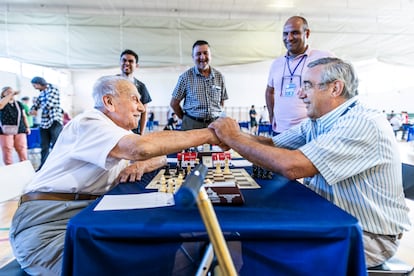
“I’m going to take this one, and then think for a moment,” says Álvarez.
“And then this one, see you later,” says López.
The 66-year-old arbiter has worked Álvarez into a corner, but their time runs out, and they agree to a draw. The room has filled with chess players of all ages, some as young as 10.
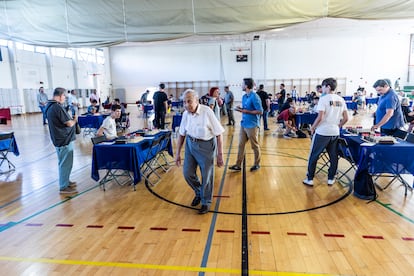
At 6 p.m., the tournament truly gets going. Silence takes over the room, and the chief arbiter reminds all that cell phones are prohibited. “Much luck to you all. You may begin.”
Daniel, Manuel’s challenger, arrives just in time. He’s wearing a black shirt and dark gray athletic shorts. They have just enough time to greet each other and wish each other luck.
The young man is coming in to the tournament with two victories and two defeats to his name. Daniel has played chess since he was a child, but only started taking it seriously three years ago. He has also been a member of the Moratalaz club, and is perfectly aware of Manuel’s skills and reputation. As everyone knows, his mind is still sharp despite his age. Sitting down across from him and shaking his hand, Daniel thinks he is facing “a real powerhouse.” Perhaps this older man can no longer beat the very best, as he once did, but he can certainly defeat “an average player,” like him.
He watches Manuel in front of him, arms crossed and resting on the blue tablecloth. Calm, almost unreadable, as if he were playing poker. Daniel shifts in his chair. He wipes his hands on his pants, takes off his glasses, and rubs his eyes. He moves a piece, hits the clock, and gets up to take a walk and clear his head.

Two hours have gone by, and the game is evenly matched. Daniel trusts that time is on his side. The longer the game lasts, the more chances Manuel has to commit an error. But Manuel, who typically moves fast when he is tired, is thinking through his options today. Sometimes five minutes or more go by before he makes a decision.
At 8:30 p.m., lmost no natural light filters through the windows. The lights are turned on, and only around 20 games are still in play. It’s so late that Álvarez will not make it home in time to see Pasapalabra. He hasn’t stood up once, but his fatigue is evident. Sometimes, after moving a piece, he mumbles something. Other times, he lifts his gaze, as if seeking a mental refresh, then quickly returns it to the board.
A trap
By 9 p.m., most of the important pieces have been taken and the game is so evenly matched that it seems headed for a draw — when, suddenly, Daniel spots a chance to win. He thinks that, at last, fatigue has caught up with the veteran player and that he has made a fatal mistake.
This is how it goes down: Manuel advanced his black king, leaving a clear path for one of Daniel’s white pawns to “promote” — that is, to reach the eighth and final rank and become a queen, like the unlikely case of a laborer who, after a life of sweat and tears, strikes gold.
Savoring victory, Daniel replaces his pawn with a queen. It’s a harsh blow for the world’s oldest chess player, but Manuel hasn’t even flinched. What Daniel doesn’t know is that he’s walked into a trap. When Manuel advanced his black king, he blocked the white king’s path with the help of two other pawns. Now, all he has to do is move his black bishop and complete the net, leaving the white king with no escape. Daniel, who had thought victory was his, jumps in surprise. Checkmate.
The young player shakes his hand: “Congratulations.” The winner responds: “Good game.”
Manuel Álvarez Escudero retreats with his walker to prepare for the next round. He can’t hear well, his vision is poor, and he has a hard time walking — but in front of a chessboard, he is still a force to be reckoned with.
Sign up for our weekly newsletter to get more English-language news coverage from EL PAÍS USA Edition









































