Life after prison in Venezuela: ‘Freedom and life are one and the same’
Political prisoners started to be released a month ago, but the pain does not end when they walk free
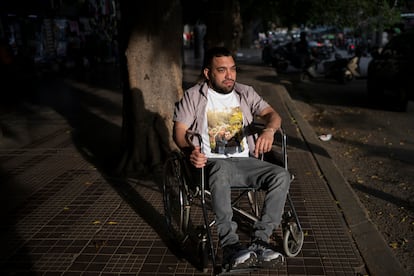
Ramón Centeno is learning to sleep with the three dogs his mother left behind and to live without her. He was released from prison on parole in a wheelchair, after spending more than four years locked up in a jail he walked into — on crutches, but walking nonetheless. He was arrested days after conducting an interview. The Chavista regime released him on January 14: he was one of the first 24 journalists considered political prisoners to regain their freedom, amid this transition of sorts that began in Venezuela after the U.S. military intervention of January 3, in which Nicolás Maduro and his wife, Cilia Flores, were captured.
Centeno is among the nearly 400 people who have been released from prison since January 8, according to the organization Foro Penal. The total number of those released exceeds 700, a figure that is still being finalized due to the emergence of previously unknown lists of detainees. The new amnesty bill promises to release hundreds of people from prison, but its scope remains uncertain.
“Go get Ramón Centeno dressed, they just signed his release papers,” he recalls hearing his guards say at the National Guard’s Anti-Drug Command, a few meters from El Helicoide, the dreaded Caracas prison. That phrase marked the beginning of a new life, irreversibly altered by four years in a state of imprisonment that he shouldn’t have been in. In 2022, on a television set, he had heard Attorney General Tarek William Saab implicate him in the so-called “Iron Hand” operation, along with members of parliament, mayors, and Chavista officials—an operation presented as an offensive against drug cartels, smuggling, and price gouging. Throughout that time, he also heard his jailers say—more than once—that they had made a mistake with him.
A month ago, the president of the National Assembly, Jorge Rodríguez, announced the release of “a significant number” of detainees as a “unilateral gesture of peace.” The process, however, has been slow and agonizing for the families who have maintained vigils outside the prisons. It has been marked by misinformation and profound inconsistencies between the assessments of victims’ advocates and the official figures. The government is now working on a general amnesty bill, which is expected to be approved this week, and, for the first time, a leader of Chavismo—Jorge Rodríguez himself—has approached some of the families camped outside the prison gates. “Next Tuesday, and at the latest by Friday, they will all be free,” he promised them.
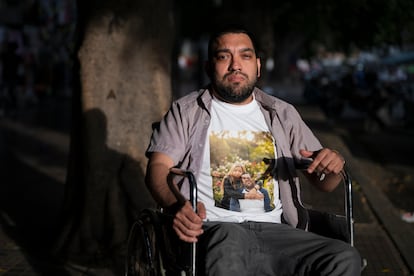
Centeno was working for the pro-government newspaper Últimas Noticias when he conducted the interview that led to his arrest. A member of the United Socialist Party of Venezuela (PSUV) since his youth, his close ties to power did not save him from arbitrary detention. “I’ve been in the party since I was 14, and I don’t regret it, but don’t ask me if I’m going back. Just look at me now,” he told EL PAÍS. His defense was not taken up by the opposition either. “Only my mother defended me.”
Of his four years in prison, he remembers the bell they attached to his wheelchair to signal if he needed to use the bathroom. Sometimes they would take him hours later, whenever the guard felt like it. He also remembers all the books he read, the beatings he received from some cellmates, and those from the officer who arrested him.
“Some people criticize me for leaving and forgiving,” he says, with a hint of indignation. “I think there has to be a process of justice now. For me, this is irreversible damage, but I want to understand why they did this to me. I believe in forgiveness with justice and remembrance. I can hug you, but I want you to remember what you did to me.”
In prison, the wounds from a fractured femur and hip—sustained in a traffic accident from which he was recovering when he was arrested—became infected, leaving him unable to walk. He spent part of his four-year sentence hospitalized and suffered three bouts of facial paralysis. Despite his mother’s 14 requests for humanitarian measures to ensure he received adequate medical care, conditional release only came now. Since his release, Centeno has had to appear in court three times. After the first hearing, his mother, Omaira Navas, died of a stroke. “I haven’t been able to process anything. I had to bury my mother, and I’ve tried to keep what I experienced in prison from affecting my heart,” he says, breaking down in tears. “I think she performed the first miracle: making me forget the four years I was imprisoned and only remember her.”
Those who remain
The releases have sparked impromptu celebrations in neighborhoods across the country. At the home of Víctor Castillo, municipal coordinator for Vente Venezuela, he was welcomed with balloons and banners after a 21-month wait. He was arrested on April 28, 2024, after María Corina Machado’s first tour of Portuguesa state, in the midst of her presidential campaign. That massive demonstration also marked the beginning of a sustained persecution by security forces against the opposition leader’s team.
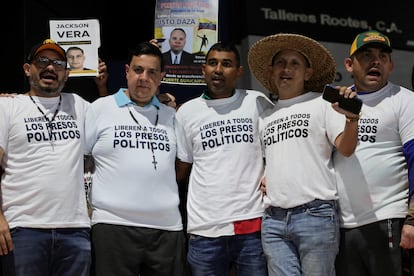
“I never imagined this would happen to me,” he says this week, hours after being released from El Helicoide, his eyes red from lack of sleep. “Prison is supposed to be for criminals, but today it’s also for innocent people. You get used to being free, to seeing the sun whenever you want and enjoying the rain.” Being separated from his wife and two daughters, he says, is part of the psychological torture of an unjust imprisonment. His confinement also left him with a hearing impairment, a constant ringing in his ear that was never treated during his incarceration.
One day Castillo was among cornfields, and the next in a cell with no natural ventilation, 700 kilometers from his family. “That was incomprehensible,” he says. His life has always been linked to agriculture: first as a worker for the Spanish company Agroisleña, expropriated by the Chavista regime, and later as a leader in the grain sector. He couldn’t vote in the elections he worked on when he joined the Comando Con Venezuela, convinced that political change was possible. “We were hoping that if we won, we’d be gone. But it didn’t happen.”
Now, enjoying a freedom that still requires him to appear in court every 30 days, he awaits the release of those still behind bars, especially his political colleagues. He begins to list names. “Write them down, please,” he asks. Perkins Rocha, María Oropeza, Juan Iriarte, Freddy Superlano, Juan Pablo Guanipa, Luis Camacaro, Dignora Hernández, Albany Colmenares, Catalina Ramos. And he goes on. Many of them were released this past Sunday in a day marked by celebrations and rallies demanding the freedom of all the others.
“The experience of political persecution and imprisonment in Venezuela has left a devastating emotional scar on political prisoners and their families,” states a report prepared by Psychologists Without Borders and the NGO Justice, Encounter, and Forgiveness. The impact affects approximately 4,000 people.
Castillo was the breadwinner for his family. “They tore me from my home, and they were left in limbo. My wife had two burdens: Víctor Castillo in El Helicoide and our family back in Portuguesa.” His case is not exceptional. Despite differences in prison conditions—unsanitary conditions, high temperatures, lack of drinking water, lack of sleeping spaces, punishments, or isolation—in Venezuelan prisons, it is the families who support the inmates.
“The mothers or wives of political prisoners are left in charge of their homes in a country where poverty is widespread. The little money they have must be used to pay for aid for the detainees, because inside the prisons they are provided with nothing: no food, no drinking water, no medicine. And even then, many times they are not even allowed to deliver it. The families are also imprisoned,” says Martha Tineo of Justice, Encounter and Forgiveness.
Lawyer and defendant imprisoned
Carlos Julio Rojas was reunited with his lawyer, Eduardo Torres, in prison. Both were being held. Human rights defenders, they became two of the most emblematic cases of political prisoners in Venezuela. Rojas, a journalist and union and community leader in Caracas, was arrested in 2024, months before the presidential elections. Attorney General Tarek William Saab accused him of being part of an alleged assassination plot against Nicolás Maduro that was thwarted during the president’s registration as a candidate with the National Electoral Council. The image of Rojas handcuffed and escorted by two hooded guards was broadcast on state television.
Torres was arrested in May 2025. He was accused of conspiracy, terrorism, and treason for an alleged plan to boycott the parliamentary elections that led to the creation of the National Assembly that is currently debating the amnesty bill.
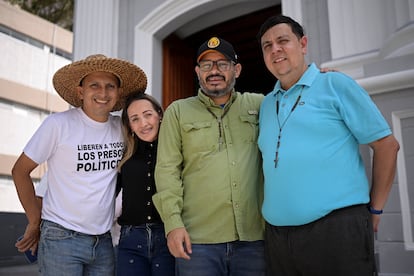
This week they reunited at one of the masses they attended to thank those who supported them during their legal processes. Amidst hugs, they said they had lost their fear of speaking out, despite the restrictions imposed on their release: a travel ban and the obligation to appear periodically before the courts. Rojas, who has been detained four times, maintains that this one—the longest—has been the worst. Inside and outside of prison, he continued to demand his rights. For this reason, he spent more than a month in solitary confinement.
The most rebellious prisoners, or those most detested by the regime, spend long periods in tiny, uninhabitable punishment cells known as “tigritos” (little tigers). They exist in all prisons. In Yare II, where Eduardo Torres was held, they also serve another purpose. “When I first arrived, I spent 21 days in a three-by-three-meter room with a latrine. There were 13 of us, and we slept on top of each other. I got scabies there,” he recounts. “They’ve turned this into a policy of adaptation. But in these prisons, what they punish is leaking information.”
Torres was forcibly disappeared for several days until it was learned that he was being held at El Helicoide. Six months later, he received his first visit, after he had already been transferred to Yare II, on the outskirts of Caracas. That prison, like El Rodeo, Tocorón, and Tocuyito, is intended for common criminals, but has been repurposed to house political prisoners due to the overcrowding at El Helicoide.
Neither inside nor outside of prison has Torres ceased to be a lawyer. That’s why, more than telling his own story, he’s concerned with pointing out the judicial irregularity of his release while others implicated in the same case remain imprisoned. “I was accused of giving civic education workshops that were supposedly going to end in the sabotage of the elections. There are five of us accused of the same crimes. I was released, and a journalist was released, but three are still detained people inside,” he says. Then he lists the arbitrary—almost absurd—circumstances of the process: a 59-year-old university professor imprisoned for teaching; another man detained simply for having the same name and a photo of María Corina Machado on his phone; and a third held for sharing a name with his father, the true organizer of the courses, who is now under house arrest due to his advanced age.
For Torres, the country’s reconstruction—invoked by both Donald Trump and Delcy Rodríguez and the opposition leadership—can only be achieved on the basis of the rule of law. He insists on the urgent need for an autonomous, independent, and impartial justice system. He doesn’t go into details about the nine months he spent in prison. He simply says they were very difficult. “But for those of us who are lawyers, that’s when we truly understand that freedom and life are one and the same.”
Sign up for our weekly newsletter to get more English-language news coverage from EL PAÍS USA Edition