
Amnesty bill for political prisoners breaks years of Chavista repression in Venezuela
The announcement of the release marks a turning point for the regime, which is retreating for the first time after years of radicalization
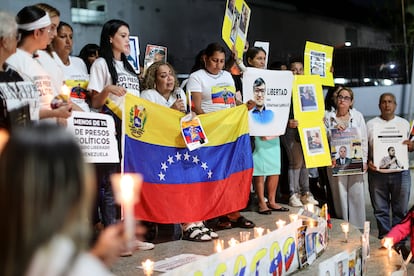
The general amnesty for all political prisoners announced on Friday by Venezuela’s acting president, Delcy Rodríguez, fulfills one of the most deeply felt aspirations of Venezuelan society. It also marks a sharp shift in the relationship between the Bolivarian Revolution and its adversaries over the last years. The decision, which has surprised observers both inside and outside Venezuela, appears to be the culmination of a series of official announcements aimed at loosening Chavismo’s grip on the country and its enemies. For the first time in a long time, the regime is retreating after years of radicalization.
Rodríguez — who, in announcing this decision, asked that “the spirit of revenge not prevail” and expressed her desire for “respectful coexistence” for all — argued that this unexpected move had already been discussed and approved by President Nicolás Maduro. The fact, however, is that it is being implemented now, less than a month after the U.S. military operation that captured Maduro and his wife, Cilia Flores.
Amnesty for Venezuelan political prisoners was one of the great debates between opposition politicians and the Chavista ruling party. This was especially true during Maduro’s 13 years in power, a period marked by a severe deterioration in the country’s social climate, a surge in popular protests, and a rise in the number of prisoners. In every parliamentary debate and international dialogue held between the two sides during these years, a general amnesty for political prisoners was the first thing that the opposition demanded, and the first thing that Chavismo refused.
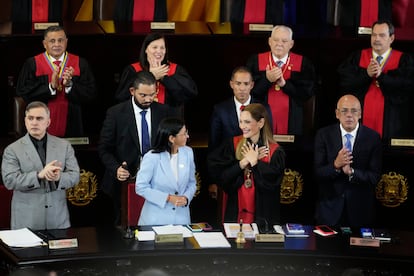
A bill for a general amnesty for political prisoners was one of the first legislative initiatives of the majority bloc of opposition parties after their landslide victory in the December 2015 parliamentary elections. The proposal was flatly rejected by the Chavista bloc — Diosdado Cabello, minister of the interior and then a member of parliament, mockingly called it “the self-pardon law” — and it was ultimately blocked, along with the rest of the opposition’s legal projects, thanks to a ruling by the Supreme Court of Justice, controlled by the ruling party, that stripped the legislative branch of its powers, thereby exacerbating the chronic political crisis.
Demands for the release of political prisoners and denunciations of the deteriorating conditions of their imprisonment began in the early years of the Bolivarian Revolution. They were a direct consequence of the political polarization that Hugo Chávez promoted in Venezuela to consolidate his control over the country. Chávez, who was far more popular than Maduro, did not have to use excessive force to govern.
The political crisis of 2002 — in which the opposition, appalled by Chávez’s confrontational and anarchic tendencies, launched a conspiracy to overthrow him — could be considered the beginning of the era of political prisoners in Venezuela. It re-emerged again after more than 20 years without significant developments.
In Chávez’s time, the number of political prisoners was much lower than it is now — about 15 people in total — although the painful memory of police investigator Iván Simonovis, who served 15 years in prison accused of conspiring to overthrow the government, persists in the minds of many people; as does that of Judge Maria Afiuni, or General Raúl Isaías Baduel, a general and former friend of Chávez’s who would eventually die in prison.
The proliferation of prisoners; the stories of mistreatment and deaths in prison; the reports from the United Nations Fact-Finding Mission on these abuses; and the increase in penitentiaries to hold all the detainees all fall almost entirely under the period of Nicolás Maduro’s administration. In 2014, 2017, 2018, 2019, and 2024, the Maduro government went after what it saw as serious plots and vigorously repressed several popular uprisings that spread throughout the country. By the end of 2024, the number of political prisoners had reached 1,500.
The increase in political prisoners and the accounts of their terrible conditions made the demand for an amnesty law enormously popular as a first step towards laying the foundations for rebuilding the rule of law.
At that time, it was common for Chavista leaders to omit the issue, or to reflect briefly in speeches and opinion programs on the harmful effects that impunity could have on a society.
The announcement of an amnesty bill is music to the ears of dozens of Venezuelan families and slightly eases the country’s tense political landscape. And it comes with an added bonus: it not only means that hundreds of people prosecuted for exercising their constitutional rights in recent years — politicians, journalists, judges, businesspeople, social activists — are regaining their freedom. Additionally, all of them will be spared the post-release measures requiring them to appear periodically in court and preventing them from leaving the country.
Sign up for our weekly newsletter to get more English-language news coverage from EL PAÍS USA Edition









































