
‘Takaichi fever’ grips Japan: The ultraconservative leader becomes a phenomenon that transcends politics
The first woman to lead a government in the Asian country has propelled the ruling party to its strongest result in modern history
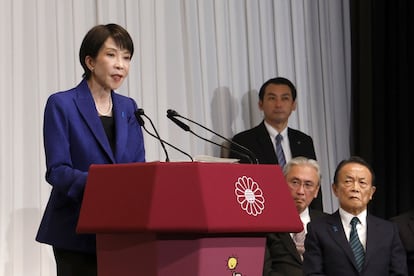
The fact that Japan’s prime minister, the ultraconservative Sanae Takaichi, has become a phenomenon that transcends politics was clear at her final campaign rally last Saturday in a park on Tokyo’s outskirts. Braving freezing temperatures, the darkness of night, and a light rain that would turn to snow by dawn, thousands gathered just to see her — to be there — aware they were witnessing a historic moment
When Takaichi took the stage, the audience’s response was subdued but extremely attentive. They applauded tentatively. The first woman to lead a Japanese government then explained her method: “Work, work, work.” An effective phrase she repeats at every rally, almost a meme in itself. She called for a concerted effort to make Japan once again a “strong and wealthy archipelago.” She touched on her core themes: strengthening defense, raising wages, encouraging companies to build factories at home, and boosting technology, self‑sufficiency, and the rare‑earth industry. Her tone wasn’t grandiose; instead, she sounded as if she were already putting the plan into action. “We have to hurry; we have to start now,” she said.
“I was very impressed,” said Tomi Takashi, a 60-year-old teacher, at the end of the rally.
The response at the polls on Sunday was a surge of votes unlike anything ever seen before. The “Takaichi fever,” as Fuji TV dubbed it, propelled the Liberal Democratic Party (LDP), led by the prime minister, to its best postwar results in the House of Representatives, the most politically powerful chamber of the Diet (Japan’s bicameral parliament). And that’s saying something for a party that has governed Japan almost uninterruptedly since 1955.
The conservative party has increased its representation from 198 to 316 seats, surpassing the two-thirds threshold in parliament for the first time. This opens the door for it to propose constitutional changes, particularly regarding defense, an extremely sensitive issue in a country where pacifism is enshrined in the constitution. Together with its current coalition partner, the Innovation Party, the LDP holds a commanding majority of 354 seats.
“The citizens of this country have given us tremendous support, saying that we must carry out this policy change no matter what,” said Takaichi at a press conference on Monday. “We will grit our teeth and fulfill the promises we have made to the people.”
It was an atypical election — the shortest (16 days after the dissolution of Parliament) in Japan’s constitutional history. Takaichi called them three months after taking office when her approval ratings were at their peak. She had been sworn in by Parliament, but had not been elected, turning the election into a de facto referendum on her leadership. The verdict could not be clearer.
“Being a woman, her perspective is very different, and that really resonates with me. Until now, [the prime ministers] have all been men,” said Yumi Oyama, 30, also at the rally on Saturday. This tech worker had never been interested in politics. That changed with Takaichi. “She’s the kind of person you’d trust to spend money,” she said. “I’ve been inspired by how she’s spoken about the country’s future.”
To say Takaichi has “charisma” is a stretch, says Satoru Ishido, a 42-year-old writer and journalist, and a regular on televised debates. But he does concede that she has “something.” “Freshness” and more “approachability” than her predecessor, fellow LDP member Shigeru Ishiba, whose disastrous election results left the party in ruins in both houses of Parliament. He lasted only a year.
Takaichi’s novelty — and the fact that she is a woman in a male‑dominated political world, often populated by older men in identical suits and burdened by the stereotype of doing politics at night and behind closed doors rather than in Parliament — works in her favor. She is the opposite: she boasts of sleeping only two or three hours a night and starts working at dawn.
Interviewed last Friday, Ishido said that Takaichi, a leading figure in the LDP’s hardline wing, also appeals to voters further to the right. But her message resonates across the political spectrum. He calls her a leader “very focused on policy.” “She held the position of minister of internal affairs and communications for a long time. She is conservative, energetic, and firm, which sometimes made things difficult, but she has substance.” If she performed well on Sunday, as she did, he predicted a term that would last “quite a while.”
Takaichi, 64, grew up in Nara Prefecture, in central Japan. Unlike countless other high-ranking officials, she does not come from a family with a political tradition. Her mother was a police officer, and her father worked for a car company. She studied at Kobe University, interned in the United States in the office of a Democratic congresswoman, and upon her return, worked as a television presenter. She was first elected to parliament in 1993. Takaichi belongs to the hardline wing of the LDP. She is the political heir of former prime minister Shinzo Abe — another of the party’s hawks — who was assassinated in 2022. It was Abe who first appointed her to a Cabinet position in 2006.
She is not known for being a champion of feminist policies or minority rights. Although she served as minister for gender equality, she opposed changing a law that enshrines male succession to the throne and is against same-sex marriage.
But at the same time, she projects a carefree image: in her youth, she was a biker and played drums in a heavy metal band (one of her favorite songs is the adrenaline-fueled Burn by Deep Purple). She carefully cultivates an image that combines softness and toughness; sobriety and showmanship. An admirer of former British prime minister Margaret Thatcher, she might wear the “Iron Lady’s” iconic blue suit and pearl necklace one day, and the next be in a tracksuit playing a K-pop song on the drums with the South Korean president. Style sections praise her accessories, even as she faces a diplomatic spat with China, one of the most delicate issues ahead. She has received the explicit support of U.S. President Donald Trump: on Sunday, the tycoon immediately congratulated her on her “landslide victory.”

“The world is changing,” said Mio, a 36-year-old fund manager preparing to vote for Takaichi’s party on Sunday in Tokyo’s bustling Shinjuku district. She had never voted before. Partly because she had lived in the United States for a decade, and partly because this candidate had, for the first time, made her feel truly connected to the people. “She’s strong. She has a clear vision for the country.” And Mio isn’t afraid of a potential constitutional change. “She wants to make the country stronger and protect it.”
Japan “is heading for an economic and fiscal catastrophe, but Takaichi doesn’t seem to understand it,” Koichi Nakano, a professor of political science at Sophia University in Tokyo, observed last Thursday. He warned political spectrum was shifting to the right and predicted that Takaichi’s “bet” to “personalize politics” and “create a system for which she is barely accountable” would likely win. He was alarmed by Takaichi’s intention to cut consumption taxes while simultaneously increasing defense spending, which would in turn “antagonize China and militarize the tension.” What’s more, Tokyo has agreed with Trump to invest $550 billion in the United States. “It doesn’t make much sense in terms of security and economic policy,” said Nakano.
“She’s dangerous,” said a pacifist voter from the Komeito Party — part of the centrist alliance soundly defeated in the elections — during an opposition rally last week in Tokyo. She declined to give her name but voiced her fear of a leader she believes could fan the flames in a world already ablaze
Military boost
Takaichi, a nationalist, is known for advocating a more militarily assertive Japan. In her third week in office, she triggered a diplomatic dispute with Beijing by suggesting that any Chinese attempt to blockade or seize Taiwan could pose an “existential threat” to Japan, justifying the deployment of the Self‑Defense Forces. Her government has since begun reviewing the country’s anti‑nuclear doctrine and approved a record military budget in December. On Sunday, she called for opening a debate on revising the constitution’s pacifist principles. On Monday, she confirmed her intention to pursue that amendment.
And finally, there is the matter of the Yasukuni Shrine: a litmus test for every prime minister. This Shinto shrine, in the heart of Tokyo, honors the souls of 2.5 million soldiers who died in wars serving Japan. Among them are 14 officers convicted by international courts after World War II. For countries that suffered Japanese imperial aggression, such as China, it remains a symbol of Japanese militarism, and every time a Japanese prime minister has visited it — the last one was Abe —, it has caused a considerable uproar. On Sunday, Takaichi said that she would seek the “understanding” of Washington and neighboring countries before taking any action.
On Thursday, at that twilight hour before sunset, two young men strolled through the silent gardens of the shrine. “It’s a difficult subject, but it’s important for Japanese people to learn about it,” said R. Kurihara, one of the young men. Both are 18 and had recently studied the issue. Kurihara believes prime ministers should not make official visits to Yasukuni. His friend, T. Yokoya, doesn’t disagree. It was Thursday, and they were preparing to vote for the first time on Sunday. They don’t share their political views — not with each other, not even with their parents. But they insist that young people are interested in politics.
As for Takaichi, Kurihara said: “She’s popular for her energetic character. And I’ve heard that she works very hard to solve the problems we are facing.”
Sign up for our weekly newsletter to get more English-language news coverage from EL PAÍS USA Edition









































