
Trumpism takes off in Japanese politics
Experts associate the rise of the ultra-nationalist Sanseito party with a crisis of confidence after decades of economic stagnation

Eitetsu Nishikawa — a 58-year-old taxi driver from Tokyo — finds it unfair that foreigners can “easily” obtain a driver’s license in Japan. He believes this situation could become a serious problem, potentially threatening his job. He argues that crime rates have increased due to the rise in immigration and tourism in recent years. He believes “it’ll only get worse,” if the Japanese people don’t sort things out. Nishikawa is disenchanted with his country’s politics: he says that Japan has been “going through a long period of decline.”
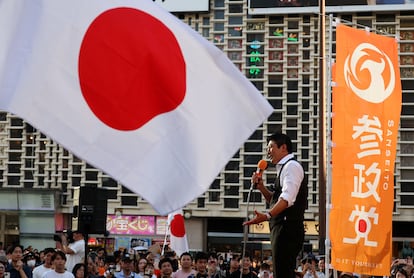
A few months ago, Nishikawa came across a “charismatic” and “magnetic” man on YouTube, someone who expresses “loudly and clearly what the Japanese dare not say.” Sohei Kamiya — the founder and general secretary of the Sanseito political party — promotes an agenda based on the motto “Japan First.” Kamiya himself has stated that he was inspired by the “bold political style” of U.S. President Donald Trump and his MAGA movement. “He’s very smart, his brain works very fast,” Nishikawa notes, describing Kamiya.
Japanese politics has generally been a predictable, almost monotonous terrain, where rarely anything shakes the foundations of the system. Since its founding in 1955, the conservative Liberal Democratic Party (LDP) has governed Japan practically uninterruptedly. It has only failed to do so for two brief periods: between 1993 and 1994 and from 2009 to 2012. But this institutional lethargy is being unsettled at an increasingly rapid pace.
The LDP and its traditional ally — the minor Komeito party — lost their majority in the upper house of the National Diet (the Japanese parliament) in the July 2025 House of Councillors election, weighed down by the rise of populist parties that utilize xenophobic and sexist rhetoric. Some of these new parties even promote conspiracy theories.
The electoral setback follows the one that occurred in October of last year, when the center-right coalition lost its majority in the lower house. It also confirms that the global wave of nationalism and the expansion of forces aligned with exclusionary positions are gaining ground in Japan.
Established opposition parties — such as the Constitutional Democratic Party and the Japan Innovation Party — have been able to capitalize on widespread discontent with the government for some time. However, the momentum gained by Sanseito clearly illustrates how this discontent is being channeled toward ultra-nationalist options. In just five years of existence, the party already has 18 seats between the two legislative chambers (15 in the upper and three in the lower) and 151 in the municipal assemblies. And its leader arouses passion and reproach in equal measure.
Kamiya, 47, entered politics with the goal of “educating and changing the attitudes of young people,” he writes on his blog. A former supermarket manager and former reservist in the Japan Ground Self-Defense Force, he was elected to the Suita Municipal Assembly — in the Osaka Prefecture — back in 2007. In 2012, he ran for the House of Representatives as a candidate for the ruling LDP, even receiving the endorsement of then-prime minister Shinzo Abe. However, he was defeated and left the party shortly after.
A year later, he launched his YouTube channel, where he shares his vision of what he calls “a grand national strategy.” He currently has nearly half-a-million subscribers. His content extols traditional values and a “true Japanese identity” (with special emphasis on Shintoism, the country’s indigenous and oldest religion). He also warns of the threat posed by neighboring countries (especially China).
Although Sanseito was officially established as a political party in 2020, its model began to take shape back in 2018, when Kamiya launched the Ishiki Kaikaku Daigaku (translated as “the university for reforming mentality”) seminar to “offer [students] information that’s unavailable in schools or the media,” he announced. Featuring experts in various fields, it cost around $700 for six months.
An investigation by The Asahi Shimbun — one of the largest newspapers in Japan — highlights that the courses included topics such as Crimes Committed by Foreigners Visiting or Residing in Japan, Special Privileges for Zainichi (resident Koreans), Was Hitler Really a Great Evil? and Why is now the time to awaken the Japanese Spirit? As a former seminar leader explained to the aforementioned newspaper, the program served to forge a wide network of contacts that would later expand the party’s support base.
Sanseito — which translates literally into “the party for participating in politics” — emerged amidst the COVID-19 pandemic and through the recruitment of “volunteers with a strong grasp of the crisis in our precious country,” according to its website. Upon entering, a message reads: “Don’t have a party to vote for? Then we were made for you.”
The party won its first seat in 2022 — for the House of Councillors, the upper chamber — which was occupied by Kamiya. At the time, Japan was still suffering the consequences of the pandemic. Hence, rejection of health measures and the defense of the “freedom” not to wear a mask or get vaccinated became the hallmarks of the party’s electoral discourse.
Hiroyuki Nagayama — a professor in the Department of Social Sciences at Hiroshima University — points out that the rise of the far-right in Japan is due to the fact that they haven’t yet taken office. “People perceive them as an alternative to the established powers, so they believe there’s a possibility of them doing something different […] they place great hopes in them,” he points out.
Young voters
In the last election — according to Japanese media — more than twice as many voters under 30 voted for Sanseito as those who chose the LDP. EL PAÍS attempted to canvass the opinions of this demographic in Tokyo, but the most common responses were: “I don’t [have an opinion] about [that party]” and “I don’t know anything about politics.” However, more than one person let out a nervous laugh when hearing the names Kamiya or Sanseito.
EL PAÍS visited one of the party’s offices in the Japanese capital, located in an office building in the Akasaka neighborhood. In the small lobby, there were white orchids — accompanied by congratulatory messages — and a couple of posters. One of them shows several characters drawn in an anime style: two men and two women in uniform in the center, shielded by several samurai, emperors and kamikaze pilots. The text reads “It’s our turn now” and “Stop destroying Japan!”
A middle-aged woman at the desk politely invites visitors to leave their business cards. She explains that she’s not in a position to speak to the press and that there’s no one else available to assist journalists. Emails sent by EL PAÍS in the days leading up to the meeting to arrange an interview have gone unanswered.
Taxi driver Nishikawa admits he was unaware of Sanseito’s existence until the last election. But after seeing the party’s leader in action, he knew how he would fill in his ballot. “Kamiya presents good policies to protect Japan,” he says with a serious expression, while nodding his head. He doesn’t elaborate any further. Nishikawa hopes — “for the sake of the new generations” — that a party other than the LDP will “restore greatness” to his country.
Sociologist Tadamasa Kimura — a professor at Rikkyo University in Tokyo — points out that the rise of this movement “isn’t due to a simple surge of populism.”
“It’s a reaction,” he clarifies. “[Voters] aren’t electing a specific figure or party, but rather voting against a political system that has failed them,” he argues.
“We’re facing a profound crisis of confidence in absolutely everything,” Kimura declares. And, in this context, a tendency to “perceive that minorities are unfairly benefiting from their [immigration] status” is emerging. This, in turn, generates the emotional need to “be loyal to one’s own group and respect traditions,” the expert notes. He’s spent the last two decades analyzing Japanese public opinion online and has found that people between the ages of 20 and 45 “are frustrated with what they have” and “with what they want to be, but can’t.” Kimura links this trend to the past three decades of economic stagnation that have plagued Japan.
Sanseito has placed immigration at the center of the political debate, blaming the LDP for approving policies that bring about a “silent invasion of foreigners.”

Japan has relaxed immigration laws in recent years, in an attempt to grow its workforce in the face of its rapidly aging population. According to official data, a record 3.8 million foreign residents were expected in 2024. And, while this figure represents just 3% of the total population, it represents a 10.5% year-over-year increase. Last week, Justice Minister Keisuke Suzuki estimated that this proportion could exceed 10% of the population by 2040.
The number of tourists also reached a record high last year, with 36.9 million visitors to Japan. And although crime rates have risen for two consecutive years, analysts attribute this to a very low baseline, as the total number of incidents plummeted during the pandemic. On social media, however, the message is circulating that Japan will become “a colony” if it does not resist “foreign pressure,” as Kamiya has proclaimed.
The politician also frequently alludes to one of Trump’s supporters’ favorite entities: the so-called “deep state,” a sort of shadowy state apparatus that operates covertly to manipulate the elected administration. Regarding the economy, Sanseito’s manifesto promises tax cuts and an expansion of public spending, financed primarily through debt.
The party’s roadmap also includes criticism of gender equality policies, which “have only served to reduce the birth rate.” As an alternative, it proposes that women with children receive a substantial subsidy, so that they can abandon formal employment and dedicate themselves to raising their kids. As part of this retrograde approach, Sanseito also opposes same sex marriage and advocates repealing the law that prohibits discrimination against the LGBTQ+ community. Kamiya has been met with protests in several cities from civil society groups that reject his positions.
Marimoto Haruko, 57, voted for Sanseito. A traditional supporter of the LDP, she’s “very dissatisfied” with the party, especially since “there are no role models like [former Prime Minister Shinzo] Abe,” who was assassinated in 2022. His mandate — in two stages, from 2006 to 2007 and from 2012 to 2020 — was the longest in the country’s modern history. During his tenure, he implemented a conservative and nationalist agenda that combined the strengthening of Japan’s international role with liberal economic reforms at home.
“Many people want to work but can’t”
Haruko believes that Prime Minister Shigeru Ishiba’s administration “looks after the interests of the Chinese more than the Japanese.” She works in the real estate sector. And, while she’s satisfied with her financial situation, this isn’t the case for her young colleagues, who are employed under very precarious conditions.
“There are many people who want to work but can’t; it’s becoming difficult to survive,” she says. Haruko links this situation to immigration, particularly from the Kurdish community, which began to form in the 1990s but has increased exponentially since major earthquakes struck Turkey in 2023. These immigrants are mainly involved in construction: they perform demolition work, which is more dangerous.
Although the number of Kurds in Japan is very small (around 3,000, or less than 0.1% of all foreigners), their presence has generated disproportionate media attention, which has been accompanied by a notable increase in hostility. Nearly half of Kurdish residents of Japan live in Kawaguchi, a commuter town near Tokyo with a population of 600,000. The proportion of foreign residents there is 8.27%, almost three times the national average. The vast majority are of Chinese origin (53%), who run restaurants, supermarkets and small businesses. In the last elections, Sanseito was the most popular party in Kawaguchi.
Yoshiro Nakamura is the director of the Center for Multicultural Collaboration and Coexistence in that town, as well as a Japanese language teacher for foreigners in his neighborhood. He’s saddened by the fact that, over the last two years, “violent rhetoric has increased.”
“It’s not just Sanseito; all the parties have proposed harsh immigration policies to attract votes. The general trend is one of exclusion,” he describes, adding that, in Kawaguchi, coexistence generally flows without incident.
Despite the LDP’s poor results and this backdrop, sociologist Kimura finds it difficult to imagine a radical change in the Japanese political landscape. “Voters are projecting their own desires onto Kamiya, but I think Sanseito won’t be able to live up to expectations and will fizzle out, as has happened with [other parties] that came before it,” he predicts. “Japanese society has the ability to calm and contain those kinds of extreme desires. I don’t know which party or who will lead the next generation, but I venture to say that we’ll remain in the middle,” he concludes.
Sign up for our weekly newsletter to get more English-language news coverage from EL PAÍS USA Edition









































