
Cuban political prisoner Luis Manuel Otero Alcántara released from prison
The artist is being housed at a government facility while awaiting his definitive release
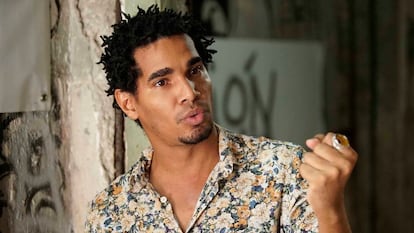

The news that many Cubans had been waiting for over the past five years arrived on Tuesday afternoon: artist Luis Manuel Otero Alcántara, one of the most well-known political prisoners of the Castro regime, was released from Guanajay prison, southeast of Havana, just four days before completing the sentence he had been serving for what the government described as the offenses of “assault,” “contempt,” “public disorder,” and “incitement to commit crimes.” However, there is a sense of disappointment among Otero Alcántara’s supporters: the artist is not completely free but remains in the custody of Cuban authorities, and his whereabouts are unknown.
Several activists were informed, through other inmates at Guanajay prison, that Otero Alcántara had left the facility under heavy security and was reportedly transferred to a government facility while awaiting either his definitive release or departure into exile. So far, the Havana government has not issued an official statement on the matter.
“Right now, Luis Manuel is disappeared. He is not free. He has not been released,” said curator and activist Anamely Ramos, a friend of the artist. “He is in the hands of State Security somewhere in Havana. Neither his family nor his close friends have received any official communication, and if we know he was taken out of Guanajay, it is only thanks to the solidarity of other prisoners.”
In two days, on July 9, the artist’s sentence was due to expire. Otero Alcántara, who was named one of Time magazine’s 100 most influential people in 2021, had long been in the regime’s sights because of his protest art and his repeated challenges to the government. Through live broadcasts on social media, his campaign against Decree 349 — a government mechanism for regulating and censoring artistic creation in Cuba — and his hunger strikes, he became a figure the regime viewed as threatening.
At one point, he was charged with “insulting national symbols” for using the Cuban flag in his performance Drapeau, in which he carried the flag with him 24 hours a day for an entire month in 2019. Prosecutors also accused him of “public disorder” and “contempt” for gathering with rapper Maykel Osorbo and others during a protest on April 4, 2021, singing the song Patria y Vida in public, and chanting lyrics deemed “offensive” toward Cuban President Miguel Díaz-Canel and other government officials.
Otero Alcántara, leader of the San Isidro Movement — which drew international attention after several artists, intellectuals, and citizens undertook a hunger strike in response to political repression — was last free on July 11, 2021, the date of the largest anti-government protests to take place in Cuba since the Revolution came to power.
As he left his home at Damas Street 955, which also served as the movement’s headquarters, Cuban authorities intercepted him before he could join the demonstration, where cries of “Freedom” echoed toward Havana’s Capitol building. Following those protests, the government turned more than 1,500 citizens who took to the streets across the country into political prisoners, many of whom received sentences of up to 20 years in prison.
On previous occasions, Cuban authorities had offered Otero Alcántara the possibility of leaving Cuba indefinitely in exchange for his release, but the artist rejected the proposal. However, in a 2024 interview with EL PAÍS, speaking from prison, he acknowledged that he had begun considering exile.
“I never thought of leaving, but the regime has insinuated that there’s no option for me to walk through the streets of Cuba, because of the threat they’ve made me believe I am, or that people believe I am,” he said. “Just as they built me these five years out of nothing — out of falsehoods — they could easily build another five or 10 years; it wouldn’t be an issue for them. So, I choose exile. But I don’t want to leave Cuba. That’s the big problem: I’ll either be a martyr, or I’ll be outside of Cuba. I can’t find any other way out."
By April of this year, amid growing tensions between the United States and Cuba, the cases of both Otero Alcántara and Maykel Osorbo — who was sentenced to eight years in prison — were raised during a meeting in Havana with the first U.S. delegation to visit the country and hold negotiations with Cuban officials since the Obama era. Neither man was released during earlier prisoner releases carried out with the mediation of the Vatican.
Throughout his imprisonment, Otero Alcántara continued creating art from his prison cell. He says that art is what kept him going. “Thanks to art, painting, drawing, I’ve been able to survive these three years,” he told EL PAÍS in 2024. “I continue to draw, paint, make things. I have many ongoing projects, dealing with things that take me back to my childhood: childhood traumas, sex during childhood, mistreatment by teachers. In three years, I’ve done a lot. I come up with an idea probably every week. Without [my art], in this confinement, I would be like a sparrow: I would have thrown myself against the bars a long time ago.”
Sign up for our weekly newsletter to get more English-language news coverage from EL PAÍS USA Edition









































