
Maykel Osorbo and Luis Manuel Otero, the Cuban political prisoners with the most influence in Havana-Washington talks
The internationally renowned artists are part of the negotiations between Cuba and the United States
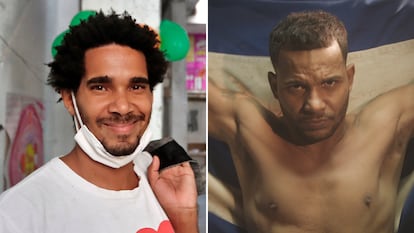

Even at the maximum-security prison in Guanajay, southwest of Havana, news has reached the inmates that one of their own, the rapper Maykel Castillo, “Osorbo,” could be back on the streets in two weeks. This is the deadline that, according to U.S. State Department sources speaking to USA Today, Washington has given the Cuban government as part of ongoing negotiations. Osorbo is acting as if nothing new is happening. There have been other releases, other agreements with the Vatican or the Americans, other moments when it seems something is about to happen for him, but nothing ever comes to pass. When Cuba announced the release of more than 500 prisoners in early 2025, Osorbo’s friends (his stage name alludes to bad luck in the Yoruba language) asked him if he had any hope that he would be among those listed. “I’m unlucky,” he said. “Nothing good has ever happened to me.”
On Tuesday, in a hurried phone call from prison, Osorbo, who is serving a nine-year sentence, told EL PAÍS that he preferred not to spend his time thinking about when he might be released. “I’m calm, in my corner, waiting,” the rapper said. Even if that were the case, if — as part of the dialogue between Havana and Washington — Cuban authorities were to release their more than 700 political prisoners, Osorbo would remain the same: “If I get out of here alive, I’ll still be what I am, a musician, a Cuban who had a difficult life and got back up a thousand times. But if they decide, out of malice, that I should remain imprisoned, then they’ll have to kill me.”
His name, along with that of artist Luis Manuel Otero Alcántara, Cuba’s most prominent political prisoners, came up during the secret meeting held on April 10 in Havana — involving the first delegation to fly from Washington to engage in dialogue with the Cubans since the Obama era. Donald Trump rang in the new year with the capture of Nicolás Maduro, became embroiled in a protracted war with Iran, and has recently stated his intention to usher in a “new dawn for Cuba.”
Among other important issues on the negotiating table, this month’s meeting on the island addressed the cases of Osorbo and Otero: two artists, both Black, both poor people from Old Havana. One in the maximum-security prison of Guanajay, the other in Kilo 5, in Pinar del Río. One a two-time Grammy winner, the other named one of Time magazine’s 100 most influential people.
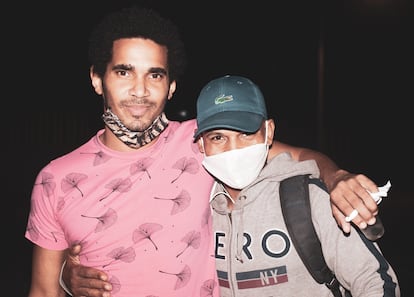
Osorbo is serving a nine-year prison sentence for the crimes of “disobedience, resistance, and contempt.” Otero is serving a five-year sentence for the crimes of “assault, contempt, public disorder, and incitement to commit crimes.” Years before going to prison, both had already captured the attention of Cubans for their constant denunciations of Decree 349, a government censorship mechanism used to regulate artistic creation in the country; for putting their bodies on the line to make state repression visible; and for barricading themselves in the headquarters of the San Isidro Movement and staging a hunger strike that mobilized international attention and exposed how a government was capable of suffocating young people and artists. The day Cuban authorities realized that the freedom they practiced individually and offered to the rest of the Cuban population posed a danger, they imprisoned them.
Even so, at the beginning of the month, when American journalist Kristen Welker and her team from the NBC News program Meet the Press arrived at the José Martí Memorial, President Miguel Díaz-Canel — who, more than ever before, has been granting interviews to major media outlets amid the uncertainty surrounding tensions with the United States and the need to reaffirm his position as Cuba’s president, a role from which he was allegedly intended to be removed — denied not only that Osorbo was a political prisoner, but also rejected the idea that there was such a thing as prisoners of conscience in Cuba.
“I believe, Kristen, that we must move beyond all the rhetoric that has existed regarding concepts about Cuba, about democracy, human rights, whether we are a tyranny or a dictatorship or not,” Díaz-Canel told the journalist, who then pointed out that there were more than 1,200 political prisoners on the island, including the rapper Osorbo, “who is in prison and has won two Latin Grammys.” Díaz-Canel smiled and let her know that it was nothing more than “prejudice.” “In Cuba, not everyone supports the Revolution — there are people who do not accept the Revolution, who every day demonstrate in various ways against the Revolution, and they are not in prison. That narrative they’ve created — that image that in Cuba anyone who speaks out against the Revolution is imprisoned and is a political prisoner — is a lie, it’s slander.”
Osorbo and Otero, two marked lives
When he was 10 years old, Osorbo’s mother left the house casually, without a word. The boy didn’t see her again for two decades. She had jumped into the sea, part of the exodus that in 1994 became known as the “Balsero crisis,” in which more than 35,000 Cubans fled to Miami. His paternal grandmother took him in. But “when your mother is gone, everything is gone, and a large part of my downfall was due to the lack of a mother,” the rapper said in a video posted on his Facebook profile five years ago. Since then, Osorbo’s life has also been a long journey through the country’s prisons and juvenile detention centers. He has spent almost half his life in these places.
“I was always just a Black man from Old Havana. Without clothes, without shoes, just like that, in the park, talking to this person and that person, just another Cuban from the neighborhood,” he tells EL PAÍS. “The government is the one that turned me into a threat, because for them, poor Black people are a threat when we tell them what they’ve done wrong. They’re afraid of us.”
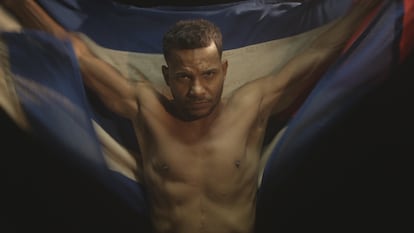
Otero also grew up in a humble family in the El Cerro neighborhood. In a conversation days before his arrest in 2021, he recounted how he became the person he is today. “I didn’t study at any academy, nobody gave me anything, I wasn’t anyone’s son, and I wasn’t put in the Higher Institute of Art. I’m just a Black guy from El Cerro who has earned the love of many people and connected with many others through my work and my way of doing things.”
Art came to Osorbo and Otero through self-teaching. Five years ago, in the midst of a Cuba on the brink of its greatest crisis in history, both began to gain notoriety for their constant public denunciations, which then spread to social media. They were both arrested in 2021, when the country was in turmoil amid the accelerated collapse of the healthcare system due to the coronavirus crisis, the closure of tourism, the resulting economic blow, and a complete lack of freedoms. This context had fostered numerous expressions of discontent among Cubans.
On several occasions, the artists were arrested and then released. On the afternoon of March 18, 2021, the political police entered Osorbo’s house and dragged him away barefoot and shirtless while he was having lunch. His whereabouts were unknown until several days later, when the UN declared him missing.
On July 11, 2021, Otero was surprised to see so many people in the streets. “I went into the streets, into the daylight, without a phone, disconnected from everything. That was one of the happiest days of my life,” he said in an interview with EL PAÍS last year. “In fact, when [the police] detained me and put me in a patrol car with three officers, the patrol car’s radio was announcing: ‘Hey, thousands of people are coming down San Lázaro Street, thousands of people are coming down Trillo Park.’ And, at that moment, I said: ‘Well, it looks like things have really gone down.’ And the patrol driver told me: ‘But you’re not going to be there.’” It was the largest anti-establishment protest since the Revolution came to power, which turned thousands of citizens into political prisoners, including Otero.
Prison hasn’t been the end of their artistic careers. With the song Patria y Vida (Homeland and Life), which has become an anthem for the liberation of Cuba, Osorbo, one of the authors, received two Latin Grammys for Best Urban Song and Song of the Year. Rapper Eliexer Márquez Duany, “El Funky,” who has known Osorbo since elementary school and is a co-writer of the song, was saddened that he couldn’t accompany him to accept the award at the Latin Recording Academy gala in Miami. “When I play that song, the first thing that comes to mind is Maykel,” El Funky says now. “We made it together; it was always our dream. Rap has been everything to Maykel; it has saved him from many things.”
In September 2021, Otero’s face appeared among Time magazine’s 100 most influential people, alongside Russian opposition leader Alexei Navalny, pop star Britney Spears, tennis player Naomi Osaka, and Puerto Rican singer Bad Bunny. This recognition acknowledged the artist’s ongoing struggle against totalitarian power.
“Luis has not only had to forge his own path in a system that limits freedom of expression, but he has had to do so facing surveillance, censorship, harassment, and ultimately, imprisonment. Luis has become a symbol because his case encapsulates many of the tensions of the current Cuban context: the relationship between art and politics, between body and power, between visibility and punishment,” said art curator Claudia Genlui, the artist’s former partner, who supports his art from exile. Otero, who has continued creating from his cell and has staged six hunger strikes while in detention, is expected to officially reach the end of his sentence next July.
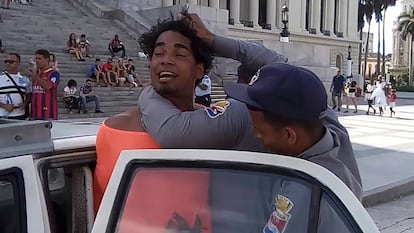
“Luis is a person with a life, with loved ones, with a history that has been violently interrupted. His release should mean, above all, the possibility of recovering that life,” says Genlui. “His freedom is a right that should never have been taken from him.” However, the art curator focuses on the context in which this release takes place, if Otero is ultimately freed inside two weeks, as the information leaked from the State Department indicates. “If it is part of a political negotiation, that raises important questions about the conditions, about his subsequent fate, about what these forms of forced exile imply.”
Guarantees upon release
Amid ongoing negotiations between high-ranking officials in Havana and Washington, about which very little is officially known, several human rights organizations have focused on demanding the release of the hundreds of political prisoners held in jails throughout the country. In the context of these talks, two releases have taken place, although the Cuban government has never publicly acknowledged that they are part of any kind of negotiation with Washington. Rather, they have denied any kind of ultimatum to release their political prisoners.
Of the first round of releases, carried out in March, only 27 political prisoners benefited, out of a total of 54 freed. In the second round, in which 2,010 prisoners were released, “not a single political prisoner was freed,” asserts Javier Larrondo, director of Prisoners Defenders, an NGO that documents the cases. Rather, since it became known that Washington officials were sitting at the table with representatives of the Castroist government, the regime has not stopped creating new political prisoners, imprisoning citizens for protesting or expressing public discontent. Since March, Cuban civil organizations have registered the detention of at least 28 new people for political reasons.
Reality shows that, as has happened before, there is no guarantee of safety for prisoners of conscience who may be released as part of a diplomatic agreement. “They don’t have many guarantees. Several political prisoners who have been granted early release — whether through parole, extra-penal leave, or even pardons — have subsequently been imprisoned again,” explained lawyer Raudiel Peña Barrios, a member of the legal advisory group Cubalex. He emphasizes that if Osorbo, Otero, or any other political prisoner were released, they could end up back in prison the moment they begin to exercise their right to freedom of expression. “They don’t have full guarantees that they won’t be imprisoned again.”
Therefore, Camila Rodríguez, director of Justicia 11J, a working group that documents human rights violations in Cuba, insists that any dialogue must include the premise that the process of releasing political prisoners be complete, unconditional, and with real guarantees of non-repetition. “Releases under formulas that maintain the sentence are not enough, because that leaves people in a permanent state of vulnerability,” she says. She also believes that civil society groups working on behalf of political prisoners and the families of those detained should participate in the process, and she demands the publication of lists that guarantee transparency in the releases, something that has not happened in the past. “In this context, any new dialogue should focus not only on how many people are released from prison, but also on how those decisions are made, who participates in them, and what guarantees exist to ensure that this freedom is real and lasting.”
Sign up for our weekly newsletter to get more English-language news coverage from EL PAÍS USA Edition









































