
US gives Cuba two-week ultimatum to release high-profile political prisoners
In a secret meeting in Havana on April 10, Washington pressured for the release of artist Luis Manuel Otero and rapper Maykel Osorbo, as well as the rest of the prisoners
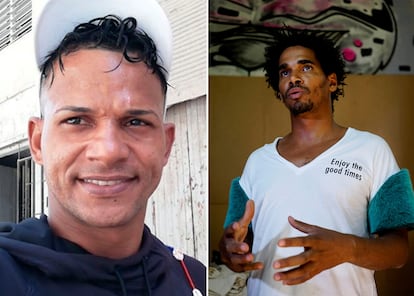

The United States government has issued an ultimatum demanding that Cuba release artist Luis Manuel Otero Alcántara and rapper Maykel Osorbo, who have been imprisoned on the island for five years. In a secret meeting on April 10 in Havana, as part of negotiations that both governments have confirmed but about which very little is officially known, State Department officials gave Cuban authorities a two-week deadline for the release of the high-profile artists “as a gesture of good faith,” as well as the release of the more than 1,000 other political prisoners held by the regime.
In the statement, which was obtained by the U.S. media outlet USA Today, a State Department spokesperson insisted that President Donald Trump “remains committed to the release of all political prisoners,” as well as to the generation of change that Trump recently called a “new dawn for Cuba.” Although a few months ago the Republican administration spoke of economic rather than political reforms on the island, the discourse coming from Washington has shifted in recent weeks, ruling out negotiations unless the government of Miguel Díaz-Canel also makes political concessions. The Cuban government has a “narrow window to make changes before circumstances irreversibly worsen,” the source stated.
Osorbo and Otero, two of the island’s most prominent political prisoners, who led the symbolic hunger strike at the San Isidro Movement headquarters in 2020, were arrested a year later after having been targeted by the regime for some time. Osorbo was dragged from his home in Old Havana by Cuban political police, naked and barefoot, while he was having lunch. Otero was arrested on July 11, 2021, as he left his house to join the demonstrations that took place throughout Cuba that day, leaving thousands of citizens imprisoned as political detainees to this day. Osorbo was sentenced to nine years in prison. Otero received a five-year sentence, meaning his term is expected to formally end in three months.
At the beginning of April, Havana announced the pardon of 2,010 prisoners, one of the largest pardons it has granted, as part of negotiations with the United States. A month earlier, the Cuban government had announced the release of 52 prisoners. However, on neither occasion has it acknowledged that this was a pact made during the dialogues with Washington, instead describing it as “a common practice in our criminal justice system and part of the humanitarian trajectory of the Revolution,” and as part of the religious celebrations of Holy Week. Among those released, independent human rights organizations have noted very few prisoners of conscience.
The mid-April meeting between Cuban and U.S. officials in Havana marks the first time a U.S. delegation has visited the island since the restoration of diplomatic relations under former Democratic President Barack Obama 10 years ago. Axios reported that at the meeting — which included Raúl Castro’s grandson, Raúl Guillermo Rodríguez Castro, nicknamed “El Cangrejo” (The Crab) — U.S. officials reiterated to the Cuban authorities that “the Cuban economy is in free fall” and “the island’s ruling elites have a small window to make key U.S.-backed reforms before circumstances irreversibly worsen,” according to an official quoted by the outlet.
Among other things, the meeting addressed the United States’ proposal to collaborate on internet connectivity through the installation of Starlink satellite services, and the possibility of dismantling the economic embargo against the island, which has lasted more than six decades. In that case, it would be necessary to compensate the American individuals and companies whose assets and property were confiscated after the triumph of the 1959 Revolution. The need to guarantee “greater political freedoms, which would eventually include free and fair elections” was also discussed, according to Axios.
“President Trump is committed to seeking a diplomatic solution, if feasible, but he will not allow the island to pose a greater threat to national security if Cuba’s leaders are unable or unwilling to act,” the official said.
Although diplomatic talks between the two governments remain shrouded in mystery — constantly contradicting each other with rhetoric of sovereignty from the Cuban side and constant threats from the U.S. — there is official recognition of the negotiations taking place after the capture of Nicolás Maduro in Venezuela, when Trump began hinting that Cuba would be his next destination. Since then, there have been periods of silence and periods of more or less direct attacks. USA Today reported on April 15 that the Pentagon was discreetly preparing for a military operation, should Trump order an intervention in the country located 90 miles from Florida.
Later, Trump was asked by reporters on Air Force One whether he was considering a military attack on Cuba. “Well, it depends on what your definition of military action is,” he replied, accustomed to speaking vaguely or leaving room for doubt. For months, he had simply stated repeatedly that Cuba was “a failed nation,” now with its room for maneuver tightened by the lack of fuel aid from abroad, due to the embargo he imposed on January 29.
Sign up for our weekly newsletter to get more English-language news coverage from EL PAÍS USA Edition









































